


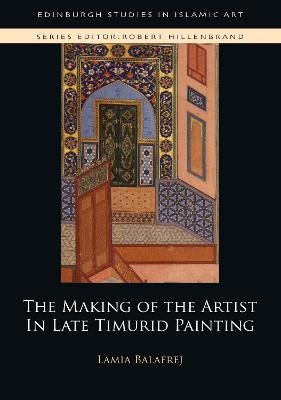
The Making of the Artist in Late Timurid Painting
Seiten
2019
Edinburgh University Press (Verlag)
978-1-4744-3743-1 (ISBN)
Edinburgh University Press (Verlag)
978-1-4744-3743-1 (ISBN)
- Titel ist leider vergriffen;
keine Neuauflage - Artikel merken
Centred on late Timurid manuscript painting (ca. 1470-1500), this book reveals that pictures could function as the painter's delegate, charged with the task of centring and defining artistic work, even as they did not represent the artist's likeness.
In the absence of a tradition of self-portraiture, how could artists signal their presence within a painting? Centred on late Timurid manuscript painting (ca. 1470-1500), this book reveals that pictures could function as the painter’s delegate, charged with the task of centring and defining artistic work, even as they did not represent the artist’s likeness. Influenced by the culture of the majlis, an institutional gathering devoted to intricate literary performances and debates, late Timurid painters used a number of strategies to shift manuscript painting from an illustrative device to a self-reflective object, designed to highlight the artist’s imagination and manual dexterity. These strategies include visual abundance, linear precision, the incorporation of inscriptions addressing aspects of the painting and the artist’s signature. Focusing on one of the most iconic manuscripts of the Persianate tradition, the Cairo Bustan made in late Timurid Herat and bearing the signatures of the painter Bihzad, this book explores Persian manuscript painting as a medium for artistic performance and self-representation, a process by which artistic authority was shaped and discussed.
In the absence of a tradition of self-portraiture, how could artists signal their presence within a painting? Centred on late Timurid manuscript painting (ca. 1470-1500), this book reveals that pictures could function as the painter’s delegate, charged with the task of centring and defining artistic work, even as they did not represent the artist’s likeness. Influenced by the culture of the majlis, an institutional gathering devoted to intricate literary performances and debates, late Timurid painters used a number of strategies to shift manuscript painting from an illustrative device to a self-reflective object, designed to highlight the artist’s imagination and manual dexterity. These strategies include visual abundance, linear precision, the incorporation of inscriptions addressing aspects of the painting and the artist’s signature. Focusing on one of the most iconic manuscripts of the Persianate tradition, the Cairo Bustan made in late Timurid Herat and bearing the signatures of the painter Bihzad, this book explores Persian manuscript painting as a medium for artistic performance and self-representation, a process by which artistic authority was shaped and discussed.
Lamia Balafrej is Assistant Professor of Art History at the University of California, Los Angeles.
Introduction: Painting about Painting
1. Pictorial Preface
2. Writing on the Image
3. Potential World
4. Calligraphic Line
5. Wondrous Signature
Epilogue: Manuscripts in Motion
Bibliography
| Erscheinungsdatum | 16.07.2019 |
|---|---|
| Reihe/Serie | Edinburgh Studies in Islamic Art |
| Zusatzinfo | 74 colour illustrations |
| Verlagsort | Edinburgh |
| Sprache | englisch |
| Maße | 172 x 244 mm |
| Themenwelt | Kunst / Musik / Theater ► Kunstgeschichte / Kunststile |
| Kunst / Musik / Theater ► Malerei / Plastik | |
| ISBN-10 | 1-4744-3743-5 / 1474437435 |
| ISBN-13 | 978-1-4744-3743-1 / 9781474437431 |
| Zustand | Neuware |
| Informationen gemäß Produktsicherheitsverordnung (GPSR) | |
| Haben Sie eine Frage zum Produkt? |
Mehr entdecken
aus dem Bereich

aus dem Bereich
kleine Kulturgeschichte einer brillanten Allianz
Buch | Softcover (2025)
Iudicium (Verlag)
CHF 33,90


