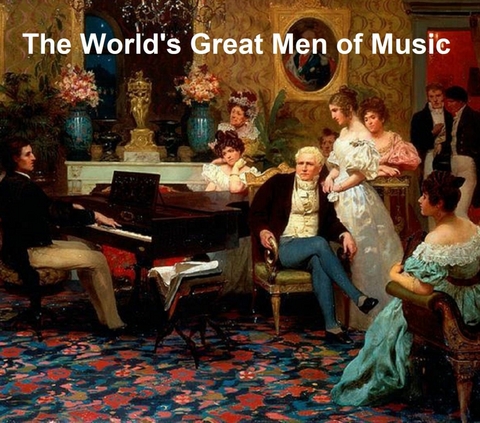
World's Great Men of Music (eBook)
367 Seiten
Seltzer Books (Verlag)
978-1-4553-5027-8 (ISBN)

First published in 1922. Chapters include: Palestrina, Bach, Handel, Gluck, Haydn, Mozart, Beethoven, Weber, Schubert, Mendelssohn, Schumann, Chopin, Berlioz, Liszt, Verdi, Wagner, Franck, Brahms, Grieg, Tschaikowsky, MacDowell, Debussy, Toscanini, Stokowski, and Koussevitzky.
XI ROBERT SCHUMANN
Many of the composers whose life stories we have read were surrounded by musical atmosphere from their earliest years; Robert Schumann seems to have been an exception. His father, August Schumann, was the son of a poor pastor, and the boy August was intended to be brought up a merchant. At the age of fifteen he was put into a store in Nonneburg. He was refined in his tastes, loved books, and tried even in boyhood to write poetry. He seemed destined, however, to live the life marked out for him, at least for a time. It grew so distasteful, that later he gave it up and, on account of extreme poverty, returned to his parents' home, where he had the leisure to write. At last he secured a position in a book store in Zeitz. In this little town he met the daughter of his employer. The engagement was allowed on the condition that he should leave the book store and set up his own business. But where was the money to come from? He left the store, returned home and in a year and a half had earned a thousand thalers, then quite a handsome sum.
He now claimed the hand of his chosen love and established in the book business, labored so unceasingly, that the business increased. Then he moved to a more favorable location, choosing the mining town of Zwickau, in Saxony.
Here, this industrious, honorable man and his attractive, intelligent, but rather narrow and uneducated young wife lived out their lives, and brought up their children, of whom Robert, born June 8, 1810, was the youngest; before him there were three brothers and a sister. All passed away before Robert himself.
He was the so-called "handsome child" of the family, and much petted by the women. Besides his mother there was his god-mother, who was very fond of him, and at her home he would spend whole days and nights. As his talents developed, the boy became the spoilt darling of everybody. This lay at the foundation of his extreme susceptibility, even the obstinacy of his riper years.
Little Robert at six was sent to a popular private school and now for the first time mingled with a number of children of his own age. The first symptoms of ambition, the source of much of his later achievement, began to show itself, though quite unconsciously. It made him the life of all childish games. If the children played "soldiers," little Robert was always captain. The others loved his good nature and friendliness, and always yielded to him.
He was a good student in the primary school, but in no way distinguished himself in his studies. The following year he was allowed to take piano lessons of an old pedantic professor from Zwickau High School. This man had taught himself music, but had heard little of it. The kind of instruction he was able to give may be imagined, yet Robert was faithful all his life to this kind old friend.
In spite of inadequate guidance, music soon kindled the boy's soul. He began to try to make music himself, though entirely ignorant of the rules of composition. The first of these efforts, a set of little dances, were written during his seventh or eighth year. It was soon discovered that he could improvise on the piano; indeed he could sketch the disposition of his companions by certain figures on the piano, so exactly and comically that every one burst out laughing at the portraits. He was fond of reading too, much to his father's delight, and early tried his hand at authorship. He wrote robber plays, which he staged with the aid of the family and such of his youthful friends as were qualified. The father now began to hope his favorite son would become an author or poet; but later Robert's increasing love for music put this hope to flight.
The father happened to take his boy with him to Carlsbad in the summer of 1819, and here he heard for the first time a great pianist, Ignatz Moscheles. His masterful playing made a great impression on the nine year old enthusiast, who began now to wish to become a musician, and applied himself to music with redoubled zeal. He also made such good progress at school that at Easter 1820 he was able to enter the Zwickau Academy.
The love for music grew with each day. With a boy of his own age, as devoted as himself to music, four-hand works of Haydn, Mozart and Beethoven, as well as pieces by Weber, Hummel and Czerny, were played almost daily. The greatest ecstasy was caused by the arrival of a Steck piano at the Schumann home, which showed that father Schumann endeavored to further his boy's taste for music. About this time Robert found by chance, the orchestral score of an old Italian overture. He conceived the bold idea of performing it. So a bit of an orchestra was gathered among the boys he knew, who could play an instrument. There were two violins, two flutes, a clarinet and two horns. Robert, who conducted with great fervor, supplied as best he could the other parts on the piano.
This effort was a great incentive to the boys, principally to Robert, who began to arrange things for his little band and composed music for the one hundred fiftieth Psalm. This was in his twelfth year.
August Schumann was more and more convinced that Providence had intended his son to become a musician, and though the mother struggled against it, he resolved to see that Robert had a musical education. Carl Maria von Weber, then living in Dresden, was written to, and answered he was willing to accept the boy as a student. The plan never came to anything however, for what reason is not known. The boy was left now to direct his own musical studies, just when he needed an expert guiding hand. He had no rivals in his native town, where he sometimes appeared as a pianist. It was no wonder he thought he was on the right road, and that he tried more than ever to win his mother's consent to his following music as a life work.
And now a great change took place in the lively, fun-loving boy. He seemed to lose his gay spirits and become reflective, silent and reserved. This condition of mind never left him, but grew into a deeper reserve as the years passed.
Two events deeply stirred Robert's nature with great force—the death of his father in 1826, and his acquaintance with the works of Jean Paul. The Jean Paul fever attacked him in all its transcendentalism, and this influence remained through life, with more or less intensity.
After his father left him, Robert found he must make a choice of a profession. His mother had set her heart on his making a study of law, while his heart was set on music. Yielding to her wishes for a time he went to Leipsic in March 1828 to prepare to enter the University as a student of law. He also gained consent to study piano at the same time, and began lessons with Frederick Wieck. The desire to study with Wieck was inspired by the piano playing of his little daughter, Clara, then nine years old, who had already gained a considerable degree of musical culture and promised to make her mark as a pianist.
Under his new teacher, Robert for the first time was obliged to study a rational system of technic and tone production. He was also expected to learn harmony correctly, but strangely enough he seemed to take no interest in it, even saying he thought such knowledge useless. He held to this foolish idea for some time, not giving it up till forced to by realizing his total ignorance of this branch of the art.
Robert now became greatly impressed by the genius of Franz Schubert. He eagerly played everything the master had composed for the piano, both for two and four hands, and Schubert's death during this year, filled him with profound grief. The young musical friends with whom Robert had become intimate, while living in Leipsic, shared his enthusiasm about his hero of German song, and they desired to enlarge their knowledge of Schubert's work. They did more, for they decided to take one representative composition and practise together till they had reached the highest perfection. The choice fell on the Trio in B flat major, Op. 99, whose beauties had greatly impressed them. After much loving labor the performance was well nigh perfect. Schumann arranged a musical party at which the Trio was played. Besides students and friends, Wieck was invited and given the seat of honor.
This musical evening was the forerunner of many others. Weekly meetings were held in Robert's room, where much music was played and discussed. The talk often turned to grand old Bach and his "Well-tempered Clavichord," to which in those early days, he gave ardent study.
With all this music study and intercourse with musical friends there was very little time left for the study of law. Yet he still kept up appearances by attending the lectures, and had intended for some months to enter the Heidelberg University. This decision was put into execution in May 1829, when he started by coach for Heidelberg.
We find Robert Schumann at nineteen domiciled in the beautiful city of Heidelberg, and surrounded by a few musical friends, who were kindred spirits. With a good piano in his room, the "life of flowers," as he called it, began. Almost daily they made delightful trips in a one-horse carriage into the suburbs. For longer trips they went to Baden-Baden, Wurms, Spires and Mannheim. Whenever Robert went with his friends he always carried a small "dumb piano" on which he industriously practised finger exercises, meanwhile joining in the conversation. During the following August and September, Robert and two or three chosen companions made a delightful journey through Italy, the...
| Erscheint lt. Verlag | 1.3.2018 |
|---|---|
| Sprache | englisch |
| Themenwelt | Kunst / Musik / Theater ► Musik ► Klassik / Oper / Musical |
| ISBN-10 | 1-4553-5027-3 / 1455350273 |
| ISBN-13 | 978-1-4553-5027-8 / 9781455350278 |
| Informationen gemäß Produktsicherheitsverordnung (GPSR) | |
| Haben Sie eine Frage zum Produkt? |
 EPUB (Adobe DRM)
Größe: 2,8 MB
Kopierschutz: Adobe-DRM
Adobe-DRM ist ein Kopierschutz, der das eBook vor Mißbrauch schützen soll. Dabei wird das eBook bereits beim Download auf Ihre persönliche Adobe-ID autorisiert. Lesen können Sie das eBook dann nur auf den Geräten, welche ebenfalls auf Ihre Adobe-ID registriert sind.
Details zum Adobe-DRM
Dateiformat: EPUB (Electronic Publication)
EPUB ist ein offener Standard für eBooks und eignet sich besonders zur Darstellung von Belletristik und Sachbüchern. Der Fließtext wird dynamisch an die Display- und Schriftgröße angepasst. Auch für mobile Lesegeräte ist EPUB daher gut geeignet.
Systemvoraussetzungen:
PC/Mac: Mit einem PC oder Mac können Sie dieses eBook lesen. Sie benötigen eine
eReader: Dieses eBook kann mit (fast) allen eBook-Readern gelesen werden. Mit dem amazon-Kindle ist es aber nicht kompatibel.
Smartphone/Tablet: Egal ob Apple oder Android, dieses eBook können Sie lesen. Sie benötigen eine
Geräteliste und zusätzliche Hinweise
Buying eBooks from abroad
For tax law reasons we can sell eBooks just within Germany and Switzerland. Regrettably we cannot fulfill eBook-orders from other countries.
EPUB (Ohne DRM)Digital Rights Management: ohne DRM
Dieses eBook enthält kein DRM oder Kopierschutz. Eine Weitergabe an Dritte ist jedoch rechtlich nicht zulässig, weil Sie beim Kauf nur die Rechte an der persönlichen Nutzung erwerben.
Dateiformat: EPUB (Electronic Publication)
EPUB ist ein offener Standard für eBooks und eignet sich besonders zur Darstellung von Belletristik und Sachbüchern. Der Fließtext wird dynamisch an die Display- und Schriftgröße angepasst. Auch für mobile Lesegeräte ist EPUB daher gut geeignet.
Systemvoraussetzungen:
PC/Mac: Mit einem PC oder Mac können Sie dieses eBook lesen. Sie benötigen dafür die kostenlose Software Adobe Digital Editions.
eReader: Dieses eBook kann mit (fast) allen eBook-Readern gelesen werden. Mit dem amazon-Kindle ist es aber nicht kompatibel.
Smartphone/Tablet: Egal ob Apple oder Android, dieses eBook können Sie lesen. Sie benötigen dafür eine kostenlose App.
Geräteliste und zusätzliche Hinweise
Buying eBooks from abroad
For tax law reasons we can sell eBooks just within Germany and Switzerland. Regrettably we cannot fulfill eBook-orders from other countries.
aus dem Bereich