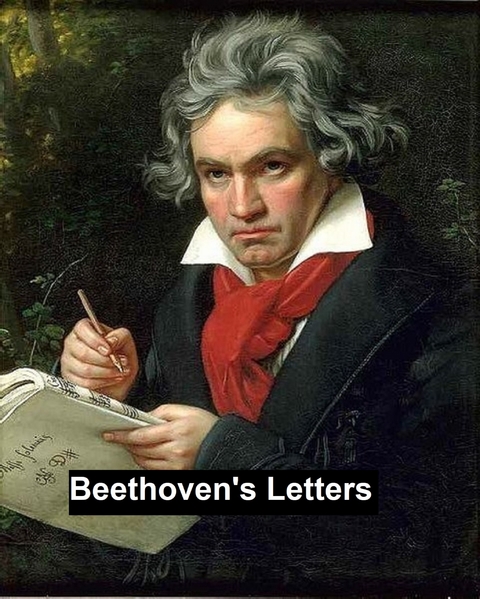
Beethoven's Letters (eBook)
427 Seiten
Seltzer Books (Verlag)
978-1-4553-3005-8 (ISBN)
From the collection of Dr. Ludwig Nohl, also his letters to the Archduke Rudolph, Cardinal-Archbishop of Olmuetz, from the collection of Dr. Ludwig Ritter von Koechel. Translated by Lady Wallace.According to Wikipedia: 'Ludwig van Beethoven (16 December 1770 - 26 March 1827) was a German composer and pianist. He was a crucial figure in the transitional period between the Classical and Romantic eras in Western classical music, and remains one of the most acclaimed and influential composers of all time.'
From the collection of Dr. Ludwig Nohl, also his letters to the Archduke Rudolph, Cardinal-Archbishop of Olmuetz, from the collection of Dr. Ludwig Ritter von Koechel. Translated by Lady Wallace. According to Wikipedia: "e;Ludwig van Beethoven (16 December 1770 - 26 March 1827) was a German composer and pianist. He was a crucial figure in the transitional period between the Classical and Romantic eras in Western classical music, and remains one of the most acclaimed and influential composers of all time."e;
92. TO H.R. HIGHNESS THE ARCHDUKE RUDOLPH.
Franzensbrunn, Aug. 12, 1812.
It was my bounden duty long ago to have recalled myself to Y.R.H.'s recollection, but partly my occupations and the state of my health, as well as my own insignificance, made me reluctant to do so. I missed Y.R.H. by one night only in Prague; for when proceeding to pay my respects to you in the morning, I found you had set off the very night before. In Toeplitz I heard a military band four times a day,--the only musical report which I can give you. I was a great deal with Goethe.[1] My physician Staudenheim, however, ordered me off to Carlsbad,[2] and from thence here, and probably I shall have to go back to Toeplitz from this. What flights! And yet it seems very doubtful whether any improvement in my condition has hitherto taken place. I receive the best accounts of Y.R.H.'s health, and also of the persistent devotion you exhibit towards the musical Muse. Y.R.H. has no doubt heard of a concert that I gave for the benefit of the sufferers by fire in the Stadt Baden,[3] assisted by Herr Polledro.[4] The receipts were nearly 1000 florins W.W., and if I had not been restricted in my arrangements we might easily have taken 2000 florins. It was literally a poor concert for the poor. I could only find at the publisher's here some of my earlier sonatas with violin accompaniments, and as Polledro had set his heart on these, I was obliged to content myself with playing an old Sonata.[5] The entire concert consisted of a trio, in which Polledro played, my Sonata with violin, then again something was played by Polledro, and, lastly, I extemporized. Meanwhile I do sincerely rejoice that by this means something has fallen to the share of the poor Badeners. Pray deign to accept my best wishes for your welfare, and my entreaty that you will sometimes think of me.
[K.]
[Footnote 1: Beethoven speaks very briefly of his meeting with Goethe. Goethe in his Tag- und Jahrschriften of 1812 makes no allusion to Beethoven during his stay at Toeplitz. It does not, therefore, appear that either of these master-minds found any particular pleasure in each other when they met personally. Beethoven, indeed, dedicated to "the immortal Goethe" (1812) his composition the Meeresstille und glueckliche Fahrt, but only wrote once to him in 1823 to obtain a subscription from the Grand Duke of Weimar for his Grand Mass, and received no answer from Goethe. In the complete edition of Goethe's works Beethoven's name is only once mentioned by Goethe, when he refers to his funeral obsequies.]
[Footnote 2: Dr. Staudenheim was, like Malfatti, one of the most celebrated physicians in Vienna. Beethoven, too, was well acquainted with Staudenheim, but in his regimen he neither followed the prescriptions of Staudenheim nor of Malfatti.]
[Footnote 3: The Stadt Baden, near Vienna, had been visited on July 16th by a most destructive conflagration.]
[Footnote 4: Giov. Batt. Polledro, Kapellmeister in Turin, born 1776, travelled through Germany as a violinist from 1809 to 1812. He gave a concert in Vienna in March, 1812.]
[Footnote 5: The violin Sonata with pianoforte was probably Op. 47 (composed in 1803 and published in 1805, according to Thayer, No. 111), or one of his earlier compositions, Op. 30, or 24, or 23.]
93. TO BETTINA VON ARNIM.
Toeplitz, August 15, 1812.
MY MOST DEAR KIND FRIEND,--
Kings and princes can indeed create professors and privy-councillors, and confer titles and decorations, but they cannot make great men,--spirits that soar above the base turmoil of this world. There their powers fail, and this it is that forces them to respect us.[1] When two persons like Goethe and myself meet, these grandees cannot fail to perceive what such as we consider great. Yesterday, on our way home, we met the whole Imperial family; we saw them coming some way off, when Goethe withdrew his arm from mine, in order to stand aside; and, say what I would, I could not prevail on him to make another step in advance. I pressed down my hat more firmly on my head, buttoned up my great-coat, and, crossing my arms behind me, I made my way through the thickest portion of the crowd. Princes and courtiers formed a lane for me; Archduke Rudolph took off his hat, and the Empress bowed to me first. These great ones of the earth know me. To my infinite amusement, I saw the procession defile past Goethe, who stood aside with his hat off, bowing profoundly. I afterwards took him sharply to task for this; I gave him no quarter, and upbraided him with all his sins, especially towards you, my dear friend, as we had just been speaking of you. Heavens! if I could have lived with you as he did, believe me I should have produced far greater things. A musician is also a poet, he too can feel himself transported into a brighter world by a pair of fine eyes, where loftier spirits sport with him and impose heavy tasks on him. What thoughts rushed into my mind when I first saw you in the Observatory during a refreshing May shower, so fertilizing to me also![2] The most beautiful themes stole from your eyes into my heart, which shall yet enchant the world when Beethoven no longer directs. If God vouchsafes to grant me a few more years of life, I must then see you once more, my dear, most dear friend, for the voice within, to which I always listen, demands this. Spirits may love one another, and I shall ever woo yours. Your approval is dearer to me than all else in the world. I told Goethe my sentiments as to the influence praise has over men like us, and that we desire our equals to listen to us with their understanding. Emotion suits women only; (forgive me!) music ought to strike fire from the soul of a man. Ah! my dear girl, how long have our feelings been identical on all points!!! The sole real good is some bright kindly spirit to sympathize with us, whom we thoroughly comprehend, and from whom we need not hide our thoughts. He who wishes to appear something, must in reality be something. The world must acknowledge us, it is not always unjust; but for this I care not, having a higher purpose in view. I hope to get a letter from you in Vienna; write to me soon and fully, for a week hence I shall be there. The Court leaves this to-morrow, and to-day they have another performance. The Empress has studied her part thoroughly. The Emperor and the Duke wished me to play some of my own music, but I refused, for they are both infatuated with Chinese porcelain. A little indulgence is required, for reason seems to have lost its empire; but I do not choose to minister to such perverse folly--I will not be a party to such absurd doings to please those princes who are constantly guilty of eccentricities of this sort. Adieu! adieu! dear one; your letter lay all night next my heart, and cheered me. Musicians permit themselves great license. Heavens! how I love you! Your most faithful friend and deaf brother,
BEETHOVEN.
[Footnote 1: Fraeulein Giannatasio del Rio, in the journal she sent to the Grenz Boten in 1857, states that Beethoven once declared, "It is very pleasant to associate with the great of the earth, but one must possess some quality which inspires them with respect."]
[Footnote 2: According to Bettina (see Goethe's Correspondence with a Child, II. 193), their first acquaintance was made in Beethoven's apartments.]
94. TO PRINCESS KINSKY,--PRAGUE
Vienna, Dec. 30, 1812.
YOUR HIGHNESS,--
The dreadful event which deprived you of your husband, Prince von Kinsky, snatching him from his father-land and from all those who love him,[1] as well as from many whom he generously supported, filling every heart capable of appreciating goodness and greatness with the deepest sorrow, affected me also in the most profound and painful degree. The stern duty of self-interest compels me to lay before your Highness a humble petition, the reasonable purport of which may, I hope, plead my excuse for intruding on your Highness at a time when so many affairs of importance claim your attention. Permit me to state the matter to your Highness.
Y.H. is no doubt aware that when I received a summons to Westphalia in the year 1809, his Highness Prince von Kinsky, your late husband, together with his I.H. Archduke Rudolph and H.H. the Prince von Lobkowitz, offered to settle on me for life an annual income of 4000 gulden, provided I declined the proposal in question, and determined to remain in Austria. Although this sum was by no means in proportion to that secured to me in Westphalia, still my predilection for Austria, as well as my sense of this most generous proposal, induced me to accept it without hesitation. The share contributed by H.H. Prince Kinsky consisted of 1800 florins, which I have received by quarterly instalments since 1809 from the Prince's privy purse. Though subsequent occurrences partially diminished this sum, I rested satisfied, till the appearance of the Finance Patent, reducing bank-notes into Einloesung Schein. I applied to H.I.H. the Archduke Rudolph to request that the portion of the annuity contributed by H.I.H. should in future be paid in Einloesung Schein. This was at once granted, and I received a written assurance to that effect from H.I.H. Prince von Lobkowitz agreed to the same with regard to his share,--700 florins [see No. 84]. H.H. Prince von Kinsky being at that time in Prague, I addressed my respectful petition to him last May, through Herr Varnhagen von Ense, an officer in the Vogelsang...
| Erscheint lt. Verlag | 1.3.2018 |
|---|---|
| Sprache | englisch |
| Themenwelt | Kunst / Musik / Theater ► Musik ► Klassik / Oper / Musical |
| ISBN-10 | 1-4553-3005-1 / 1455330051 |
| ISBN-13 | 978-1-4553-3005-8 / 9781455330058 |
| Informationen gemäß Produktsicherheitsverordnung (GPSR) | |
| Haben Sie eine Frage zum Produkt? |
 EPUB (Adobe DRM)
Größe: 854 KB
Kopierschutz: Adobe-DRM
Adobe-DRM ist ein Kopierschutz, der das eBook vor Mißbrauch schützen soll. Dabei wird das eBook bereits beim Download auf Ihre persönliche Adobe-ID autorisiert. Lesen können Sie das eBook dann nur auf den Geräten, welche ebenfalls auf Ihre Adobe-ID registriert sind.
Details zum Adobe-DRM
Dateiformat: EPUB (Electronic Publication)
EPUB ist ein offener Standard für eBooks und eignet sich besonders zur Darstellung von Belletristik und Sachbüchern. Der Fließtext wird dynamisch an die Display- und Schriftgröße angepasst. Auch für mobile Lesegeräte ist EPUB daher gut geeignet.
Systemvoraussetzungen:
PC/Mac: Mit einem PC oder Mac können Sie dieses eBook lesen. Sie benötigen eine
eReader: Dieses eBook kann mit (fast) allen eBook-Readern gelesen werden. Mit dem amazon-Kindle ist es aber nicht kompatibel.
Smartphone/Tablet: Egal ob Apple oder Android, dieses eBook können Sie lesen. Sie benötigen eine
Geräteliste und zusätzliche Hinweise
Buying eBooks from abroad
For tax law reasons we can sell eBooks just within Germany and Switzerland. Regrettably we cannot fulfill eBook-orders from other countries.
EPUB (Ohne DRM)Digital Rights Management: ohne DRM
Dieses eBook enthält kein DRM oder Kopierschutz. Eine Weitergabe an Dritte ist jedoch rechtlich nicht zulässig, weil Sie beim Kauf nur die Rechte an der persönlichen Nutzung erwerben.
Dateiformat: EPUB (Electronic Publication)
EPUB ist ein offener Standard für eBooks und eignet sich besonders zur Darstellung von Belletristik und Sachbüchern. Der Fließtext wird dynamisch an die Display- und Schriftgröße angepasst. Auch für mobile Lesegeräte ist EPUB daher gut geeignet.
Systemvoraussetzungen:
PC/Mac: Mit einem PC oder Mac können Sie dieses eBook lesen. Sie benötigen dafür die kostenlose Software Adobe Digital Editions.
eReader: Dieses eBook kann mit (fast) allen eBook-Readern gelesen werden. Mit dem amazon-Kindle ist es aber nicht kompatibel.
Smartphone/Tablet: Egal ob Apple oder Android, dieses eBook können Sie lesen. Sie benötigen dafür eine kostenlose App.
Geräteliste und zusätzliche Hinweise
Buying eBooks from abroad
For tax law reasons we can sell eBooks just within Germany and Switzerland. Regrettably we cannot fulfill eBook-orders from other countries.
aus dem Bereich