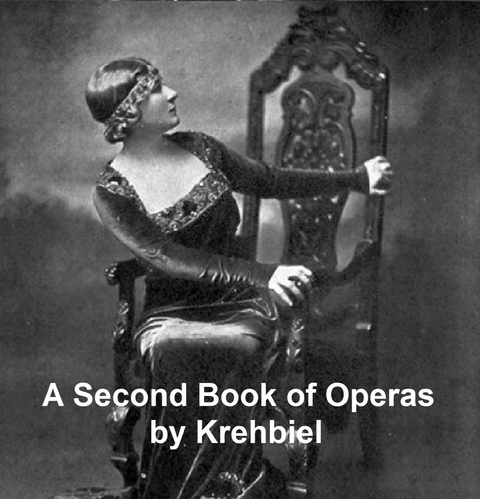
Second Book of Operas (eBook)
251 Seiten
Seltzer Books (Verlag)
978-1-4553-0233-8 (ISBN)
"e;Whether or not the English owe a grudge to their Lord Chamberlain for depriving them of the pleasure of seeing operas based on Biblical stories I do not know. If they do, the grudge cannot be a deep one, for it is a long time since Biblical operas were in vogue, and in the case of the very few survivals it has been easy to solve the difficulty and salve the conscience of the public censor by the simple device of changing the names of the characters and the scene of action if the works are to be presented on the stage, or omitting scenery, costumes and action and performing them as oratorios. In either case, whenever this has been done, however, it has been the habit of critics to make merry at the expense of my Lord Chamberlain and the puritanicalness of the popular spirit of which he is supposed to be the official embodiment, and to discourse lugubriously and mayhap profoundly on the perversion of composers' purposes and the loss of things essential to the lyric drama.
CHAPTER XII "MADAMA BUTTERFLY"
This is the book of the generation of "Madama Butterfly": An adventure in Japan begat Pierre Loti's "Madame Chrysantheme"; "Madame Chrysantheme" begat John Luther Long's "Madame Butterfly," a story; "Madame Butterfly," the story, begat "Madame Butterfly," a play by David Belasco; "Madame Butterfly," the play, begat "Madama Butterfly," the opera by Giacomo Puccini. The heroine of the roving French romanticist is therefore seen in her third incarnation in the heroine of the opera book which L. Illica and G. Giacosa made for Puccini. But in operatic essence she is still older, for, as Dr. Korngold, a Viennese critic, pointed out, Selica is her grandmother and Lakme her cousin.
Even this does not exhaust her family history; there is something like a bar sinister in her escutcheon. Mr. Belasco's play was not so much begotten, conceived, or born of admiration for Mr. Long's book as it was of despair wrought by the failure of another play written by Mr. Belasco. This play was a farce entitled "Naughty Anthony," created by Mr. Belasco in a moment of aesthetic aberration for production at the Herald Square Theatre, in New York, in the spring of 1900. Mr. Belasco doesn't think so now, but at the time he had a notion that the public would find something humorous and attractive in the spectacle of a popular actress's leg swathed in several layers of stocking. So he made a show of Blanche Bates. The public refused to be amused at the farcical study in comparative anatomy, and when Mr. Belasco's friends began to fault him for having pandered to a low taste, and he felt the smart of failure in addition, he grew heartily ashamed of himself. His affairs, moreover, began to take on a desperate aspect; the season threatened to be a ruinous failure, and he had no play ready to substitute for "Naughty Anthony." Some time before a friend had sent him Mr. Long's book, but he had carelessly tossed it aside. In his straits it came under his eyes again, and this time he saw a play in it--a play and a promise of financial salvation. It was late at night when he read the story, but he had come to a resolve by morning and in his mind's eye had already seen his actors in Japanese dress. The drama lay in the book snugly enough; it was only necessary to dig it out and materialize it to the vision. That occupation is one in which Mr. Belasco is at home. The dialogue went to his actors a few pages at a time, and the pictures rose rapidly in his mind. Something different from a stockinged leg now!
Glimpses of Nippon--its mountains, waters, bridges, flowers, gardens, geishas; as a foil to their grace and color the prosaic figures of a naval officer and an American Consul. All things tinged with the bright light of day, the glories of sunset or the super-glories of sunrise. We must saturate the fancy of the audience with the atmosphere of Japan, mused Mr. Belasco. Therefore, Japanese scenes, my painter! Electrician, your plot shall be worked out as carefully as the dialogue and action of the play's people. "First drop discovered; house-lights down; white foots with blue full work change of color at back of drop; white lens on top of mountain; open light with white, straw, amber, and red on lower part of drop; when full on lower footlights to blue," and so on. Mr. Belasco's emotions, we know, find eloquent expression in stage lights. But the ear must be carried off to the land of enchantment as well as the eye. "Come, William Furst, recall your experiences on the Western coast. For my first curtain I want a quaint, soft Japanese melody, pp--you know how!"
And so "Madame Butterfly," the play, was made. In two weeks all was ready, and a day after the first performance at the Herald Square Theatre, on March 5, 1900, the city began to hum with eager comment on the dramatic intensity of the scene of a Japanese woman's vigil, of the enthralling eloquence of a motionless, voiceless figure, looking steadily through a hole torn through a paper partition, with a sleeping child and a nodding maid at her feet, while a mimic night wore on, the lanterns on the floor flickered out one by one and the soft violins crooned a melody to the arpeggios of a harp.
The season at the Herald Square Theatre was saved. Some time later, when Mr. Belasco accompanied Mr. Charles Frohman to London to put on "Zaza" at the Garrick Theatre, he took "Madame Butterfly" with him and staged it at the Duke of York's Theatre, hard by. On the first night of "Madame Butterfly" Mr. Frohman was at the latter playhouse, Mr. Belasco at the former. The fall of the curtain on the little Japanese play was followed by a scene of enthusiasm which endured so long that Mr. Frohman had time to summon his colleague to take a curtain call. At a stroke the pathetic play had made its fortune in London, and, as it turned out, paved the way for a new and larger triumph for Mr. Long's story. The musical critics of the London newspapers came to the house and saw operatic possibilities in the drama. So did Mr. Francis Nielson, at the time Covent Garden's stage manager, who sent word of the discovery to Signor Puccini. The composer came from Milan, and realized on the spot that the successor of "Tosca" had been found. Signori Illica and Giacosa, librettists in ordinary to Ricordi & Co., took the work of making the opera book in hand. Signor Illica's fancy had roamed in the Land of Flowers before; he had written the libretto for Mascagni's "Iris." The ephemeral life of Cho-Cho-San was over in a few months, but by that time "Madama Butterfly," glorified by music, had lifted her wings for a new flight in Milan.
It is an old story that many operas which are recognized as masterpieces later, fail to find appreciation or approval when they are first produced. "Madama Butterfly" made a fiasco when brought forward at La Scala on February 17, 1904.
[Footnote: At this premiere Campanini was the conductor and the cast was as follows: Butterfly, Storchio; Suzuki, Giaconia; Pinkerton, Zenatello; Sharpless, De Luca; Goro, Pini-Corsi; Bonzo, Venturini; Yakuside, Wulmann. At the first performance in London, on July 10, 1905, at Covent Garden, the cast was: Butterfly, Destinn; Suzuki, Lejeune; Pinkerton, Caruso; Sharpless, Scotti; Goro, Dufriche; Bonzo, Cotreuil; Yakuside, Rossi. Conductor, Campanini. After the revision it was produced at Brescia on May 28, 1904, with Zenatello, of the original cast, Krusceniski as Butterfly, and Bellati as Sharpless. The first American performances were in the English version, made by Mrs. B. H. Elkin, by the Savage Opera Company, which came to the Garden Theatre, New York, after a trial season in Washington, on November 12, 1906. It had a run of nearly three months before it reached the Metropolitan Opera House, on February 11, 1907. Mr. Walter Rothwell conducted the English performance, in which there were several changes of casts, the original Butterfly being Elza Szamozy (a Hungarian singer); Suzuki, Harriet Behne; Pinkerton, Joseph F. Sheehan, and Sharpless, Winifred Goff. Arturo Vigna conducted the first Italian performance at the Metropolitan, with Geraldine Farrar as Butterfly, Louise Homer as Suzuki, Caruso as Pinkerton, Scotti as Sharpless, and Albert Reiss as Goro.]
So complete was the fiasco that in his anxiety to withdraw the work Signer Puccini is said to have offered to reimburse the management of the theatre for the expenditures entailed by the production. Failures of this kind are frequently inexplicable, but it is possible that the unconventional character of the story and the insensibility of the Italians to national musical color other than their own, had a great deal to do with it in this case. Whatever the cause, the popular attitude toward the opera was displayed in the manner peculiar to Italy, the discontented majority whistling, shrilling on house keys, grunting, roaring, bellowing, and laughing in the good old-fashioned manner which might be set down as possessed of some virtuous merit if reserved for obviously stupid creations.
"The Pall Mall Gazette" reported that at the time the composer told a friend that on this fateful first night he was shut up in a small room behind the scenes, where he could hear nothing of what was going on on the stage or in the audience-room. On a similar occasion, nearly a century before, when "The Barber of Seville" scored an equally monumental failure, Rossini, in the conductor's chair, faced the mob, shrugged his shoulders, and clapped his hands to show his contempt for his judges, then went home and composedly to bed. Puccini, though he could not see the discomfiture of his opera, was not permitted to remain in ignorance of it. His son and his friends brought him the news. His collaborator, Giacosa, rushed into the room with dishevelled hair and staring eyes, crying: "I have suffered the passion of death!" while Signorina Storchio burst into such a flood of tears and sobs that it was feared she would be ill. Puccini was cut to the heart, but he did not lose faith in the work. He had composed it in love and knew its potentialities, His faith found justification when he produced it in Brescia three months later and saw it start out at once on a triumphal tour of the European theatres. His work of revision was not a large or comprehensive one. He divided the second act into two acts, made some condensations to relieve the long strain, wrote a few measures of introduction for the final scene, but refused otherwise to change the music. His fine...
| Erscheint lt. Verlag | 1.3.2018 |
|---|---|
| Sprache | englisch |
| Themenwelt | Kunst / Musik / Theater ► Musik ► Klassik / Oper / Musical |
| ISBN-10 | 1-4553-0233-3 / 1455302333 |
| ISBN-13 | 978-1-4553-0233-8 / 9781455302338 |
| Informationen gemäß Produktsicherheitsverordnung (GPSR) | |
| Haben Sie eine Frage zum Produkt? |
 EPUB (Adobe DRM)
Größe: 500 KB
Kopierschutz: Adobe-DRM
Adobe-DRM ist ein Kopierschutz, der das eBook vor Mißbrauch schützen soll. Dabei wird das eBook bereits beim Download auf Ihre persönliche Adobe-ID autorisiert. Lesen können Sie das eBook dann nur auf den Geräten, welche ebenfalls auf Ihre Adobe-ID registriert sind.
Details zum Adobe-DRM
Dateiformat: EPUB (Electronic Publication)
EPUB ist ein offener Standard für eBooks und eignet sich besonders zur Darstellung von Belletristik und Sachbüchern. Der Fließtext wird dynamisch an die Display- und Schriftgröße angepasst. Auch für mobile Lesegeräte ist EPUB daher gut geeignet.
Systemvoraussetzungen:
PC/Mac: Mit einem PC oder Mac können Sie dieses eBook lesen. Sie benötigen eine
eReader: Dieses eBook kann mit (fast) allen eBook-Readern gelesen werden. Mit dem amazon-Kindle ist es aber nicht kompatibel.
Smartphone/Tablet: Egal ob Apple oder Android, dieses eBook können Sie lesen. Sie benötigen eine
Geräteliste und zusätzliche Hinweise
Buying eBooks from abroad
For tax law reasons we can sell eBooks just within Germany and Switzerland. Regrettably we cannot fulfill eBook-orders from other countries.
EPUB (Ohne DRM)Digital Rights Management: ohne DRM
Dieses eBook enthält kein DRM oder Kopierschutz. Eine Weitergabe an Dritte ist jedoch rechtlich nicht zulässig, weil Sie beim Kauf nur die Rechte an der persönlichen Nutzung erwerben.
Dateiformat: EPUB (Electronic Publication)
EPUB ist ein offener Standard für eBooks und eignet sich besonders zur Darstellung von Belletristik und Sachbüchern. Der Fließtext wird dynamisch an die Display- und Schriftgröße angepasst. Auch für mobile Lesegeräte ist EPUB daher gut geeignet.
Systemvoraussetzungen:
PC/Mac: Mit einem PC oder Mac können Sie dieses eBook lesen. Sie benötigen dafür die kostenlose Software Adobe Digital Editions.
eReader: Dieses eBook kann mit (fast) allen eBook-Readern gelesen werden. Mit dem amazon-Kindle ist es aber nicht kompatibel.
Smartphone/Tablet: Egal ob Apple oder Android, dieses eBook können Sie lesen. Sie benötigen dafür eine kostenlose App.
Geräteliste und zusätzliche Hinweise
Buying eBooks from abroad
For tax law reasons we can sell eBooks just within Germany and Switzerland. Regrettably we cannot fulfill eBook-orders from other countries.
aus dem Bereich