


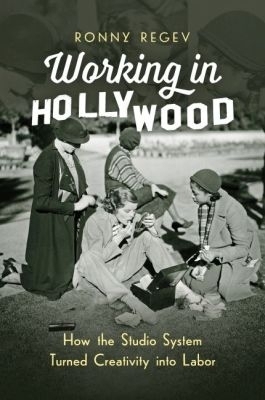
Working in Hollywood
How the Studio System Turned Creativity Into Labor
Seiten
2018
The University of North Carolina Press (Verlag)
978-1-4696-3650-4 (ISBN)
The University of North Carolina Press (Verlag)
978-1-4696-3650-4 (ISBN)
- Lieferbar (Termin unbekannt)
- Versandkostenfrei
- Auch auf Rechnung
- Artikel merken
Reveals an important untold story of an influential twentieth-century workplace. Ronny Regev argues that the Hollywood studio system institutionalized creative labour by systemizing and standardizing the work of actors, directors, writers, and cinematographers, meshing artistic sensibilities with the efficiency-minded rationale of industrial capitalism.
A history of the Hollywood film industry as a modern system of labor, this book reveals an important untold story of an influential twentieth-century workplace. Ronny Regev argues that the Hollywood studio system institutionalized creative labor by systemizing and standardizing the work of actors, directors, writers, and cinematographers, meshing artistic sensibilities with the efficiency-minded rationale of industrial capitalism. The employees of the studios emerged as a new class: they were wage laborers with enormous salaries, artists subjected to budgets and supervision, stars bound by contracts. As such, these workers-people like Clark Gable, Katharine Hepburn, and Anita Loos-were the outliers in the American workforce, an extraordinary working class.
Through extensive use of oral histories, personal correspondence, studio archives, and the papers of leading Hollywood luminaries as well as their less-known contemporaries, Regev demonstrates that, as part of their contribution to popular culture, Hollywood studios such as Paramount, Warner Bros., and MGM cultivated a new form of labor, one that made work seem like fantasy.
A history of the Hollywood film industry as a modern system of labor, this book reveals an important untold story of an influential twentieth-century workplace. Ronny Regev argues that the Hollywood studio system institutionalized creative labor by systemizing and standardizing the work of actors, directors, writers, and cinematographers, meshing artistic sensibilities with the efficiency-minded rationale of industrial capitalism. The employees of the studios emerged as a new class: they were wage laborers with enormous salaries, artists subjected to budgets and supervision, stars bound by contracts. As such, these workers-people like Clark Gable, Katharine Hepburn, and Anita Loos-were the outliers in the American workforce, an extraordinary working class.
Through extensive use of oral histories, personal correspondence, studio archives, and the papers of leading Hollywood luminaries as well as their less-known contemporaries, Regev demonstrates that, as part of their contribution to popular culture, Hollywood studios such as Paramount, Warner Bros., and MGM cultivated a new form of labor, one that made work seem like fantasy.
Ronny Regev is assistant professor of history at the Hebrew University of Jerusalem.
| Erscheinungsdatum | 16.10.2018 |
|---|---|
| Verlagsort | Chapel Hill |
| Sprache | englisch |
| Maße | 197 x 240 mm |
| Gewicht | 525 g |
| Themenwelt | Kunst / Musik / Theater ► Film / TV |
| Sachbuch/Ratgeber ► Geschichte / Politik ► Allgemeines / Lexika | |
| Geisteswissenschaften ► Geschichte ► Regional- / Ländergeschichte | |
| Wirtschaft | |
| ISBN-10 | 1-4696-3650-6 / 1469636506 |
| ISBN-13 | 978-1-4696-3650-4 / 9781469636504 |
| Zustand | Neuware |
| Informationen gemäß Produktsicherheitsverordnung (GPSR) | |
| Haben Sie eine Frage zum Produkt? |
Mehr entdecken
aus dem Bereich



aus dem Bereich
Handbuch zum Lesen des Himmels
Buch | Hardcover (2025)
Harpercollins (Verlag)
CHF 30,80


