Pistols and Revolvers (eBook)
224 Seiten
Amber Books Ltd (Verlag)
978-1-78274-266-1 (ISBN)
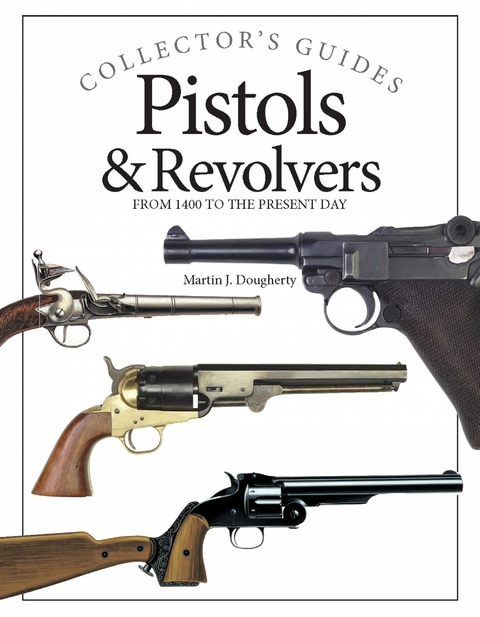
From early hand cannon of the late 14th century to the latest automatics and machine pistols, Collector's Guides: Pistols & Revolvers traces the development of these small arms as they evolved over the centuries. From a Thirty Years' War wheel lock to today's Beretta 92, from the Luger to the Colt to the latest Ruger, Collector's Guides: Pistols & Revolvers offers a narrative history of the classics among these firearms. Throughout the book there are technical specifications for featured firearms.
Illustrated with more than 250 colour and black-and-white artworks and photographs, Collector's Guides: Pistols & Revolvers is an expertly written account of the history of sporting and military firearms.
Matchlock, wheel lock, flintlock and caplock; .44 or 9mm; revolver and automatic - the history of pistols and revolvers is a fascinating journey through the development of hand-held firearms technology. From early hand cannon of the late 14th century to the latest automatics and machine pistols, Collector's Guides: Pistols & Revolvers traces the development of these small arms as they evolved over the centuries. From a Thirty Years' War wheel lock to today's Beretta 92, from the Luger to the Colt to the latest Ruger, Collector's Guides: Pistols & Revolvers offers a narrative history of the classics among these firearms. Throughout the book there are technical specifications for featured firearms. Illustrated with more than 250 colour and black-and-white artworks and photographs, Collector's Guides: Pistols & Revolvers is an expertly written account of the history of sporting and military firearms.
New Zealander marines, rifles slung, train with their backup weapons. A handgun is not the weapon of choice for a combat situation, but it does provide the means for emergency self-defence if a situation goes bad.
Introduction
Weapons of any kind can be defined as ‘tools used to break things and hurt people’, but this does not make them intrinsically good or bad. It is the purpose to which a weapon is put that matters, not its inherent capability. A weapon may serve as a badge of office and never be drawn in anger, or it can be a deterrent to aggression or used to defend the lives of innocents. It can, of course, also be used for violence and mayhem.
Certain weapons have acquired a reputation over the years, sometimes by association with law enforcement or military personnel, sometimes due to popularity with criminals. Some weapons have been given an artificial reputation by their portrayal in video games, movies and television shows, or are considered to be somehow ‘good’ or ‘bad’ depending on their use by one side or another in a war. Not all of these associations are fair, and not all elements of a weapon’s reputation are accurate. Some have become classics or notoriously iconic without really deserving it, while others have somehow evaded the recognition they rightly deserve.
To the user, whose life might depend on a weapon’s ability to stop an assailant, characteristics like accuracy, controllability and wounding power are critically important, but the collector might have a wholly different set of criteria for determining which weapons are interesting and which are not. Combat capability is one factor, of course, but physical beauty, perfection of design or an interesting feature not found on similar weapons might all be equally important.
Users and Collectors
The collector might also rate a given weapon highly due to its historical importance. The first use of a now-standard feature, innovative design or incorporation of new materials and association with historical personalities or events can all spark the interest of the collector or historian. A weapon that offers fairly lousy combat performance, is inaccurate, kicks too hard and is virtually impossible to reload quickly might still be a favourite with the collector, whereas the practical user would probably arm himself with something more effective if given the chance.
And of course some firearms are worth collecting for no better reason than the owner likes them. A cheap little plinking gun, one of thousands mass-produced over the years, might be given pride of place in a collection because the owner’s daughter fired her first shots with it, or simply because of fond memories of recreational shooting with friends. Where the practical gun user has fairly strict rules, the collector’s world is much more subjective and this means that there is much possibility for debate among enthusiasts about which guns are worth collecting and which are considered uninteresting.
Hunting from horseback with black powder pistols would have been quite a challenge. The inherent inaccuracy and unreliability of the weapon, combined with the motion of the target and the firer’s mount, all added up to a great many missed shots.
The author’s experience is that some classic handguns are pretty awful to shoot, fiddly to reload and prone to mechanical issues that can make them utterly maddening… yet they are still wonderful devices that it is a real privilege to shoot with. By way of example, I would not want to bet my life on a Mauser C96, but I did truly enjoy target shooting with one. Just operating the mechanism, opening the action to load the magazine from a stripper clip – even fumbling with the detachable stock was a worthwhile experience. The stock can only be attached two ways, and for some reason both of them seemed to be wrong whenever I tried it… but what a wonderful piece of practical history it was.
Thus there is no single factor that makes a weapon worth collecting or not, or which determines what is interesting and what can be ignored. Today’s under-rated or wildly experimental weapon may be tomorrow’s classic. What is true is that every single weapon has a story and has its own unique character. It is up to the individual to decide whether those characteristics appeal or not.
Flintlock pistols were often presented and sometimes carried as pairs, giving the user two shots before reloading and ensuring that in a duel situation both combatants had identical weapons.
Pistols and Revolvers
Handguns are not battlefield weapons. In other words, someone who was expecting combat would probably want a more potent weapon such as a rifle or submachinegun in the field. However, a handgun is easy to carry and will serve well in an emergency – any firepower is better than no firepower. Sidearms are thus primarily defensive weapons, used to deal with a sudden threat rather than being the weapon of choice when going looking for trouble. There are exceptions, of course, such as when a weapon must be concealed until used and anything larger is thus inappropriate, but for the most part a sidearm is carried in case of emergency rather than as a primary combat weapon.
Samuel Colt is often credited, incorrectly, with inventing the revolver. What he did do was to implement mass-production on an industrial scale, and to create a marketing programme to match the output of his factory.
That said, if a weapon is needed then it should be as effective as possible. In addition to being a visual deterrent to violence, a handgun should offer a good balance of ability to hit a target – or possibly multiple targets – and the capability to ‘stop’ the target when hit. Stopping power is not the same thing as lethality. Any bullet can kill if it hits a vital organ, but many handgun rounds are unlikely to cause the opponent to immediately stop whatever he is intent upon doing – and that is what matters in a splitsecond defensive situation. Thus it could be argued that firing a round with the ability to ‘stop’ an opponent is the paramount requirement in a handgun intended for combat.
However, stopping power is of no real use if the bullet misses the target. In addition, some handguns are too powerful for some users – and some are too powerful for almost any user! These extremely potent guns are impressive in their own right and can be useful for hunting, but for self-defence they are not a good choice. A gun that throws itself off target because the user cannot control its recoil, or causes an involuntary flinch upon firing, is less than ideal. Some handguns will actually injure an unwary shooter.
The Handgun in Combat
Huge cartridges also take up a lot of space in a weapon, making it bulky, heavy and reducing the amount of ammunition that can be carried in the cylinder or magazine. There is a trade-off to be made between potency of the round and the number that can be carried, which is important for several reasons. Most shooters cannot reliably hit a human-sized target with every shot under combat conditions, even at close range, so multi-shot capability is important even with a single target. There is also the possibility that a single shot will not stop a target, so shooting multiple times may be the only way to survive the encounter.
Obviously an exceedingly imprecise weapon is a liability, but accuracy – beyond a certain limit – is not critical to a combat handgun. As already noted, most handguns are acceptably accurate out to ranges far beyond those at which their users can shoot well mid-fight. A hunting weapon, or one used for competition, will need to be highly accurate over much greater distances than a weapon intended for close-range combat.
Handgun design is all about balancing these factors – ammunition capacity, accuracy, controllability and stopping power – as well as other considerations such as reliability, ease of use, comfort of carry, reloading speed, quality of sights and so forth. A good balance will create a fine weapon, but an extreme concentration on one factor might also result in a classic. Some of the most famous and influential guns are not great combat weapons, but instead personify some aspect or ideal of handgun design to the detriment of others or overall capability. As a rule, however, form follows function. Handgun design tends to be concentrated on creating either specialist weapons for hunting or to showcase a single attribute, or (more commonly) solid, general-purpose sidearms. The process began as soon as it became possible to create a firearm that could be held in just one hand.
The imagery in this early Smith & Wesson advertisement is clear: you can bet your life on these guns. To the practical user, nothing is more important – but the collector may have entirely different criteria for what is a ‘good’ or ‘interesting’ weapon and what is not.
Early Pistol Designs
The earliest black powder muzzleloading pistols were less than reliable, and even if they did discharge at all their accurate range was lamentably short. Indeed, some Napoleonic cavalry officers considered that if they were close enough to shoot an opponent with any degree of confidence, they were close enough to use their swords. That said, early pistols saw use from horseback, on foot and aboard ships. Many had a brass butt plate to allow the weapon to be used as a club after firing.
Attempts to increase handgun firepower...
| Erscheint lt. Verlag | 20.4.2017 |
|---|---|
| Reihe/Serie | Collector's Guides | Collector's Guides |
| Sprache | englisch |
| Themenwelt | Kunst / Musik / Theater ► Antiquitäten |
| Sachbuch/Ratgeber ► Freizeit / Hobby ► Sammeln / Sammlerkataloge | |
| Natur / Technik ► Fahrzeuge / Flugzeuge / Schiffe ► Militärfahrzeuge / -flugzeuge / -schiffe | |
| Sozialwissenschaften ► Politik / Verwaltung | |
| Schlagworte | Automatic • Beretta • Colt • handgun • Luger • Pistol • Revolver • Ruger • Small • Webley |
| ISBN-10 | 1-78274-266-2 / 1782742662 |
| ISBN-13 | 978-1-78274-266-1 / 9781782742661 |
| Informationen gemäß Produktsicherheitsverordnung (GPSR) | |
| Haben Sie eine Frage zum Produkt? |
 EPUB (Adobe DRM)
Größe: 25,1 MB
Kopierschutz: Adobe-DRM
Adobe-DRM ist ein Kopierschutz, der das eBook vor Mißbrauch schützen soll. Dabei wird das eBook bereits beim Download auf Ihre persönliche Adobe-ID autorisiert. Lesen können Sie das eBook dann nur auf den Geräten, welche ebenfalls auf Ihre Adobe-ID registriert sind.
Details zum Adobe-DRM
Dateiformat: EPUB (Electronic Publication)
EPUB ist ein offener Standard für eBooks und eignet sich besonders zur Darstellung von Belletristik und Sachbüchern. Der Fließtext wird dynamisch an die Display- und Schriftgröße angepasst. Auch für mobile Lesegeräte ist EPUB daher gut geeignet.
Systemvoraussetzungen:
PC/Mac: Mit einem PC oder Mac können Sie dieses eBook lesen. Sie benötigen eine
eReader: Dieses eBook kann mit (fast) allen eBook-Readern gelesen werden. Mit dem amazon-Kindle ist es aber nicht kompatibel.
Smartphone/Tablet: Egal ob Apple oder Android, dieses eBook können Sie lesen. Sie benötigen eine
Geräteliste und zusätzliche Hinweise
Buying eBooks from abroad
For tax law reasons we can sell eBooks just within Germany and Switzerland. Regrettably we cannot fulfill eBook-orders from other countries.
aus dem Bereich