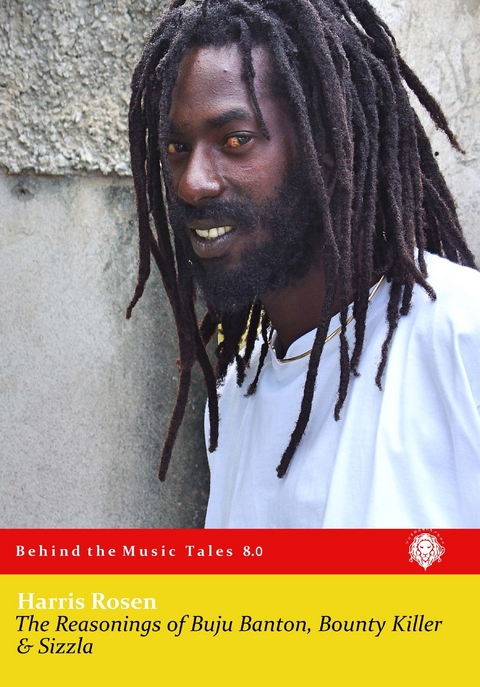
Reasonings of Buju Banton, Bounty Killer & Sizzla (eBook)
100 Seiten
Peace! Carving (Verlag)
978-0-9953072-0-9 (ISBN)
The Reasonings of Buju Banton, Bounty Killer & Sizzla is three exclusive interviews, ten exclusive photos, and 104 links to music and tales.
An engaging literal account of how three prodigious talents ply and impact a nation of millions with their reactionary music.
Now, in The Reasonings of Buju Banton, Bounty Killer & Sizzla, the 8th book in the series, you can get inside the minds of some of the most important artists who have made their mark on Reggae music for generations to come.
Buju Banton is one of these men. A certified natural talent, his career was hallmarked by his socio-political and overtly sexual lyrics. Then he turned his back and became a devout Rastafarian.
Bounty Killer is acknowledged far and wide as The Warlord. His commanding delivery, attitude and streetwise outlaw music made him one of the biggest stars of his generation. He has likewise spoken candidly about the state of Reggae music and what was keeping it back from crossing over to the masses. Then he faced his most formidable opponent, ever.
Sizzla has released over 60 albums and is respected worldwide for his music. He has actively engaged a youthful following with his spiritual Rastafarian teachings and lifestyle, educating them on corruption, oppression and how to uplift themselves.
The Reasonings of Buju Banton, Bounty Killer & Sizzla, is a rare treat. It captures the thoughts and hopes of artists who have made it their lives to bring one of the most popular forms of music to a much more comprehensive audience.
The Reasonings of Buju Banton, Bounty Killer & Sizzla is three exclusive interviews, ten exclusive photos, and 104 links to music and tales. An engaging literal account of how three prodigious talents ply and impact a nation of millions with their reactionary music.Now, in The Reasonings of Buju Banton, Bounty Killer & Sizzla, the 8th book in the series, you can get inside the minds of some of the most important artists who have made their mark on Reggae music for generations to come.Buju Banton is one of these men. A certified natural talent, his career was hallmarked by his socio-political and overtly sexual lyrics. Then he turned his back and became a devout Rastafarian. Bounty Killer is acknowledged far and wide as The Warlord. His commanding delivery, attitude and streetwise outlaw music made him one of the biggest stars of his generation. He has likewise spoken candidly about the state of Reggae music and what was keeping it back from crossing over to the masses. Then he faced his most formidable opponent, ever.Sizzla has released over 60 albums and is respected worldwide for his music. He has actively engaged a youthful following with his spiritual Rastafarian teachings and lifestyle, educating them on corruption, oppression and how to uplift themselves.The Reasonings of Buju Banton, Bounty Killer & Sizzla, is a rare treat. It captures the thoughts and hopes of artists who have made it their lives to bring one of the most popular forms of music to a much more comprehensive audience.
Jamaica, Jamaica.
I began listening to Reggae music in 1991. Growing up in Toronto it is impossible not to be affected by its driving rhythms and patois, especially when one is a Hip-Hop fan and the vast majority of the community is of Caribbean culture.
Over the years I have visited Jamaica multiple times and travelled coast to coast taking in its majestic sights and sounds. From Spanish Town to Burnt Savannah; Red Hills and Mona; uptown and downtown parties; Sting and Studio One 50th anniversary; inside the homes and studios of its leading lights and legends.
The music and its culture is indeed an international experience. I will never forget entering the Lagos Hilton Hotel club in Lagos, Nigeria, and witnessing Dancehall Queens in action and meeting local artists who had booked tickets to Jamaica to further their career.
The Jamaican Dancehall of today has a rich lineage. One that has gradually transformed from the live bands and sound systems of the 40s and 50s to the record producers and don promoters of the 60s and 70s, through the age of digital in the 80s, then onward to the 90s and beyond.
Arthur “Duke” Reid’s Trojan Sound and Sir Clement “Coxsone” Dodd’s Studio One are revered worldwide for fueling the sound and creating an industry. Though without its unsung heroes the Art Form would be stuck in the mud.
Hedley Jones, perhaps the most unheralded pioneer in the history of the music, built the core of the entire industry.
Jones made the first solid wood electric guitar in 1940, a full year before Les Paul constructed his prototype and seven years before he patented it.
A professional musician and licensed electronic technician, He was commissioned by hardware store owner Tom Wong in 1947 to create Jamaica’s first full audio spectrum amplified sound system. Wong, a.k.a. Tom The Great Sebastian, acknowledged as the first Jamaican sound with a Toaster, then dominated the party scene. On the heels o Wong’s success, Jones was commissioned to create separate sound systems for Duke Reid and Sir Coxsone Dodd.
Jones went on to implement Jamaica’s first traffic lights in 1952; and the first double necked solid body electric guitar in 1961.
By 1963, Jamaican artists had begun to carve out a unique sound of their own. The savvy Reid and Dodd saw the future and started their record labels, moving into producing and manufacturing. Jones was commissioned by Sir Coxsone Dodd to build the equipment for the iconic Studio One. His sound system electronics were fueling the dances and the recordings that played at them, notably the global symbol of all Jamaican music, Bob Marley.
______
As Reggae developed, so did its talents. An incursion of sound systems superseded the Toaster for the deejay and sound clashes as the message took a turn from societal issues to sex and gun talk. Over time the location where dances took place became a musical form itself known as Dancehall.
In the mid-80s, digital riddims took over on the heels of Lloyd James a.k.a. King Jammy, Casio MT-40 production of Wayne Smith’s “(Under Me) Sleng Teng”. Jammy harkening back to the days of Hedley Jones earned his stripes as an electronic technician.
The 90s espoused the age of slackness as the beloved red, green and gold of the Rastafari made way for gold chains and ribald Dancehall Queens. Righteous conscious artists such as Garnett Silk, Tony Rebel and ragga man Capleton balanced it out.
The digital rhythms then spread to the lucrative U.S. market on the backs of Shabba Ranks, Buju Banton, Chaka Demus and Pliers and others.
Unfortunately, the music became overwrought with a litany of contradictions as it seemingly embraced western culture on the one hand and opposed it on the other, primarily manifested by its anti-gay rhetoric and ideology.
As a direct result, the music was shunned by many just as it had seemingly begun to crossover into mainstream acceptance. The major labels that had embraced the music and culture dropped offending artists from their rosters relegating them to the minor leagues of distributed labels and speciality store import orders.
_______
Born Mark Anthony Myrie in Kingston, Jamaica, July 15, 1973, Buju Banton is a certified natural talent. His career began in 1988, and by 1992 his sociopolitical and hyper-sexual lyrical assaults reigned supreme. In 1992, He broke Bob Marley’s record for number one singles in a calendar year with rapid-fire releases leading the charge for a new generation of artist and the ensuing age of slackness. Tunes such as the anti-gay “Boom Bye Bye” clashed head-on with “Batty Rider” and “Deportees” illustrating and agitating the mentality and sentiment of the time.
The poor and downtrodden people ate it up with vigour, as the ever-percolating undercurrent and climate of Jamaica continued to simmer.
The Mr. Mention album earned the best-selling album in Jamaican history in 1993 leading to a deal with Mercury Record. Voice of Jamaica followed in August 1993 marking his international major label debut. Then his inner circle came crashing down.
Buju Banton lost close friends and peers DJ Pan Head, Dirtsman and Mickey Simpson in separate 1993 incidents setting him on the path to righteous and conscious life. The tragic December 2004 loss of beacon of light Garnett Silk weighed heavy too. It became the catalyst that completed his spiritual transformation and full embrace of the Rastafari way of life.
The seminal classic ‘Til Shiloh released on July 18, 1995, and the world grasped his conscious message. Buju Banton could do no wrong and indeed his status became rather celestial. He then maintained solid and steady year in and year out, both on the domestic and international scenes.
This Buju Banton interview occurred in December 2003 at his Axum compound, home of Gargamel Recording Studio in Kingston, Jamaica, after a spliff and a hot Guinness.
At the time, Elephant Man was good to go. Sean Paul had the light. And if the dispute onstage that year’s Sting International festivities were any indication, Vybz Kartel and Ninjaman continued dancehall’s coup d’etat tradition of new blood clashing with old guards.
Chilling in his studio compound, you got the sense that Buju Banton had been there, done that. The lyrics factory wasn’t working overtime, he’d never sold platinum, and since taking the dancehall crown from Shabba Ranks and then renouncing even metaphorical forms of violence after the 1993 murders of his friends, he’d been out of the clashing circuit.
Buju Banton had the fitness regimen required to live long and prosper in the dancehall, gladiator business or not.
______
Born Rodney Price in Kingston, Jamaica, June 12, 1972, Bounty Killer is known far and wide as The Warlord. From 1993 through 2003 his booming, commanding delivery, boss attitude and streetwise outlaw music laid claim to the top spot in the worldwide dancehall. A string of prominent tunes was hitting nonstop, his name on the tip of everyone’s tongue. He was responsible for putting on Scare Dem and Elephant Man, The Alliance, Mavado and others.
Outspoken and controversial, Bounty Killer had his share of battles in the dancehall with Merciless and Vybz Kartel. However, his seemingly omnipresent war with Beenie Man is the most well known spanning clash albums, onstage fighting and bad-mind towards each other until 2014 when they recorded the song “Legendary” together.
His most infamous song is his guest shot on No Doubt’s “Hey Baby,” which earned him a Grammy Award for Best Pop Performance by a Duo or Group with Vocal at the 45th Annual Awards show on February 23, 2003
This Bounty Killer interview occurred during the summer of 2002 inside a New York, New York hotel room before the release of his Ghetto Dictionary volumes - The Mystery and The Art of War on VP Records.
Bounty Killer spoke on the state of Reggae music and what was holding it back from crossing over to the masses. The difficulties of working with No Doubt on “Hey Baby” and its controversial video. He lashed out at his arch rival, Beenie Man, and named his top Sound Systems, artists, events, and strains of ganja.
_____
Kingdoms rise, and Kingdoms fall. Over the past two decades, Sizzla has just about out-ruled them all. Of the more recent heir-apparent cited by royal watchers in Reggae music’s global dancehall culture - a man like Garnett Silk, Capleton, Buju Banton, Bounty Killer and Beenie Man, none have ascended the throne as high as the one known by his loyal subjects in Jamaica and around the world as Kalonji.
Born Miguel Orlando Collins in Kingston Jamaica, April 17, 1976, and raised by devout Rasta parents in the August Town district of East Kingston, Sizzla first began spreading his homeschooling by way of the microphone as a teenage DJ for the Caveman Hi-Fi Soundsystem. But it wasn’t until 1994 when his initial studio sessions with Fattis Burrell yielded hit after hit on the Xtreminator label, that Jamaicans first realised the scope of what was yet to come.
Sizzla has released over 60 albums and commands respect around the world for his musical offerings. He has embraced and engaged countless youth with his spiritual Rastafarian teachings and lifestyle educating them on corruption, oppression and how to uplift themselves and their...
| Erscheint lt. Verlag | 31.1.2018 |
|---|---|
| Sprache | englisch |
| Themenwelt | Kunst / Musik / Theater ► Musik ► Pop / Rock |
| ISBN-10 | 0-9953072-0-2 / 0995307202 |
| ISBN-13 | 978-0-9953072-0-9 / 9780995307209 |
| Informationen gemäß Produktsicherheitsverordnung (GPSR) | |
| Haben Sie eine Frage zum Produkt? |
 EPUB (Adobe DRM)
Kopierschutz: Adobe-DRM
Adobe-DRM ist ein Kopierschutz, der das eBook vor Mißbrauch schützen soll. Dabei wird das eBook bereits beim Download auf Ihre persönliche Adobe-ID autorisiert. Lesen können Sie das eBook dann nur auf den Geräten, welche ebenfalls auf Ihre Adobe-ID registriert sind.
Details zum Adobe-DRM
Dateiformat: EPUB (Electronic Publication)
EPUB ist ein offener Standard für eBooks und eignet sich besonders zur Darstellung von Belletristik und Sachbüchern. Der Fließtext wird dynamisch an die Display- und Schriftgröße angepasst. Auch für mobile Lesegeräte ist EPUB daher gut geeignet.
Systemvoraussetzungen:
PC/Mac: Mit einem PC oder Mac können Sie dieses eBook lesen. Sie benötigen eine
eReader: Dieses eBook kann mit (fast) allen eBook-Readern gelesen werden. Mit dem amazon-Kindle ist es aber nicht kompatibel.
Smartphone/Tablet: Egal ob Apple oder Android, dieses eBook können Sie lesen. Sie benötigen eine
Geräteliste und zusätzliche Hinweise
Buying eBooks from abroad
For tax law reasons we can sell eBooks just within Germany and Switzerland. Regrettably we cannot fulfill eBook-orders from other countries.
aus dem Bereich