


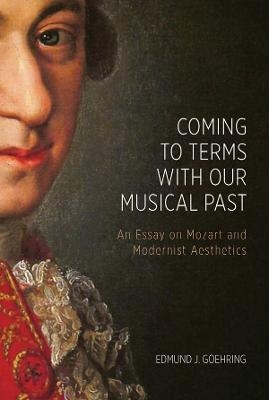
Coming to Terms with Our Musical Past
An Essay on Mozart and Modernist Aesthetics
Seiten
2018
University of Rochester Press (Verlag)
978-1-58046-930-2 (ISBN)
University of Rochester Press (Verlag)
978-1-58046-930-2 (ISBN)
- Titel z.Zt. nicht lieferbar
- Versandkostenfrei
- Auch auf Rechnung
- Artikel merken
WINNER: 2019 Marjorie Weston Emerson Award from the Mozart Society of America
A bold, restorative vision of Mozart's works, and Western art music generally, as manifestations of an idealism rooted in the sociable nature of humans.
A bold, restorative vision of Mozart's works, and Western art music generally, as manifestations of an idealism rooted in the sociable nature of humans.
WINNER: 2019 Marjorie Weston Emerson Award from the Mozart Society of America
For over a generation now, many leading performers, critics, and scholars of Mozart's music have taken a rejection of transcendence as axiomatic. This essentially modernist, antiromantic orientation attempts to neutralize the sorts of aesthetic experiences that presuppose an enchantment with Mozart's art, an engagement traditionally articulated by such terms as intention, mimesis, author, and genius. And what is true of much recent Mozart interpretation isoften manifest in the interpretation of Western art music more generally.
Edmund Goehring's Coming to Terms with Our Musical Past explores what gets lost when the vocabulary of enchantment is abandoned. The bookthen proceeds to offer an alternative vision of Mozart's works and of the wider canon of Western art music. A modernized poetics, Goehring argues, reduces art to mechanism or process. It sees less because it excludes a necessaryand enlarging human presence: the generative, and receiving, "I."
This fascinating new book-length essay is addressed to any reader interested in the performing arts, visual arts, and literature and their relationship to the broader culture. Goehring draws on seminal thinkers in art criticism and philosophy to propose that such works as Mozart's radiate an idealism that has human sociability both as its source and its object.
This book is available as an Open Access eBook under the Creative Commons license: CC BY-NC.
A bold, restorative vision of Mozart's works, and Western art music generally, as manifestations of an idealism rooted in the sociable nature of humans.
A bold, restorative vision of Mozart's works, and Western art music generally, as manifestations of an idealism rooted in the sociable nature of humans.
WINNER: 2019 Marjorie Weston Emerson Award from the Mozart Society of America
For over a generation now, many leading performers, critics, and scholars of Mozart's music have taken a rejection of transcendence as axiomatic. This essentially modernist, antiromantic orientation attempts to neutralize the sorts of aesthetic experiences that presuppose an enchantment with Mozart's art, an engagement traditionally articulated by such terms as intention, mimesis, author, and genius. And what is true of much recent Mozart interpretation isoften manifest in the interpretation of Western art music more generally.
Edmund Goehring's Coming to Terms with Our Musical Past explores what gets lost when the vocabulary of enchantment is abandoned. The bookthen proceeds to offer an alternative vision of Mozart's works and of the wider canon of Western art music. A modernized poetics, Goehring argues, reduces art to mechanism or process. It sees less because it excludes a necessaryand enlarging human presence: the generative, and receiving, "I."
This fascinating new book-length essay is addressed to any reader interested in the performing arts, visual arts, and literature and their relationship to the broader culture. Goehring draws on seminal thinkers in art criticism and philosophy to propose that such works as Mozart's radiate an idealism that has human sociability both as its source and its object.
This book is available as an Open Access eBook under the Creative Commons license: CC BY-NC.
EDMUND J. GOEHRING is Professor of Musicology at the University of Western Ontario, Canada.
Introduction: Setting the Stage, and Then Exiting It
On Critique; or, Two Paths through the Art-Critical World
On Transcendence; or, Mozart among the Neoplatonists, Present and Past
On Intention
On Being
On Chance and Necessity
On Ambiguity
On Mimesis
On Pleasure
On Concepts and Culture
The Flaws in the Finale
Conclusion: An Other Modernism?
Notes
Bibliography
Index
| Erscheinungsdatum | 11.07.2018 |
|---|---|
| Reihe/Serie | Eastman Studies in Music |
| Verlagsort | Rochester |
| Sprache | englisch |
| Maße | 152 x 229 mm |
| Gewicht | 492 g |
| Themenwelt | Kunst / Musik / Theater ► Allgemeines / Lexika |
| Kunst / Musik / Theater ► Musik ► Klassik / Oper / Musical | |
| ISBN-10 | 1-58046-930-2 / 1580469302 |
| ISBN-13 | 978-1-58046-930-2 / 9781580469302 |
| Zustand | Neuware |
| Informationen gemäß Produktsicherheitsverordnung (GPSR) | |
| Haben Sie eine Frage zum Produkt? |
Mehr entdecken
aus dem Bereich



aus dem Bereich
Essays und Gespräche
Buch | Hardcover (2025)
Wallstein Erfolgstitel (Verlag)
CHF 29,90


