


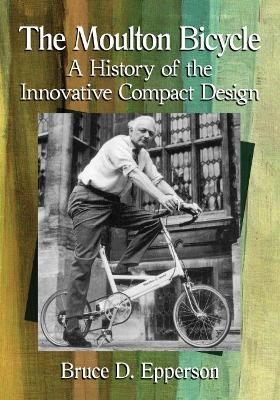
The Moulton Bicycle
A History of the Innovative Compact Design
Seiten
2018
McFarland & Co Inc (Verlag)
978-1-4766-7325-7 (ISBN)
McFarland & Co Inc (Verlag)
978-1-4766-7325-7 (ISBN)
In telling the history of the Moulton bicycle, this book follows the intertwined lives of two very different men, both unusually creative, who had an extraordinary impact on each others' careers, given that they met, at most, three or four times, and never had a professional relationship of any kind.
In 1963, British inventor Alex Moulton (1920-2012) introduced an innovative compact bicycle. Architectural Review editor Reyner Banham (1922-1988) predicted it would give rise to "a new class of cyclists," young urbanites riding by choice, not necessity. Forced to sell his firm in 1967, Moulton returned in the 1980s with an even more radical model, the AM--his acclaim among technology and design historians owed much to Banham's writings.
The AM's price tag (some models cost many thousands of dollars) has inspired tech-savvy cyclists to create "hot rod" compact bikes from Moulton-inspired "shopper" cycles of the 1970s--a trend also foreseen by Banham, who considered hot rod culture the "folk art of the mechanical era."
The author traces the intertwined lives of two unusually creative men who had an extraordinary impact on each others' careers, despite having met only a few times.
In 1963, British inventor Alex Moulton (1920-2012) introduced an innovative compact bicycle. Architectural Review editor Reyner Banham (1922-1988) predicted it would give rise to "a new class of cyclists," young urbanites riding by choice, not necessity. Forced to sell his firm in 1967, Moulton returned in the 1980s with an even more radical model, the AM--his acclaim among technology and design historians owed much to Banham's writings.
The AM's price tag (some models cost many thousands of dollars) has inspired tech-savvy cyclists to create "hot rod" compact bikes from Moulton-inspired "shopper" cycles of the 1970s--a trend also foreseen by Banham, who considered hot rod culture the "folk art of the mechanical era."
The author traces the intertwined lives of two unusually creative men who had an extraordinary impact on each others' careers, despite having met only a few times.
Bruce D. Epperson is a retired attorney who has written technical works on urban transportation planning (including bicycles) for the Federal Highway Administration, the Transportation Research Board and the Institute of Transportation Engineers. He lives in Highland, New York.
Table of Contents
Introduction
1. A Bicycle Standard of Living
2. But Today We Collect Ads
3. Cycling in a New Key
4. Who Killed Roger Rabbit’s Moulton?
5. Really, What Makes a Bike?
6. History Repeats Itself, Once More
7. Alternative Wheels
8. Vanished into the Clouds
9. Yesterday’s Tomorrow Is Not Today
10. Clip-On; Plug-In; Burn-Out
Chapter Notes
Bibliography
Index
| Erscheinungsdatum | 11.07.2018 |
|---|---|
| Zusatzinfo | 61 photos, notes, bibliography, index |
| Verlagsort | Jefferson, NC |
| Sprache | englisch |
| Maße | 178 x 254 mm |
| Gewicht | 390 g |
| Themenwelt | Kunst / Musik / Theater ► Design / Innenarchitektur / Mode |
| Sachbuch/Ratgeber ► Natur / Technik ► Fahrzeuge / Flugzeuge / Schiffe | |
| Sachbuch/Ratgeber ► Sport ► Motor- / Rad- / Flugsport | |
| Geschichte ► Teilgebiete der Geschichte ► Technikgeschichte | |
| Technik ► Fahrzeugbau / Schiffbau | |
| ISBN-10 | 1-4766-7325-X / 147667325X |
| ISBN-13 | 978-1-4766-7325-7 / 9781476673257 |
| Zustand | Neuware |
| Informationen gemäß Produktsicherheitsverordnung (GPSR) | |
| Haben Sie eine Frage zum Produkt? |
Mehr entdecken
aus dem Bereich



aus dem Bereich
eine Geschichte der Fehlbarkeit von Mensch und Technologie
Buch | Hardcover (2025)
C.H.Beck (Verlag)
CHF 44,75
Buch | Softcover (2024)
Lehmanns Media (Verlag)
CHF 27,90
von Gutenberg bis zum Smartphone
Buch | Hardcover (2025)
Klett-Cotta (Verlag)
CHF 33,55


