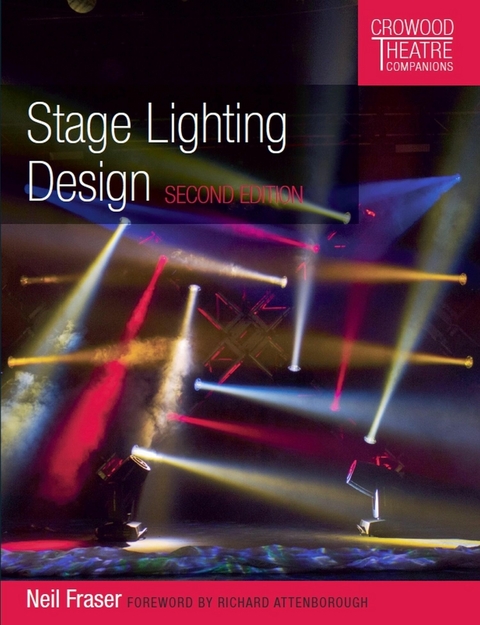
Stage Lighting Design (eBook)
358 Seiten
Crowood (Verlag)
978-1-78500-368-4 (ISBN)
Neil Fraser is an experienced lighting designer and one of the world's foremost teachers of technical theatre in leading theatre schools across the globe. He brings to his teaching over thirty years' experience of lighting professional productions for theatres worldwide, including major productions in London and New York. After seventeen years as Head of Lighting at the Royal Academy of Dramatic Art, he was appointed to his current position as RADA's Director of Technical Training.
Stage Lighting Design is a comprehensive introduction to the creation of lighting for performance, tracing the evolution of lighting design from ancient drama to contemporary theatre. Neil Fraser covers everything that today's designers will need to know, from the simple nuts and bolts of equipment, through to the complexity of a full lighting rig, including all aspects of the stage electrician and lighter designer's roles. This revised second edition includes new material on historical development, intelligent control systems and the latest advances in LED fixtures and luminaires. Each chapter includes key exercises, now totalling 100, that enable the reader to practise their skills on a wide variety of lighting challenges. The work of current designers is showcased and analysed, with examples from complete and detailed lighting designs.
Neil Fraser is an experienced lighting designer and one of the world's foremost teachers of technical theatre in leading theatre schools across the globe. He brings to his teaching over thirty years' experience of lighting professional productions for theatres worldwide, including major productions in London and New York. After seventeen years as Head of Lighting at the Royal Academy of Dramatic Art, he was appointed to his current position as RADA's Director of Technical Training.
INTRODUCTION AND BACKGROUND
WHAT IS STAGE LIGHTING?
Any light source pointed at a darkened stage could be described as stage lighting. Any light aimed towards that dark, mysterious space will show something of what is there. Real stage lighting, however, does much more than this – it does not just illuminate an empty space. Good stage lighting adds character to space, texture to object, emotion to event, impetus to action, and powerful dramatic emphasis to the stage picture. As would be expected, this takes time and practice to get right. Stage Lighting Design aims to accelerate this process and help you to become an accomplished stage lighting designer.
Fig. 1 Nicola Sabbattini’s illustration, a simple oil-lamp light source, c.1630
This book will help you to progress beyond gaining simple technical knowledge to develop good and varied techniques in the lighting of dramatic pieces for the stage. The world of stage lighting is introduced in such a way that skills will be developed at your own pace and in your own individual style. Alongside the development of good working methods you will also discover an overall personal design criteria – to not only ‘do’ lighting but also to ‘think’ lighting.
The book contains both comprehensive technical information and a wide range of practical exercises. Whilst the technical information stands in its own right, the exercises reinforce and develop the knowledge gained by making it personal to you. This will enable you to evolve an understanding of how light works within the artificial world of a stage space, to discover a means of interpreting this world to interact better with the art of the dramatist or director, and in doing so develop your own individual lighting style.
Fig. 2 The beauty of light beams caught in smoke.
Fig. 3 A lighting designer’s sketchbook.
More than anything it is this individuality, supported by a good technical understanding, that creates good and unique lighting and makes a good lighting designer.
Certain instructional devices are used throughout the text. These are boxes, as illustrated below:
INFORMATION BOX
These boxes contain technical information immediately relevant to the area being discussed in the text.
SAFETY BOX
It is most important that at all times our work is safe. Safety Boxes are placed in the text specifically to warn the reader of any possible safety aspects that they may encounter.
A General Note on the Exercises
1. Each exercise is followed by an analysis of expected results. Do not be tempted to read the analysis of the exercise before carrying it out (unless advised to do so at some point in the exercise) – otherwise you are more likely to learn what the author thinks and not what you think!
2. In the case of those exercises in parts, carry out each part completely before moving on to the next one.
3. Think of and apply your own variations on the exercises – practice certainly makes perfect.
4. The exercises, as with the various sections of the book itself, are written to create a total guide to the world of lighting design. The starting point has to be that the reader knows nothing. Often this will not be the case and so you should either select the most relevant sections or exercises, or simply read through rather than carry out all the exercises.
5. In some cases it is important to have other people look at your work. Often this is indicated in the exercise, but it is also important generally not to become too entrenched in your own ideas without reference to what others may think. Always be ready to share in this way and the results you achieve will be much enriched.
6. Further guidance on carrying out the exercises is to be found in the text.
7. If you intend to work through a number of exercises it may be a good idea to keep a written record of your journey through ideas. This may well then become a useful reference book in its own right as your career as a lighting designer or theatre technician progresses.
To those of you who wish to get ‘stuck in’ to the exercises and ideas about modern stage lighting, please jump forward to the next chapter. For those of you who would like to know a bit more background before they leap forward, I present here a potted history of what has come before.
SAFETY ISSUES
It is important to always seek advice if you are ever unsure about a safety issue whilst carrying out a practical exercise.
FIRST AID
Everyone working in technical theatre work should be encouraged to have first aid training.
A LIGHTING HISTORY
The very early history of technical theatre deals as much with the problem of how to get a decent amount of light on stage, as with what to do with it once it gets there. Surprisingly, even with such slender means at their disposal, early practitioners were often worrying about the same things or coming to the same conclusions as ourselves.
Perhaps this is not so surprising. After all, little has fundamentally changed in the relationship between viewer and viewed. Since the earliest days, since theatre came off the streets and in from the outdoor arena – since the sixteenth century at least – the audience has remained physically removed from the action and in need of help to see and understand clearly the events before them. Perhaps the really astonishing thing is how little has really changed.
ANCIENT DAYS
Early dramatic performances occurred, for the most part, out of doors. The birth of theatre in many diverse cultures and periods derived from religious ceremony, and one of the earliest references to theatrical lighting (of sorts) is in the writing of Bishop Abraham of Szuszdal who, in 1493, saw a presentation of the Annunciation in a Florentine church and marvelled at the hundreds of lights used to encircle the throne of God.1
Of the same period, Giorgio Vasari (1511–74) described the manner in which such presentations were made – particularly those staged by the architect Filippo Brunelleschi (1377–1446):
The apparatus of the Paradise of S. Felice in that city [Florence] was invented by Filippo [Brunelleschi].... On high was a Heaven full of living and moving figures, and a quantity of lights which flashed in and out.2
THE ITALIAN RENAISSANCE
Many ideas are first described in this period of high innovation and exploration. Mobile candlelight, polished bowl reflectors, light coloured by silks and shone through liquid lenses (also coloured) are all catalogued in this period. Oil and flame are dimmed mechanically, and the use of footlighting, in particular, is recorded by Serlio as early as 1530.3
In this period we know of the work of three practitioners: Serlio, Sabbattini and Di Somi.
Sebastiano Serlio (1475–1554) published a book entitled Regole generali di architettura4 in 1545 that deals with, amongst many things, a description of the artificial lighting of a typical Renaissance theatre to be erected within an interior – a courtyard or hall. Serlio talks of ‘general stage light’ and of ‘mobile light’ – the latter for specific effects like representation of the sun or moon.
Fig. 4 Typical Renaissance perspectivized stage settings.
Light was shone through glass bowls of liquid towards the stage and Serlio talks of colouring these liquids to create ‘lights shining through, of divers colours’. Similarly, water-filled bowls were used behind the light source as effective, but primitive, reflectors.
Serlio’s long manuscript is a fund of interesting detail on the staging of his period. He describes many feats of staging and numerous scenic effects, amongst them the ability to produce smoke for effect and how to create the appearance of lightning.
Fig. 5 TOP: The ‘bozze’, an early oil lamp. ABOVE: Serlio’s coloration of liquid.
Leone Ebreo Di Somi (1527–92) was in charge of court presentations in Mantua. Around 1556 he wrote a treatise on playwriting and theatre craft as a form of dialogue – questions and answers – between two courtiers.
In this document, Di Somi makes fascinating points about the lighting of comedy and tragedy. He gets close to describing back-light, introduces the notion of mirror reflectors and deals with the concept of contrast in lighting.
Nicola Sabbattini (1574–1654) built and equipped the Teatro del Sol in Pesaro that opened in 1636. Within the next three years, he published two books on the traditional practices of the theatre of his day. In these books Sabbattini wrote at some length on the subject of lighting, and interestingly made a strong case against the use, or overuse, of footlights.
Fig. 6 Sabbattini’s dimming mechanism.
In this period, lighting equipment was generally non-directional, and was for some while to come. As such the auditorium was usually as well lit as the stage.
Also worthy of study in this period are the writings of Angelo Ingegneri (1550–1631) and Josef Füzzenbach (1591–1667). The latter, a German who studied in Italy, wrote his Architectura Recreations in 1640. In it, his...
| Erscheint lt. Verlag | 19.2.2018 |
|---|---|
| Verlagsort | London |
| Sprache | englisch |
| Themenwelt | Kunst / Musik / Theater ► Theater / Ballett |
| Schlagworte | Effects • focus • LED • lighting rig • Luminaires • Spotlight |
| ISBN-10 | 1-78500-368-2 / 1785003682 |
| ISBN-13 | 978-1-78500-368-4 / 9781785003684 |
| Informationen gemäß Produktsicherheitsverordnung (GPSR) | |
| Haben Sie eine Frage zum Produkt? |
 EPUB (Adobe DRM)
Kopierschutz: Adobe-DRM
Adobe-DRM ist ein Kopierschutz, der das eBook vor Mißbrauch schützen soll. Dabei wird das eBook bereits beim Download auf Ihre persönliche Adobe-ID autorisiert. Lesen können Sie das eBook dann nur auf den Geräten, welche ebenfalls auf Ihre Adobe-ID registriert sind.
Details zum Adobe-DRM
Dateiformat: EPUB (Electronic Publication)
EPUB ist ein offener Standard für eBooks und eignet sich besonders zur Darstellung von Belletristik und Sachbüchern. Der Fließtext wird dynamisch an die Display- und Schriftgröße angepasst. Auch für mobile Lesegeräte ist EPUB daher gut geeignet.
Systemvoraussetzungen:
PC/Mac: Mit einem PC oder Mac können Sie dieses eBook lesen. Sie benötigen eine
eReader: Dieses eBook kann mit (fast) allen eBook-Readern gelesen werden. Mit dem amazon-Kindle ist es aber nicht kompatibel.
Smartphone/Tablet: Egal ob Apple oder Android, dieses eBook können Sie lesen. Sie benötigen eine
Geräteliste und zusätzliche Hinweise
Buying eBooks from abroad
For tax law reasons we can sell eBooks just within Germany and Switzerland. Regrettably we cannot fulfill eBook-orders from other countries.
aus dem Bereich