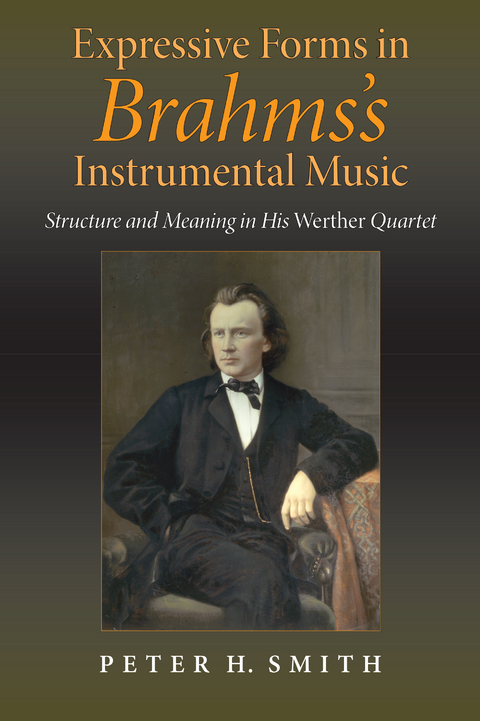
Expressive Forms in Brahms's Instrumental Music (eBook)
336 Seiten
Indiana University Press (Verlag)
978-0-253-02355-1 (ISBN)
"This book is a substantial and timely contribution to Brahms studies. Its strategy is to focus on a single critical work, the C-Minor Piano Quartet, analyzing and interpreting it in great detail, but also using it as a stepping-stone to connect it to other central Brahms works in order to reach a new understanding of the composer's technical language and expressive intent. It is an original and worthy contribution on the music of a major composer." —Patrick McCreless
Expressive Forms in Brahms's Instrumental Music integrates a wide variety of analytical methods into a broader study of theoretical approaches, using a single work by Brahms as a case study. On the basis of his findings, Smith considers how Brahms's approach in this piano quartet informs analyses of similar works by Brahms as well as by Beethoven and Mozart.
Musical Meaning and Interpretation—Robert S. Hatten, editor
Peter H. Smith is Associate Professor of Music Theory at the University of Notre Dame.
Acknowledgments
Introduction
1. Quintessential Brahms and the Paradox of the C-Minor Piano Quartet: A Representative yet Exceptional Work
Part I
2. Analytical Preliminaries: Brahms's Sonata Forms and the Idea of Dimensional Counterpoint
3. A Schoenbergian Perspective: Compositional Economy, Developing Recapitulation, and Large-Scale Form
4. Brahms and Schenker: A Mutual Response to Sonata Form
5. Brahms's Expository Strategies: Two-Part Second Groups, Three-Key Expositions, and Modal Shifts
Part II
6. Toward an Expressive Interpretation: Correlations for Suicidal Despair
7. Intertextual Resonances: Tragic Expression, Dimensional Counterpoint, and the Great C-Minor Tradition
Notes
Bibliography
Index
| Erscheint lt. Verlag | 7.7.2005 |
|---|---|
| Reihe/Serie | Musical Meaning and Interpretation |
| Zusatzinfo | 93 figures, 1 bibliog., 1 index |
| Verlagsort | Bloomington |
| Sprache | englisch |
| Maße | 160 x 160 mm |
| Gewicht | 42 g |
| Themenwelt | Kunst / Musik / Theater ► Musik ► Klassik / Oper / Musical |
| Kunst / Musik / Theater ► Musik ► Musikgeschichte | |
| Kunst / Musik / Theater ► Musik ► Musiktheorie / Musiklehre | |
| Schlagworte | Europe • music • musicology • theory |
| ISBN-10 | 0-253-02355-6 / 0253023556 |
| ISBN-13 | 978-0-253-02355-1 / 9780253023551 |
| Informationen gemäß Produktsicherheitsverordnung (GPSR) | |
| Haben Sie eine Frage zum Produkt? |
 PDF (Adobe DRM)
Kopierschutz: Adobe-DRM
Adobe-DRM ist ein Kopierschutz, der das eBook vor Mißbrauch schützen soll. Dabei wird das eBook bereits beim Download auf Ihre persönliche Adobe-ID autorisiert. Lesen können Sie das eBook dann nur auf den Geräten, welche ebenfalls auf Ihre Adobe-ID registriert sind.
Details zum Adobe-DRM
Dateiformat: PDF (Portable Document Format)
Mit einem festen Seitenlayout eignet sich die PDF besonders für Fachbücher mit Spalten, Tabellen und Abbildungen. Eine PDF kann auf fast allen Geräten angezeigt werden, ist aber für kleine Displays (Smartphone, eReader) nur eingeschränkt geeignet.
Systemvoraussetzungen:
PC/Mac: Mit einem PC oder Mac können Sie dieses eBook lesen. Sie benötigen eine
eReader: Dieses eBook kann mit (fast) allen eBook-Readern gelesen werden. Mit dem amazon-Kindle ist es aber nicht kompatibel.
Smartphone/Tablet: Egal ob Apple oder Android, dieses eBook können Sie lesen. Sie benötigen eine
Geräteliste und zusätzliche Hinweise
Buying eBooks from abroad
For tax law reasons we can sell eBooks just within Germany and Switzerland. Regrettably we cannot fulfill eBook-orders from other countries.
aus dem Bereich