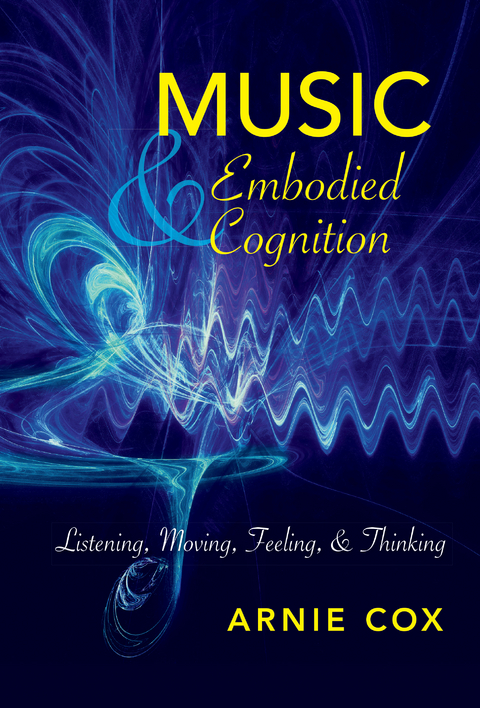
Music and Embodied Cognition (eBook)
296 Seiten
Indiana University Press (Verlag)
978-0-253-02167-0 (ISBN)
Taking a cognitive approach to musical meaning, Arnie Cox explores embodied experiences of hearing music as those that move us both consciously and unconsciously. In this pioneering study that draws on neuroscience and music theory, phenomenology and cognitive science, Cox advances his theory of the "mimetic hypothesis," the notion that a large part of our experience and understanding of music involves an embodied imitation in the listener of bodily motions and exertions that are involved in producing music. Through an often unconscious imitation of action and sound, we feel the music as it moves and grows. With applications to tonal and post-tonal Western classical music, to Western vernacular music, and to non-Western music, Cox's work stands to expand the range of phenomena that can be explained by the role of sensory, motor, and affective aspects of human experience and cognition.
Arnie Cox is Associate Professor of Music Theory and Aural Skills at the Oberlin College Conservatory of Music. His writings and teaching focus on the relationship between embodiment, affect, metaphor, and musical experience. He has published essays on music and gesture, the role of embodiment in music analysis, and the nature of musical subjectivities. He has been an invited speaker at numerous universities and other venues.
Acknowledgments
Part One: Theoretical Background
Introduction
1. Mimetic Comprehension
2. Mimetic Comprehension of Music
3. Metaphor and Related Means of Reasoning
Part Two: Spatial Conceptions
4. Pitch Height
5. Temporal Motion and Musical Motion
6. Perspectives on Musical Motion
Part Three: Beyond Musical Space
7. Music and the External Senses
8. Musical Affect
9. Applications
10. Review and Implications
Appendix I. Mimetic Subvocalization and Absolute Pitch
Appendix II. Levels of Abstraction Among Metaphors
Bibliography
Index
| Erscheint lt. Verlag | 6.9.2016 |
|---|---|
| Reihe/Serie | Musical Meaning and Interpretation |
| Zusatzinfo | 14 b&w illus., 10 music exx., 7 tables |
| Verlagsort | Bloomington |
| Sprache | englisch |
| Maße | 160 x 160 mm |
| Gewicht | 37 g |
| Themenwelt | Kunst / Musik / Theater ► Musik ► Musiktheorie / Musiklehre |
| Schlagworte | cognitive science • music • musicology • music theory • theory |
| ISBN-10 | 0-253-02167-7 / 0253021677 |
| ISBN-13 | 978-0-253-02167-0 / 9780253021670 |
| Informationen gemäß Produktsicherheitsverordnung (GPSR) | |
| Haben Sie eine Frage zum Produkt? |
 EPUB (Adobe DRM)
Kopierschutz: Adobe-DRM
Adobe-DRM ist ein Kopierschutz, der das eBook vor Mißbrauch schützen soll. Dabei wird das eBook bereits beim Download auf Ihre persönliche Adobe-ID autorisiert. Lesen können Sie das eBook dann nur auf den Geräten, welche ebenfalls auf Ihre Adobe-ID registriert sind.
Details zum Adobe-DRM
Dateiformat: EPUB (Electronic Publication)
EPUB ist ein offener Standard für eBooks und eignet sich besonders zur Darstellung von Belletristik und Sachbüchern. Der Fließtext wird dynamisch an die Display- und Schriftgröße angepasst. Auch für mobile Lesegeräte ist EPUB daher gut geeignet.
Systemvoraussetzungen:
PC/Mac: Mit einem PC oder Mac können Sie dieses eBook lesen. Sie benötigen eine
eReader: Dieses eBook kann mit (fast) allen eBook-Readern gelesen werden. Mit dem amazon-Kindle ist es aber nicht kompatibel.
Smartphone/Tablet: Egal ob Apple oder Android, dieses eBook können Sie lesen. Sie benötigen eine
Geräteliste und zusätzliche Hinweise
Buying eBooks from abroad
For tax law reasons we can sell eBooks just within Germany and Switzerland. Regrettably we cannot fulfill eBook-orders from other countries.
aus dem Bereich