


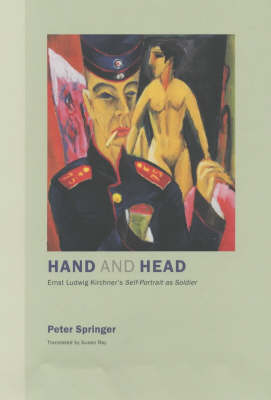
Hand and Head
Ernst Ludwig Kirchner's Self-Portrait as Soldier
Seiten
2002
University of California Press (Verlag)
978-0-520-21626-6 (ISBN)
University of California Press (Verlag)
978-0-520-21626-6 (ISBN)
- Titel ist leider vergriffen;
keine Neuauflage - Artikel merken
Expressionist painter Ernst Ludwig Kirchner's "Self-Portrait as Soldier" (1915) is one of the best-known self-portraits of the modern classical period. This book considers Kirchner in relation to Albrecht Durer and to arguments on the relative dominance of hand and mind in the pictorial arts that invoke the image of "Raphael without hands".
Expressionist painter Ernst Ludwig Kirchner's "Self-Portrait as Soldier" (1915) is one of the best-known self-portraits of the modern classical period. With its sharp foreground focus on the uniformed artist's bloody amputated hand, the painting has long been interpreted as a vehement protest against war, specifically World War I and Kirchner's participation in it. Peter Springer's innovative study presents a convincing alternative reading of Kirchner's epochal work. Springer sees in it, not a harsh condemnation of militarism, but a marked ambivalence in the artist's attitude toward war. This new reading of the painting grows out of Springer's assessment of its imagery in relation to patronage, gender relations, and national identity - and particularly to propaganda and satire. Using Kirchner's letters and other documentation, much of it only recently available, Springer reconstructs the years of Kirchner's military service. He juxtaposes a range of visual contexts that include traditions of self-portraiture, depictions of prosthetic devices, and propaganda accounts of German soldiers hacking off the hands of Belgian and French children.
He then considers Kirchner in relation to Albrecht Durer and to theoretical arguments on the relative dominance of hand and mind in the pictorial arts that invoke the image of "Raphael without hands." Nearly 100 illustrations superbly complement the text.
Expressionist painter Ernst Ludwig Kirchner's "Self-Portrait as Soldier" (1915) is one of the best-known self-portraits of the modern classical period. With its sharp foreground focus on the uniformed artist's bloody amputated hand, the painting has long been interpreted as a vehement protest against war, specifically World War I and Kirchner's participation in it. Peter Springer's innovative study presents a convincing alternative reading of Kirchner's epochal work. Springer sees in it, not a harsh condemnation of militarism, but a marked ambivalence in the artist's attitude toward war. This new reading of the painting grows out of Springer's assessment of its imagery in relation to patronage, gender relations, and national identity - and particularly to propaganda and satire. Using Kirchner's letters and other documentation, much of it only recently available, Springer reconstructs the years of Kirchner's military service. He juxtaposes a range of visual contexts that include traditions of self-portraiture, depictions of prosthetic devices, and propaganda accounts of German soldiers hacking off the hands of Belgian and French children.
He then considers Kirchner in relation to Albrecht Durer and to theoretical arguments on the relative dominance of hand and mind in the pictorial arts that invoke the image of "Raphael without hands." Nearly 100 illustrations superbly complement the text.
Peter Springer is Professor of Art History at Carl von Ossietzky University, Oldenburg, Germany. Susan Ray is Associate Professor of German at Fordham University.
Preface A Look at One's Self Self-Portrait as Soldier: Description and History Critical Interpretations of the Painting The Context: Kirchner's Time as a Soldier Other Works, 1915 1917 War Enthusiasm versus a Desire to Dodge "The Artist as Exemplary Sufferer" The Motif of the Mutilated Hand Beyond Surgery The Propaganda Iconography of the Severed Hand The Artist's Missing Hand Kirchner as a Follower of Durer Raphael without Hands Epilogue Notes Selected Bibliography Illustration Credits Index
| Erscheint lt. Verlag | 1.5.2002 |
|---|---|
| Reihe/Serie | The Discovery Series ; 10 |
| Übersetzer | Susan Ray |
| Zusatzinfo | 8 color plates, 90 b-w illustrations |
| Verlagsort | Berkerley |
| Sprache | englisch |
| Maße | 178 x 254 mm |
| Gewicht | 771 g |
| Themenwelt | Kunst / Musik / Theater ► Kunstgeschichte / Kunststile |
| Kunst / Musik / Theater ► Malerei / Plastik | |
| ISBN-10 | 0-520-21626-1 / 0520216261 |
| ISBN-13 | 978-0-520-21626-6 / 9780520216266 |
| Zustand | Neuware |
| Informationen gemäß Produktsicherheitsverordnung (GPSR) | |
| Haben Sie eine Frage zum Produkt? |
Mehr entdecken
aus dem Bereich

aus dem Bereich
kleine Kulturgeschichte einer brillanten Allianz
Buch | Softcover (2025)
Iudicium (Verlag)
CHF 33,90


