


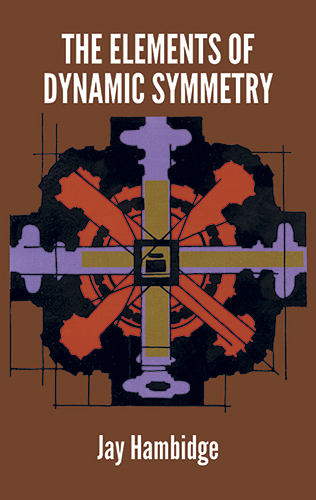
The Elements of Dynamic Symmetry (eBook)
176 Seiten
Dover Publications (Verlag)
978-0-486-14025-4 (ISBN)

Is design intuitive or is it consciously and methodically worked out? Are there basic rules governing design that, when learned, will facilitate the creative process? These questions have been asked by artists, art historians, and art critics throughout the ages. Convinced that design was not purely instinctive, Jay Hambidge (1867 1924) spent much of his life searching for the technical bases of design. He found his answer in dynamic symmetry, one of the most provocative and stimulating theories in art history. Hambidge's study of Greek art convinced him that the secret of the beauty of Greek design was in the conscious use of dynamic symmetry the law of natural design based upon the symmetry of growth in man and in plants. But Hambidge, who was not only a theoretician but also a practicing artist, did much more than analyze classical art and its principles of design: he worked out a series of root rectangles that the artist, using the simple mathematics supplied in this book, can easily follow and apply in his own work. Originally published as a series of lessons in Hambidge's magazine, The Diagonal, this engrossing book explains all the basic principles of dynamic symmetry. Part I sets forth the fundamental rectangles with their simple divisions based on the proportioning law found in nature; Part II explains compound rectangles, many of which were taken from or suggested by analysis of objects of Greek art. Whether read for its historical importance in art theory, for its illuminating insights into Greek art, or for its practical value to today's artists and commercial designers, The Elements of Dynamic Symmetry has much to offer anyone who is interested in the principle of design.
INTRODUCTION Synthesis and analysis The difference between static and dynamic symmetry Sources for the study of dynamic symmetryTHE DYNAMIC SYMMETRY OF THE PLANT The summation series How dynamic symmetry was discovered The logarithmic spiral The law of phyllotaxis Explanation of its application to designPART I. SIMPLE RECTANGLES LESSON 1. THE SQUARE (OR UNITY) Methods for manipulating the plan forms of nature The square and its diagonal The square and the diagonal to its half The root rectangles constructed outside a square The linear proportions of the root rectangles The root rectangle constructed within a square LESSON 2. THE RECTANGLE OF THE WHIRLING SQUARES (1.618) AND THE ROOT-FIVE RECTANGLE (2.236) Construction of a whirling square rectangle Method for constructing a root-five from a whirling square rectangle "Cutting a line in what Plato called "the section" LESSON 3. THE APPLICATION OF AREAS Simple method of the Greeks for the division of areas Process for the application of the square on an end to a side of a rectangle LESSON 4. THE RECIPROCAL Definition of a reciprocal Importance to design of a reciprocal shape "Explanation of the name "whirling squares" Arithmetical statement of the reciprocal considered Relationship between whirling square reciprocals and the root-five rectangle LESSON 5. THE DIAGONAL The diagonal of a rectangle The 47th proposition of the first book of Euclid The diagonal of a reciprocal Various methods for establishing reciprocals The rectangular spiral Intersection of a diagonal of the whole with a diagonal of the reciprocal Division of the root rectangles into their reciprocals LESSON 6. THE ROOT-TWO RECTANGLE (1.4142) Why a root-two rectangle is so called Rectangular spirals in a root-two rectangle A root-two rectangle plus a square A root-two rectangle described within a square Root-two rectangles described on the four sides of a square The reciprocal of a root-two rectangle plus a square A square plus two root-two reciprocals Division of a root-two rectangle into its reciprocals Division of any rectangle into thirds LESSON 7. THE ROOT-TWO RECTANGLE AND THE APPLICATION OF AREAS "A square "applied" on the end of a root-two rectangle " Application of areas to other areas A square applied to each end of a root-two rectangle Division of a root-two rectangle when the diagonal of the whole cuts the side of an applied square Application of a square on an end to a side of a root-two rectangle Similarity of figure A root-two rectangle applied to the square of a 2.4142 shape A square applied to a root-two reciprocal LESSON 8. THE ROOT-THREE RECTANGLE (1.732) Construction of a root-three rectangle Application of a square on the end of a root-three rectangle A square on an end applied to a side or a root-three rectangle Division of the root-three rectangle into its reciprocals Different ways of dividing the root-three rectangle into similar shapes LESSON 9. THE ROOT-FOUR RECTANGLE (2.) Construction of a root-four rectangle Division into its reciprocals Dynamic and static treatment of a root-four rectangle A whirling square rectangle applied to a root-four rectangle A square on an end applied to a side or a root-four rectangle LESSON 10. THE ROOT-FIVE RECTANGLE (2.236) Construction of a root-five rectangle Four whirling square rectangles described on the four sides of a square A square applied on the end of a root-five rectangle A square on an end applied to a side of a root-five rectangle Division of the root-five rectangle into its reciprocal LESSON 11. THE SPIRAL AND OTHER CURVES OF DYNAMIC SYMMETRY The logarithmic or constant angle spiral The first geometrical discovery made by the Greeks "Another great discovery, that of a mean proportional" Definition of a mean proportional Lines in continued proportion Logarithmic spiral drawn within a rectangle Construction of volutes of different kinds LESSON 12. GENERAL CONSTRUCTIONS FOR SIMILARITY OF FIGURE Enlargement and reduction of shapes by a diagonal Construction of similar shapes which can be moved up or down on a medial line Similar shapes constructed from any point in a rectangle Properties of modulation and measurableness in dynamic areas Properties of shapes similar to dynamic subdivisions of areas Construction of shapes similar to dynamic subdivisions of areas. Eternal principle of growth in dynamic shapesPART II. COMPOUND RECTANGLES LESSON I. THE COMPLEMENT Form and color complements compared Definition of a complement Relationship between areas and their complements Division of areas in terms of their complements A reciprocal in a complement of a root-five rectangle Intention the dominant factor in artistic expression Importance to the artist of the use of diagonal lines To transfer a complement How to construct different rectangles in single and multiple form within areas LESSON II. RHYTHMIC THEMES OF THE WHIRLING SQUARE RECTANGLE Root-five rectangles within the rectangle of the whirling squares Arithmetical analysis Other subdivisions of the whirling square rectangle Summing up of other ratios appearing in this lesson LESSON III. THE SQUARE PLUS A ROOT-FIVE RECTANGLE (1.4472) AND A WHIRLING SQUARE RECTANGLE APPLIED TO A SQUARE "The 1.4472 rectangle, the key ratio of the Parthenon plan" Its natural source in the regular pentagon How to draw a square plus a root-five rectangle Connection between the ratio 1.4472 and 1.382 How a whirling square rectangle is applied to a square Diagonals of the whole and diagonals of the reciprocals drawn to a whirling square rectangle within a square LESSON IV. COMPOUND RECTANGLES WITHIN A SQUARE Area in excess of a root-five rectangle placed within a square Natural source of an .809 rectangle A .191 rectangle A 1.191 rectangle LESSON V. FURTHER ANALYSIS OF THE SQUARE Analysis of excess areas resulting from application of a whirling square rectangle to a square LESSON VI. THE ADDITION OF UNITY TO DYNAMIC AREAS & "List, with corresponding diagrams, of the most important ratios of dynamic symmetry, with their reciprocals, 1/2 ratios and 1/2 reciprocals" LESSON IX. RATIOS MOST FREQUENTLY USED?Continued Analysis of a 2.309 shape with list of its subdivisions "List of subdivisions of the 2.4472, 2.472, 2.618 and 2.764 shapes" Odd compound rectangles within a squareWHAT INSTRUMENTS TO USE AND HOW TO USE THEMDEFINITIONS SELECTED FROM THE THIRTEEN BOOKS OF EUCLID'S ELEMENTSGLOSSARY
| Erscheint lt. Verlag | 4.5.2012 |
|---|---|
| Reihe/Serie | Dover Art Instruction |
| Sprache | englisch |
| Maße | 140 x 140 mm |
| Gewicht | 254 g |
| Themenwelt | Kunst / Musik / Theater ► Allgemeines / Lexika |
| Kunst / Musik / Theater ► Kunstgeschichte / Kunststile | |
| ISBN-10 | 0-486-14025-3 / 0486140253 |
| ISBN-13 | 978-0-486-14025-4 / 9780486140254 |
| Informationen gemäß Produktsicherheitsverordnung (GPSR) | |
| Haben Sie eine Frage zum Produkt? |
 EPUB (Adobe DRM)
Kopierschutz: Adobe-DRM
Adobe-DRM ist ein Kopierschutz, der das eBook vor Mißbrauch schützen soll. Dabei wird das eBook bereits beim Download auf Ihre persönliche Adobe-ID autorisiert. Lesen können Sie das eBook dann nur auf den Geräten, welche ebenfalls auf Ihre Adobe-ID registriert sind.
Details zum Adobe-DRM
Dateiformat: EPUB (Electronic Publication)
EPUB ist ein offener Standard für eBooks und eignet sich besonders zur Darstellung von Belletristik und Sachbüchern. Der Fließtext wird dynamisch an die Display- und Schriftgröße angepasst. Auch für mobile Lesegeräte ist EPUB daher gut geeignet.
Systemvoraussetzungen:
PC/Mac: Mit einem PC oder Mac können Sie dieses eBook lesen. Sie benötigen eine
eReader: Dieses eBook kann mit (fast) allen eBook-Readern gelesen werden. Mit dem amazon-Kindle ist es aber nicht kompatibel.
Smartphone/Tablet: Egal ob Apple oder Android, dieses eBook können Sie lesen. Sie benötigen eine
Geräteliste und zusätzliche Hinweise
Buying eBooks from abroad
For tax law reasons we can sell eBooks just within Germany and Switzerland. Regrettably we cannot fulfill eBook-orders from other countries.
aus dem Bereich


