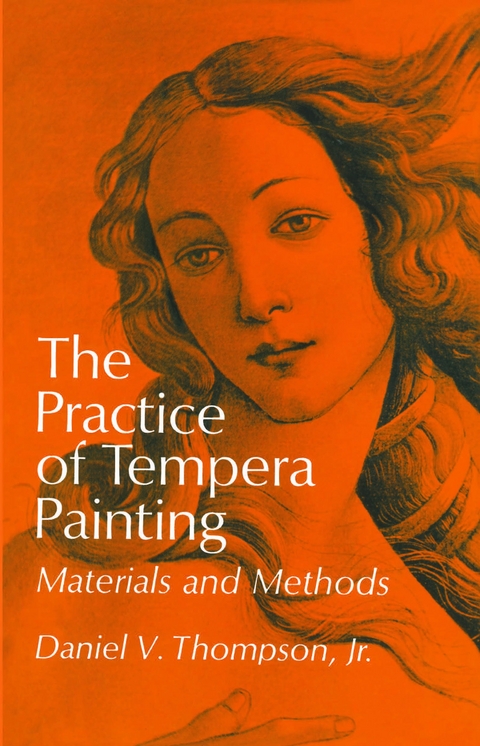
The Practice of Tempera Painting (eBook)
176 Seiten
Dover Publications (Verlag)
978-0-486-14164-0 (ISBN)
Tempera painting, the method in which colors are mixed with some binding material other than oil (primarily egg yolk), is the earliest type of painting known to man. The wall paintings of ancient Egypt and Babylon are tempera, as are many of the paintings of Giotto, Lippi, Botticelli, Raphael, Titian, Tintoretto, and many other masters. But in spite of the time-proven excellence of this technique - which boasts many clear advantages over oil paint - it does not receive the degree of attention from modern painters that it deserves. Part of the explanation for this neglect, surely, is the absence of sufficient information about the materials and procedures involved in tempera painting. The present volume, in fact, is virtually the only complete, authoritative, step-by-step treatment of the subject in the English language, D.V. Thompson wrote this book after an exhaustive study, over many years, of countless medieval and Renaissance manuscripts in the British Museum and elsewhere, and is unquestionably the world's leading authority on tempera materials and processes. Beginning with an introductory chapter on the uses and limitations of tempera, the author covers such topics as the choice of material for the panel; propensities of various woods; preparing the panel for gilding; making the gesso mixture; methods of applying the gesso; planning the design of a tempera painting; use of tinted papers; application of metals to the panel; tools for gliding; handling and laying gold; combination gold and silver leafing; pigments and brushes; choice of palette; mixing the tempera; tempering and handling the colors; techniques of the actual painting; mordant gilding; permanence of tempera painting; varnishing; and artificial emulsion painting. The drawings and diagrams, illustrating the various materials and techniques, infinitely increase the clarity of the discussions. As a careful exposition of all aspects of authentic tempera painting, including many of the possible modern uses for this ancient method, this book actually stands alone. No one who is interested in tempera painting as a serious pursuit can afford to be without it.
PrefaceI Uses and Limitations of the Tempera Tempera painting a strict discipline Tendencies in modern painting The media of the future The limitations of tempera painting Normal scale Factors in naturalistic painting A critical approachII Carriers and Grounds Properties of wood Effects of humidity Selection and conditioning of woods Casein glue for joining Precautions against warping Plywoods Wood pulp boards Paper Metals Canvas Walls Preparation of panels Materials The standard size solution Sizing the panel Applying moldings and ornaments The second sizing The intelaggio Puttying The simplest gesso The secret of success Application of the gesso An alternative method Scraping the gesso How to test the scraping Stoning down a flat Qualities of good gesso Pastiglia Gessoing frames Cennino's gesso Parchment size Gesso grosso Gesso sottile Mixing the thin gesso The perfection of the methodIII Methods of Drawing Designing for tempera Preliminary studies Form drawing Tinted papers Drawing instruments Brush drawing Modeling up the lights Transferring the cartoon Drawing on the panel Importance of the monochrome rendering Incising the outlinesIV Applications of Metals Metals in the design Bole for gilding Mixing and applying the bole How much to put on Polishing the bole Gliding with glair Tools for gilding The gilder's cushion The knife The gilder's tip Substitutes Qualities of gold leaf Handling the leaf The use of the knife and cushion Cutting the leaf The use of the tip Laying the gold The order of gilding Faulting Burnishing Varieties of burnisher Stamping and graining Punch cutting Graining pastiglia Patterns in color and gold "Combination Gold and Silver Leafing"V Pigments and Brushes Function of pigments Natural and artificial colors The colored earths Individual pigment characters Experimentation Palettes for tempera Whites Blacks Yellows Reds Browns Blues Greens Transparent pigments Shell gold The choice of a palette Grinding the colors Storing the ground colors for use Dishes for mixing The choice of brushes Sables Bristles Care of brushesVI Painting Mixing the tempera Preservatives Tempering the colors Reserves of color Liquidity of the mixture Handling the color Basic principles of tempera painting Control of form The function of the monochrome drawing The order of painting A hypothetical case Mixing values Applying the tones Glazing over the scumble Tempera vs. gouache and water color Painting drapery and other objects Development of the forms Systematic value mixing essential Variations of color systems Treatment of surface effects Painting flesh Painting hair Variations of method Final embellishments Water mordants Oil mordants Applying the mordant GildingVII Varnishing and Framing Permanence of tempera painting Importance of varnishing Cleaning the surface Precautions against dust and damp Choice and care of the varnish brush Applying the varnish Flatting the surface Function of a frame Matte gilding Water matte Oil matte Skewing down Frame edges Antiquing Other frame materialsVIII Artificial Emulsion Painting Unlimited possibilities A basic formula Casein emulsions Underpainting for oil Preparation of wall surfacesAppendix "Tempera Practice in the Yale Art School," by Professor Lewis E. York"
| Erscheint lt. Verlag | 22.6.2012 |
|---|---|
| Reihe/Serie | Dover Art Instruction | Dover Art Instruction |
| Sprache | englisch |
| Maße | 140 x 140 mm |
| Gewicht | 194 g |
| Themenwelt | Kunst / Musik / Theater ► Allgemeines / Lexika |
| Kunst / Musik / Theater ► Kunstgeschichte / Kunststile | |
| ISBN-10 | 0-486-14164-0 / 0486141640 |
| ISBN-13 | 978-0-486-14164-0 / 9780486141640 |
| Informationen gemäß Produktsicherheitsverordnung (GPSR) | |
| Haben Sie eine Frage zum Produkt? |
 EPUB (Adobe DRM)
Kopierschutz: Adobe-DRM
Adobe-DRM ist ein Kopierschutz, der das eBook vor Mißbrauch schützen soll. Dabei wird das eBook bereits beim Download auf Ihre persönliche Adobe-ID autorisiert. Lesen können Sie das eBook dann nur auf den Geräten, welche ebenfalls auf Ihre Adobe-ID registriert sind.
Details zum Adobe-DRM
Dateiformat: EPUB (Electronic Publication)
EPUB ist ein offener Standard für eBooks und eignet sich besonders zur Darstellung von Belletristik und Sachbüchern. Der Fließtext wird dynamisch an die Display- und Schriftgröße angepasst. Auch für mobile Lesegeräte ist EPUB daher gut geeignet.
Systemvoraussetzungen:
PC/Mac: Mit einem PC oder Mac können Sie dieses eBook lesen. Sie benötigen eine
eReader: Dieses eBook kann mit (fast) allen eBook-Readern gelesen werden. Mit dem amazon-Kindle ist es aber nicht kompatibel.
Smartphone/Tablet: Egal ob Apple oder Android, dieses eBook können Sie lesen. Sie benötigen eine
Geräteliste und zusätzliche Hinweise
Buying eBooks from abroad
For tax law reasons we can sell eBooks just within Germany and Switzerland. Regrettably we cannot fulfill eBook-orders from other countries.
aus dem Bereich