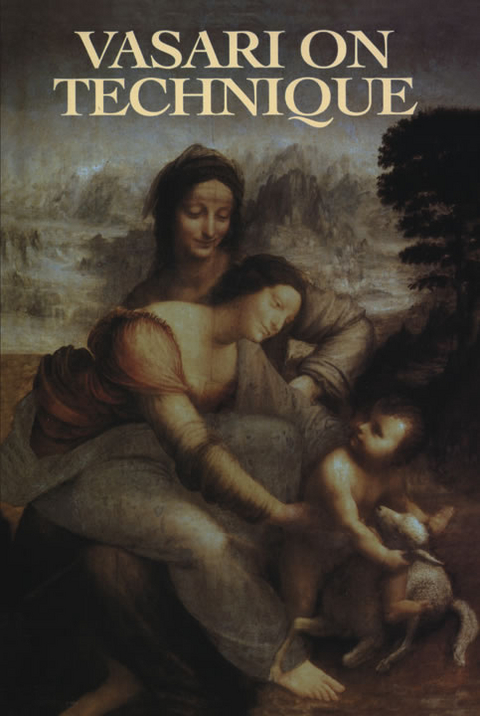
Vasari on Technique (eBook)
400 Seiten
Dover Publications (Verlag)
978-0-486-14916-5 (ISBN)
Giorgio Vasari (1511–1571) is well known for his celebrated work on the lives of the Renaissance artists. But not many people know that Vasari was a painter and architect as well as a biographer, and that he wrote one of the most valuable treatises on the technical methods of the painters, architects, and sculptors of his time. This is the first and only English translation of this important technical material (originally published in 1550 as an introduction to Vasari's Lives of the Artists).Vasari, as a practical craftsman, brings to his work as unusual understanding of the processes and materials he writes about, and conveys this knowledge to the reader in a style of the pleasantest and most readable kind. In the section on architecture, he describes the methods used in constructing rustic fountains and grottos; how Michelangelo developed new uses for architectural materials; the architectural uses of enriched plaster; the Renaissance view of Ionic, Doric, Gothic, and other types of architecture; and many similar topics.In the selection on sculpture, the reader will learn about the making of the model, completion of the statue, reliefs, bronze casting, modelled plaster work, sculpture in wood, and other processes. The final section, on painting, discusses aesthetics, perspective, foreshortening, how colors were blended, fresco painting, painting in tempera, oil painting, and much more.Scholars and historians of art have long used this book as the most detailed and valuable sourcebook of its time. But its full, readable discussions, combined with the sense of actuality and historical presence it contains, make it also perhaps the best possible description of the Renaissance artists in the heyday of their achievement.
PREFATORY NOTE TABLE OF CONTENTS LIST OF ILLUSTRATIONS INTRODUCTORY ESSAY OF ARCHITECTURE CHAPTER I. 1. The Author's object in the Discussion of Architecture 2. "Of the working of hard stones, and first of Porphyry" 3. Of Serpentine 4. Of Cipollaccio 5. "Of Breccia ('Mischio,' Conglomerate)" 6. Of Granite 7. Of Paragon (Touchstone) 8. Of Transparent Marbles for filling window openings 9. Of Statuary Marbles 10. Of Cipollino Marble 11. Of White Pisan Marble 12. Of Travertine 13. Of Slates 14. Of Peperino 15. Of the Stone from Istria 16. Of Pietra Serena 17. Of Pietra Forte 18. Conclusion of Chapter CHAPTER II. The Description of squared Ashlar-work (lavoro di quadro) and of carved Ashlar-work (lavoro di quadro intagliato) 19. The work of the Mason CHAPTER III. "Concerning the five Orders of Architecture, Rustic, Doric, Ionic, Corinthian, Composite, and also German Work" 20. Rusticated masonry and the Tuscan Order 21. The Doric Order 22. A constructive device to avoid charging architraves 23. The proportions and parts of the Doric Order 24. The Ionic Order 25. The Corinthian Order 26. The Composite Order 27. Of Terminal figures 28. German Work (the Gothic Style) CHAPTER IV. "On forming Vaults in Concrete, to be impressed with Enrichment: when the Centerings are to be removed, and how to mix the Plaster" 29. The Construction of enriched Stucco Vaults 30. Stucco made with Marble Dust CHAPTER V. "How Rustic Fountains are made with Stalactites and Incrustations from water, and how Cockle Shells and Conglomerations of vitrified stone are built into the Stucco" 31. Grottoes and Fountains of 'Rocaille' work CHAPTER VI. On the manner of making Pavements of Tesselated Work 32. Mosaic pavements 33. "Pictorial Mosaics for Walls, etc." CHAPTER VII. "How one is to recognize if a Building have good Proportions, and of what Members it should generally be composed" 34. The Principles of Planning and Design 35. An Ideal Palace NOTES ON 'INTRODUCTION' TO ARCHITECTURE PORPHYRY AND PROPHYRY QUARRIES "THE SASSI, DELLA VALLE, AND OTHER COLLECTIONS OF ANTIQUES OF THE EARLY PART OF THE SIXTEENTH CENTURY" THE 'PORPHYRY TAZZA OF THE SALA ROTONDA OF THE VATICAN "FRANCESCO DEL TADDA, AND THE REVIVAL OF SCULPTURE IN PORPHYRY" "THE CORTILE OF THE BELVEDERE IN THE VATICAN, IN THE SIXTEENTH CENTURY" PARAGON (TOUCHSTONE) AND OTHER STONES ASSOCIATED WITH IT BY VASARI TUSCAN MARBLE QUARRIES "THE ROUND TEMPLE ON THE PIAZZA S. LUIGI DEI FRANCESI, AND 'MAESTRO GIAN'" RUSTICATED MASONRY VASARI'S OPINION ON MEDIAEVAL ARCHITECTURE EGG-SHELL MOSAIC IDEAL ARCHITECTURE; AN IDEAL PALACE OF SCULPTURE CHAPTER I. (VIII.) "What Sculpture is; how good works of Sculpture are made, and what qualities they must possess to be esteemed perfect" 36. The Nature of Sculpture 37. Qualities necessary for Work in the Round 38. Works of Sculpture should be treated with a view to their destined position 39. The Proportions of the Human Figure 40. Artists must depend on their Judgement rather than on the Measuring Rule CHAPTER II. (IX.) ############################################################################################################################################################################################################################################################### 41. The small Sketch-Model in Wax of Clay 42. The Preparation of Wax 43. Polychrome Wax Effigies 44. The Manipulation of Wax over an Armature 45. The Small Model in Clay 46. The Full-sized Model in Clay 47. Drapery on the Clay Model 48. Transference of the Full-sized Model to the Marble Black 49. Danger of dispensing with the Full-sized Model 50. The Tools and Materials used in Marble Carving CHAPTER III. (X.) "Of Low and Half Reliefs, the difficulty of making them an how to bring them to perfection" 51. The Origin of Reliefs 52. Pictorial or Perspective Reliefs 53. Low Reliefs (Bassi Rilievi) 54. Flat Reliefs (Stiacciati Rilievi) CHAPTER IV. (XI.) ############################################################################################################################################################################################################################################################### 55. The Full-sized Model for Bronze 56. The Piece-Mould in Plaster 57. The Construction of the Core 58. The Piece-Mould lined with a Skin of Wax 59. This Skin of Wax applied over the Core 60. The fire-resisting Envelope applied over the Wax 61. The External Armature 62. The Vents 63. The Wax melted out 64. The Mould in the Casting-pit 65. The Composition of the Bronze 66. Making up Imperfections 67. A simpler Method of Casting small Figures and Reliefs 68. Chasing the Cast and Colouring the Bronze 69. Modern Tours de Force in small Castings CHAPTER V. (XII.) Concerning Steel Dies for making Medals of bronze or other metals and how the latter are formed from these metals ############################################################################################################################################################################################################################################################### 80. On Colouring CHAPTER V. (XIX.) 81. The Fresco process CHAPTER VI. (XX.) "Of Painting in Tempera, or with egg, on Panel or Canvas, and how it is employed on the wall which is dry" 82. Painting in Tempera CHAPTER VII. (XXI.) Of Painting in Oil on Panel or Canvas 83. "Oil Painting, its Discovery and Early History" 84. How to Prime the Panel or Canvas 85. "Drawing, by transfer or directly" CHAPTER VIII. (XXII.) Of Painting in Oil on a Wall which is dry 86. Mural Painting in Oil 87. Vasari's own Method CHAPTER IX. (XXIII.) 88. Painting on Canvas CHAPTER X. (XXIV.) "Of painting in Oil on Stone, and what stones are good for the purpose" 89. Oil painting on Stone CHAPTER XI. (XXV.) "Of Painting on the wall in Monochrome with various earths: how objects in bronze are imitated: and of groups for Triumphal Arches or festal structures, done with powdered earths mixed with size, which process is called Gouache and Tempera" 90. Imitative Paintings for Decorations CHAPTER XII. (XXVI.) Of the Sgraffiti for house decoration which withstand water; that which is used in their production; and how Grotesques are worked on the wall 91. Sgraffito-work 92. "Grotesque, or Fanciful Devices, painted or modelled on Walls" CHAPTER XIII. (XXVII.) How Grotesques are worked on the Stucco CHAPTER XIV. (XVIII.) "Of the manner of applying Gold on a Bolus, or with a Mordant, and other methods" 93. Methods of Gilding CHAPTER XV. (XXIX.) Of Glass Mosaic and how it is recognized as good and praise-worthy 94. Glass Mosaics 95. The Preparation of the Mosaic Cubes 96. The Fixing of the Mosaic Cubes CHAPTER XVI. (XXX.) Concerning the Compositions and Figures made in Inlaid Work on Pavements in imitation of objects in Monochrome 97. Pavements in Marble Mosaic and Monochrome 98. Pavements in Variegated Tiles 99. Pavements in Breccia Marble CHAPTER XVII. (XXXI.) "Of Mosaic in Wood, that is, of Tarsia; and of the Compositions that are made in Tinted Woods, fitted together after the manner of a picture" 100. Inlays in Wood CHAPTER XVIII. (XXXII.) On Painting Glass Windows and how they are put together with Leads and supported with Irons so as not to interfere with the view of the figures 101. "Stained Glass Windows, their Origin and History" 102. The Technique of the Stained Glass Window CHAPTER XIX. (XXXIII.) "Of Niello, and how by this process we have Copper Prints; and how Silver is engraved to make Enamels over Bas-relief, and in like manner how Gold and Silver Plate is chased" 103. Niello Work 104. The Origin of Engraving 105. Enamels over Reliefs CHAPTER XX. (XXXIV.) "Of Tausia, that is, work called Damascening" 106. Metal Inlays CHAPTER XXI. (XXXV.) "Of Wood Engraving and the method of executing it and concerning its first Inventor: how Sheets which appear to be drawn by hand and exhibit Lights and Half-tones and Shades, are produced with three Blocks of Wood" 107. Chiaroscuro Wood Engravings 108. Dependence on Design of the Decorative Arts NOTES ON 'INTRODUCTION' TO PAINTING FRESCO PAINTING TEMPERA PAINTING OIL PAINTING ENRICHED FAÇADES STUCCO 'GROTESQUES' "TARSIA WORK, OR WOOD INLAYS" THE STAINED GLASS WINDOW VASARI'S DESCRIPTION OF ENAMEL WORK INDEX
| Erscheint lt. Verlag | 12.7.2012 |
|---|---|
| Reihe/Serie | Dover Art Instruction |
| Sprache | englisch |
| Maße | 140 x 140 mm |
| Themenwelt | Kunst / Musik / Theater ► Allgemeines / Lexika |
| Kunst / Musik / Theater ► Kunstgeschichte / Kunststile | |
| ISBN-10 | 0-486-14916-1 / 0486149161 |
| ISBN-13 | 978-0-486-14916-5 / 9780486149165 |
| Informationen gemäß Produktsicherheitsverordnung (GPSR) | |
| Haben Sie eine Frage zum Produkt? |
 EPUB (Adobe DRM)
Kopierschutz: Adobe-DRM
Adobe-DRM ist ein Kopierschutz, der das eBook vor Mißbrauch schützen soll. Dabei wird das eBook bereits beim Download auf Ihre persönliche Adobe-ID autorisiert. Lesen können Sie das eBook dann nur auf den Geräten, welche ebenfalls auf Ihre Adobe-ID registriert sind.
Details zum Adobe-DRM
Dateiformat: EPUB (Electronic Publication)
EPUB ist ein offener Standard für eBooks und eignet sich besonders zur Darstellung von Belletristik und Sachbüchern. Der Fließtext wird dynamisch an die Display- und Schriftgröße angepasst. Auch für mobile Lesegeräte ist EPUB daher gut geeignet.
Systemvoraussetzungen:
PC/Mac: Mit einem PC oder Mac können Sie dieses eBook lesen. Sie benötigen eine
eReader: Dieses eBook kann mit (fast) allen eBook-Readern gelesen werden. Mit dem amazon-Kindle ist es aber nicht kompatibel.
Smartphone/Tablet: Egal ob Apple oder Android, dieses eBook können Sie lesen. Sie benötigen eine
Geräteliste und zusätzliche Hinweise
Buying eBooks from abroad
For tax law reasons we can sell eBooks just within Germany and Switzerland. Regrettably we cannot fulfill eBook-orders from other countries.
aus dem Bereich