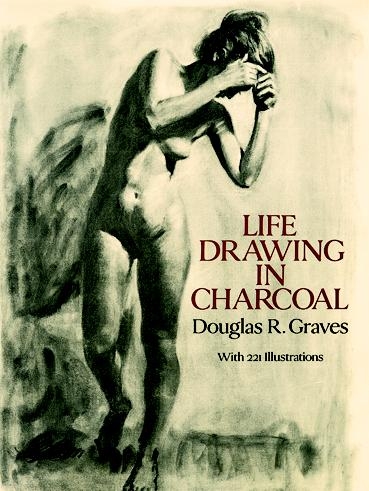
Life Drawing in Charcoal (eBook)
176 Seiten
Dover Publications (Verlag)
978-0-486-13406-2 (ISBN)
"e;The guidance to be found within these covers reflects the author's inspired ability as a teacher and artist of the highest magnitude. It is probably the finest book on the subject of drawing the human form that I have ever seen."e; - Irving Shapiro, A.W.S., Director, American Academy of ArtThis unique guide offers a bold, innovative approach to drawing from life. Instead of teaching the traditional method of building up a drawing from lines, leaving mass and tone till later, noted art instructor Douglas R. Graves takes precisely the opposite tack. The student is encouraged to begin seeing and thinking in terms of tonal masses immediately. This approach enables students to draw quickly and accurately without the need for a line drawing first. The author compares it to learning to "e;paint"e; with charcoal. Step-by-step demonstrations and over 200 of the author's own drawings offer inspiration and practical guidance in the technique. You'll learn how to "e;see"e; tonal quality, how to key a drawing, how to translate color into black and white, and valuable techniques for keeping the figure from looking "e;stiff."e; Other topics include the role of alignment in achieving proper proportions, foreshortening, male and female figure distinctions, the use of modeling to achieve added dimension, drawing the face, positioning the figure, and many other aspects of life drawing. For students of drawing beginner to expert this book is an invaluable guide not just to drawing from life but to the essential principles of observation, composition, and draftsmanship that underlie all successful drawing and painting. It belongs in the library of every artist. For this edition, the author has revised previous chapters and added a new one on "e;Different Modes of Charcoal."e;
AcknowledgmentsIntroductionPROJECT 1. Materials and Exercises Charcoal Erasers Blenders Paper Fixative ExercisesPROJECT 2. Seeing Tonal Quality Single Light Effect Tones and Their Relationships Learning to See the Tonal WorldPROJECT 3. The Difference Between Lines and Edges A New Way to Observe Defining Terms Using the Middle TonePROJECT 4. Objects As They Are Lifting Out Lights Thinking About What You See The Mind's Influence on the EyePROJECT 5. The Traditional Use of Plaster Cast Figures Charcoal as a Study Medium Squinting to Compare TonesPROJECT 6. Keying A Drawing The Value Scale Value Keys Interpreting Tones and Their ValuesPROJECT 7. Translating Color to Black and White Judging Color Intensity and Tone Light and Shadow with ColorPROJECT 8. Some Basic Figure Proportions Two Goals of Life Study Establishing Proportions Staying Loose and Free"PROJECT 9. Keeping The Figure From Looking "Stiff" Examining Parts of the Body "Movements of the Spine, Shoulders, and Hips" The Expression of ActionPROJECT 10. Seeing Large Tonal Masses Mass Versus Detail Simple Statements in Tone Staying Within the Large TonePROJECT 11. Allignments: Constructive Aids to Correct Proportions Checking Relationships by Alignment Aligning by Triangulation Using Lines for Construction Estimating Contour AnglesPROJECT 12. The Recling Figure Using a Measuring Device Proportioning ProblemsPROJECT 13. Foreshortening Foreshortening as Body Perspective "Drawing What You "See"PROJECT 14. Idealization or Interpretation Copying the Figure Two Creative DirectionsPROJECT 15. Why Study Anatomy? The Burden of Anatomical Study "Seeing" First - Anatomy Second"PROJECT 16. Male and Female Figure Distinctions Comparison of Anatomical Differences Some Standard Proportions "Fat Deposits, Subcuaneous Prominences, and Hair"PROJECT 17. Negative Shapes Seeing Negative Shapes Using the Grid Tone MosaicsPROJECT 18. Two Sources of Light Values and Secondary Lights Reflected Light and Double Contrast Geometric PosesPROJECT 19. A Tour of the Life Class Working over the Whole Figure Seeing Larger Tone Masses Preconceptions and Figure Distortions Preoccupation with Detail Self-Concepts and Figure RelationshipsPROJECT 20. Controlling Edges Textural Qualities of Edges Making Hard and Soft Edges"PROJECT 21. Scupturing, Modeling, and Rhythm" Modeling for Added Dimension Rhythm and Composition Constant and Progressive RhythmsPROJECT 22. Movement and Muscles Controlled Falling The Moving Figure Arm and Leg Movements"PROJECT 23. Drawing the Face, Head, and Hands" Placement of Facial DetailsPROJECT 24. Different Modes of Charcoal RenderingPROJECT 25. Composing a Figure On a PagePROJECT 26. Mass Drawing in Fast Action Poses Warming-up with Quick Sketches Contour and Gesture Sketches Making Lines with Tonal MediaPROJECT 27. Line Drawing: A Bonus from the Mass Approach Expressing Light and Shadow in Line Tonal Drawing as a Step to LineA Final WordIndex
| Erscheint lt. Verlag | 30.4.2012 |
|---|---|
| Reihe/Serie | Dover Art Instruction |
| Sprache | englisch |
| Maße | 210 x 210 mm |
| Themenwelt | Kunst / Musik / Theater ► Allgemeines / Lexika |
| Kunst / Musik / Theater ► Kunstgeschichte / Kunststile | |
| Schlagworte | acrylic • anatomical • Art History • art library • art students • art training • Ateliers • Beginners • beginning artist • books on human figures • charcoal drawings • Chiaroscuro • classic drawing • Clothed • Color theory • common features • contemporary artists • contemporary drawing • copying • dimensional • drawers • drawing exercises • drawing instruction • drawing paper • drawing portraits • drawing process • drawing skills • drawing teacher • drawing technique • draw portraits • expressive • figurative art • figure drawing • fundamental aspects • Gesture • Handbook • Human Anatomy • human body • human figure • Human head • Instructional • instructor • Intermediate • life class • life drawing • light shadow • likeness • Masters • Modeling • paint portraits • pastel pencils • pence • pencil • portrait artist • portraiture • Primer • professional artists • Proportions • realistic drawings • realistic portraits • Rendering • representational art • Shading • shapes • Studio • technical tips • Tonal • Torso • traditional drawing |
| ISBN-10 | 0-486-13406-7 / 0486134067 |
| ISBN-13 | 978-0-486-13406-2 / 9780486134062 |
| Informationen gemäß Produktsicherheitsverordnung (GPSR) | |
| Haben Sie eine Frage zum Produkt? |
 EPUB (Adobe DRM)
Kopierschutz: Adobe-DRM
Adobe-DRM ist ein Kopierschutz, der das eBook vor Mißbrauch schützen soll. Dabei wird das eBook bereits beim Download auf Ihre persönliche Adobe-ID autorisiert. Lesen können Sie das eBook dann nur auf den Geräten, welche ebenfalls auf Ihre Adobe-ID registriert sind.
Details zum Adobe-DRM
Dateiformat: EPUB (Electronic Publication)
EPUB ist ein offener Standard für eBooks und eignet sich besonders zur Darstellung von Belletristik und Sachbüchern. Der Fließtext wird dynamisch an die Display- und Schriftgröße angepasst. Auch für mobile Lesegeräte ist EPUB daher gut geeignet.
Systemvoraussetzungen:
PC/Mac: Mit einem PC oder Mac können Sie dieses eBook lesen. Sie benötigen eine
eReader: Dieses eBook kann mit (fast) allen eBook-Readern gelesen werden. Mit dem amazon-Kindle ist es aber nicht kompatibel.
Smartphone/Tablet: Egal ob Apple oder Android, dieses eBook können Sie lesen. Sie benötigen eine
Geräteliste und zusätzliche Hinweise
Buying eBooks from abroad
For tax law reasons we can sell eBooks just within Germany and Switzerland. Regrettably we cannot fulfill eBook-orders from other countries.
aus dem Bereich