Zum Hauptinhalt springen
Nicht aus der Schweiz? Besuchen Sie lehmanns.de
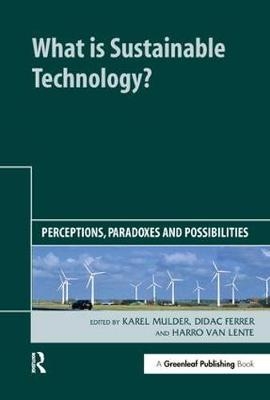
What is Sustainable Technology? -  Didac Ferrer,  Harro van Lente,  Karel Mulder

What is Sustainable Technology? (eBook)

Perceptions, Paradoxes and Possibilities
eBook Download: EPUB
2017
264 Seiten
Taylor and Francis (Verlag)
978-1-351-27846-1 (ISBN)
Systemvoraussetzungen
75,73 inkl. MwSt
(CHF 73,95)
Der eBook-Verkauf erfolgt durch die Lehmanns Media GmbH (Berlin) zum Preis in Euro inkl. MwSt.
  • Download sofort lieferbar
  • Zahlungsarten anzeigen
Designers of technology have a major responsibility in the current age. Their designs can have tremendous effects on society, in both the short and the long term. In fact, sustainable development itself has all the characteristics of a design project, albeit a vast one. But a failed product design here will be not just be unsuccessful in the market - it will have far-reaching consequences. It is our common responsibility to make the project successful. Technology has played an important role in creating the problems that we now face; but it will also play an important role in solving them. But this does not mean the technological fix will be easy. How do we allocate resources and attention when there are myriad issues under the umbrella of "e;sustainable development"e; currently in competition with one another? How do we arrive at precise specifications for the sustainable technologies that are to be developed and, furthermore, reach consensus on these specifications? What if our sustainable technological solutions aggravate other problems or create new ones? And, because sustainable development is all about the long-term consequences of our actions, how do we assess the effects of modifying existing landscapes, infrastructures and patterns of life?How could we be sure in advance that the changes that new technologies bring will make our society more sustainable? These dilemmas and paradoxes are the subject of this provocative book. Sometimes the claim that a technology is sustainable is made in order to make the technology acceptable in the political process, as in the case of nuclear energy production, where the claims of "e;sustainability"e; refer to the absence of CO2 emissions. In the case of biofuels, claims of sustainability have led to a "e;fuel or food"e; debate, showing that sustainability has counteracting articulations. And the well-known rebound effect is observed when increased resource efficiency can create a stimulus for consumption. What is Sustainable Technology? illustrates that the sustainability impact of a technology is often much more complicated and ambivalent than one might expect. Making improvements to existing designs is not the technological challenge that will lead to real solutions. We mustn't look to change a part of a machine, but rather the machine as a whole - or even the whole system in which it functions. It is these system innovations that have the potential to make a genuine contribution to sustainable development. What is Sustainable Technology? will help all those involved in designing more sustainable technologies in determining their strategies. It does so by presenting case studies of different technologies in contrasting contexts. Each case asks:1. What articulations of sustainability played a role in the design process?2. What sustainability effects did this technology lead to?3. Who was affected, where, and when?4. Could the designer have foreseen these consequences?5. How did the designer anticipate them?6. How was societal interaction dealt with during the design process?Finally, the authors reflect on future options for the sustainable technology designer. They argue that an important first step is an awareness of the multitude of sustainable development challenges that play a role in production, use, recycling and end-of-life disposal. What is Sustainable Technology? will be essential reading for product designers, engineers, material scientists and others involved in the development of sustainable technologies, as well as a wide academic audience interested in the complexities of the sustainable design process.
EPUBEPUB (Adobe DRM)

Kopierschutz: Adobe-DRM
Adobe-DRM ist ein Kopierschutz, der das eBook vor Mißbrauch schützen soll. Dabei wird das eBook bereits beim Download auf Ihre persönliche Adobe-ID autorisiert. Lesen können Sie das eBook dann nur auf den Geräten, welche ebenfalls auf Ihre Adobe-ID registriert sind.
Details zum Adobe-DRM

Dateiformat: EPUB (Electronic Publication)
EPUB ist ein offener Standard für eBooks und eignet sich besonders zur Darstellung von Belle­tristik und Sach­büchern. Der Fließ­text wird dynamisch an die Display- und Schrift­größe ange­passt. Auch für mobile Lese­geräte ist EPUB daher gut geeignet.

Systemvoraussetzungen:
PC/Mac: Mit einem PC oder Mac können Sie dieses eBook lesen. Sie benötigen eine Adobe-ID und die Software Adobe Digital Editions (kostenlos). Von der Benutzung der OverDrive Media Console raten wir Ihnen ab. Erfahrungsgemäß treten hier gehäuft Probleme mit dem Adobe DRM auf.
eReader: Dieses eBook kann mit (fast) allen eBook-Readern gelesen werden. Mit dem amazon-Kindle ist es aber nicht kompatibel.
Smartphone/Tablet: Egal ob Apple oder Android, dieses eBook können Sie lesen. Sie benötigen eine Adobe-ID sowie eine kostenlose App.
Geräteliste und zusätzliche Hinweise

Buying eBooks from abroad
For tax law reasons we can sell eBooks just within Germany and Switzerland. Regrettably we cannot fulfill eBook-orders from other countries.

Mehr entdecken
aus dem Bereich