


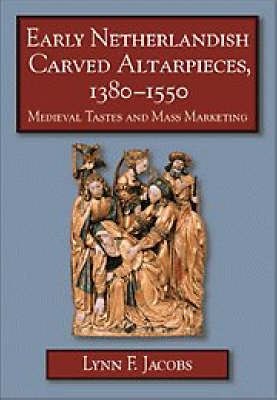
Early Netherlandish Carved Altarpieces, 1380–1550
Medieval Tastes and Mass Marketing
Seiten
1998
Cambridge University Press (Verlag)
978-0-521-47483-2 (ISBN)
Cambridge University Press (Verlag)
978-0-521-47483-2 (ISBN)
- Titel ist leider vergriffen;
keine Neuauflage - Artikel merken
A fascinating study of carved wooden altarpieces produced in the South Netherlands from the late fourteenth- through the mid-sixteenth centuries are among the most splendid examples of late medieval art. Such altarpieces powerfully express religious tastes and aesthetics of the late medieval period, but up to now have been one of the least known types of Netherlandish art.
The carved wooden altarpieces produced in the South Netherlands from the late fourteenth- to the mid-sixteenth centuries are among the most lavish and splendid examples of late medieval art. Though currently one of the least known and appreciated types of Netherlandish art, such altarpieces were the most common form of decoration on the high altars of churches in the Lowlands during the late Gothic period. Exported in huge numbers throughout much of Europe, these retables include high distinctive visual and iconographic features. These detailed narratives and masterful combinations of painting, sculpture, and architectural decoration powerfully express religious tastes and aesthetics of the late medieval period. This study also demonstrates how these works, despite their large size and complexity, were often sold on the open market, thus providing evidence of the expanding capitalistic orientation of the Netherlandish art market at the end of the middle ages.
The carved wooden altarpieces produced in the South Netherlands from the late fourteenth- to the mid-sixteenth centuries are among the most lavish and splendid examples of late medieval art. Though currently one of the least known and appreciated types of Netherlandish art, such altarpieces were the most common form of decoration on the high altars of churches in the Lowlands during the late Gothic period. Exported in huge numbers throughout much of Europe, these retables include high distinctive visual and iconographic features. These detailed narratives and masterful combinations of painting, sculpture, and architectural decoration powerfully express religious tastes and aesthetics of the late medieval period. This study also demonstrates how these works, despite their large size and complexity, were often sold on the open market, thus providing evidence of the expanding capitalistic orientation of the Netherlandish art market at the end of the middle ages.
Introduction; Part I. Medieval Tastes: 1. Narrative; 2. The combination of painting and sculpture; 3. Architectural ornament; Part II. Mass Marketing: 4. Market sales; 5. Commissioned sales; 6. The relation between market and commissioned sales; 7. Workshop production; Conclusion.
| Erscheint lt. Verlag | 28.3.1998 |
|---|---|
| Zusatzinfo | 91 Halftones, unspecified |
| Verlagsort | Cambridge |
| Sprache | englisch |
| Maße | 185 x 262 mm |
| Gewicht | 1160 g |
| Themenwelt | Kunst / Musik / Theater ► Kunstgeschichte / Kunststile |
| Kunst / Musik / Theater ► Malerei / Plastik | |
| ISBN-10 | 0-521-47483-3 / 0521474833 |
| ISBN-13 | 978-0-521-47483-2 / 9780521474832 |
| Zustand | Neuware |
| Informationen gemäß Produktsicherheitsverordnung (GPSR) | |
| Haben Sie eine Frage zum Produkt? |
Mehr entdecken
aus dem Bereich

aus dem Bereich
kleine Kulturgeschichte einer brillanten Allianz
Buch | Softcover (2025)
Iudicium (Verlag)
CHF 33,90


