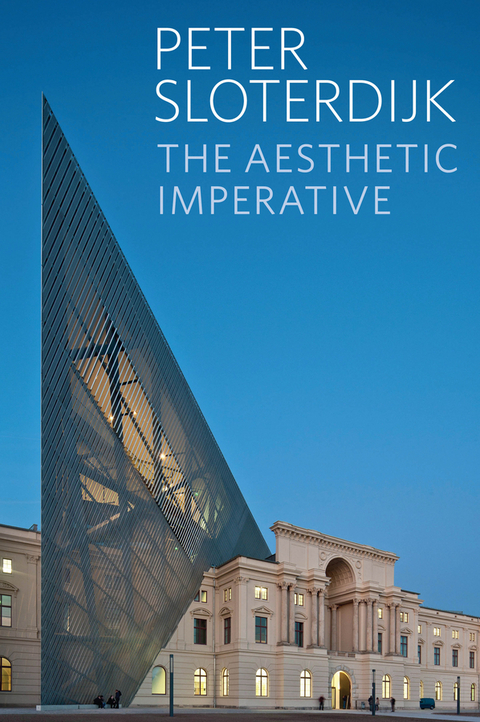
The Aesthetic Imperative (eBook)
John Wiley & Sons (Verlag)
978-0-7456-9990-5 (ISBN)
In this wide-ranging book, renowned philosopher and cultural theorist Peter Sloterdijk examines art in all its rich and varied forms: from music to architecture, light to movement, and design to typography. Moving between the visible and the invisible, the audible and the inaudible, his analyses span the centuries, from ancient civilizations to contemporary Hollywood. With great verve and insight he considers the key issues that have faced thinkers from Aristotle to Adorno, looking at art in its relation to ethics, metaphysics, society, politics, anthropology and the subject.
Sloterdijk explores a variety of topics, from the Greco-Roman invention of postcards to the rise of the capitalist art market, from the black boxes and white cubes of modernism to the growth of museums and memorial culture. In doing so, he extends his characteristic method of defamiliarization to transform the way we look at works of art and artistic movements. His bold and original approach leads us away from the well-trodden paths of conventional art history to develop a theory of aesthetics which rejects strict categorization, emphasizing instead the crucial importance of individual subjectivity as a counter to the latent dangers of collective culture.
This sustained reflection, at once playful, serious and provocative, goes to the very heart of Sloterdijk's enduring philosophical preoccupation with the aesthetic. It will be essential reading for students and scholars of philosophy and aesthetics and will appeal to anyone interested in culture and the arts more generally.
Peter Sloterdijk is Professor of Philosophy and Aesthetics at the Karlsruhe School of Design.
In this wide-ranging book, renowned philosopher and cultural theorist Peter Sloterdijk examines art in all its rich and varied forms: from music to architecture, light to movement, and design to typography. Moving between the visible and the invisible, the audible and the inaudible, his analyses span the centuries, from ancient civilizations to contemporary Hollywood. With great verve and insight he considers the key issues that have faced thinkers from Aristotle to Adorno, looking at art in its relation to ethics, metaphysics, society, politics, anthropology and the subject. Sloterdijk explores a variety of topics, from the Greco-Roman invention of postcards to the rise of the capitalist art market, from the black boxes and white cubes of modernism to the growth of museums and memorial culture. In doing so, he extends his characteristic method of defamiliarization to transform the way we look at works of art and artistic movements. His bold and original approach leads us away from the well-trodden paths of conventional art history to develop a theory of aesthetics which rejects strict categorization, emphasizing instead the crucial importance of individual subjectivity as a counter to the latent dangers of collective culture. This sustained reflection, at once playful, serious and provocative, goes to the very heart of Sloterdijk s enduring philosophical preoccupation with the aesthetic. It will be essential reading for students and scholars of philosophy and aesthetics and will appeal to anyone interested in culture and the arts more generally.
Peter Sloterdijk is Professor of Philosophy and Aesthetics at the Karlsruhe School of Design.
Contents
I. WORLD OF SOUND
La musique retrouvée 3
Remembrance of Beautiful Politics 15
Where Are We When We Hear Music? 27
II. IN THE LIGHT
Clearing and Illumination. Notes on the Metaphysics, Mysticism and Politics of Light 49
Illumination in the Black Box: On the History of Opacity 61
III. DESIGN
The Right Tool for Power: Observations on Design as the Modernization of Competence 83
On the Charisma of Symbols 97
For a Philosophy of Play 100
IV. CITY AND ARCHITECTURE
The City and its Negation: An Outline of Negative Political Theory 113
Architects Do Nothing But 'Inside Theory': Peter Sloterdijk in conversation with Sabine Kraft and Nikolaus Kuhnert 141
For a Participatory Architecture - Notes on the Art of Daniel Libeskind with reference to Maurice Merleau-Ponty and Paul Valéry 174
V. CONDITIO HUMANA
Essay on the Life of the Artist: Heretics *Wastrels* Falls/Cases* Inhabitants 185
Confessions of a Loser 192
Minima Cosmetica - An Essay on Self-Aggrandizement 197
VI. MUSEUM
The Museum: School of Disconcertment 221
World Museum and World's Fair 231
VII. ART SYSTEM
'I tell you: one must still have chaos in oneself' 249
Art is folding into itself 253
Emissaries of Violence - On the Metaphysics of Action Cinema 265
Good-For-Nothing Returns Home or The End of an Alibi - and A Theory of the End of Art 280
Afterword by Peter Weibel: Sloterdijk and the Question of Aesthetics 304
Notes 320
Publication Sources 334
"The Aesthetic Imperative crystalizes and intensifies the already formidable force of Sloterdijk's corpus. By working through the history of philosophy we discover that the bourgeois subject's capacity to discern the beautiful is at once an art of self-formation and a beautiful form of the self. This is not one more book on the relation between art and politics: it redefines the polity as a singular account of a beauty beyond art, and redefines the aesthetic by way of a subjectivity that is on its way to being political."
Claire Colebrook, Penn State University
LA MUSIQUE RETROUVÉE
Demonic Territory
Ladies and gentlemen,1 abundant attempts have been made to define the essence of music. Some people have described it as structured time or as a synthesis of calculated order and mysterious caprice, while others have seen its higher manifestations as the meeting between rigorous form and the gestures of free self-expression, or simply as passion colliding with the world of numbers. Yet none of these statements can match the famous dictum of Thomas Mann in his novel Doctor Faustus. Inspired by Kierkegaard, Mann reached the conclusion that ‘Music is demonic territory.’
This phrase, which has since become a mantra for musicologists, is notable for several reasons; moreover, it increasingly requires comment. When it first appeared in 1947 it merely aimed at illuminating the murky secrets of German culture, an area where, it was said, musicality and bestiality had become confusingly intertwined. At the same time, Mann’s dictum was supposed to indicate how, on the ground of modernism, artistically beautiful things could change into things that are artistically evil, and how diabolical guile could transform the best forces of a high civilization into their opposite. From today’s perspective, Mann’s statement has a special impact in that it replaces a definition with a warning – as if the author wanted to admit that it is impossible for some topics to lead to objective theory because they do not remain still while they are being worked on by theory. Instead, sleeping lurking monsters rouse from their slumbers and rear their heads as soon as we talk about them. According to the author of Doctor Faustus, musicologists would be well advised to study the conclusion of Christian demonologists that demons are not neutral. Instead of being model objects that can be investigated at a safe distance, they are a power that responds to invocation. Anyone who calls the dark spirit by name has already invoked him, and the invoking person should be aware that he can be confronted with an authority that will be stronger than he is. That is why folk tales say of Doctor Faust: If you know something, keep it quiet.
Let us briefly look at which kind of demonic possession is involved when we enter the territory of music – assuming that this is about a ‘territory’ that can be entered like a ground or terrain. We must seek the answer in the acoustic anthropology that has acquainted us with a large number of inspiring new findings on human hearing in recent decades. They have taught us that among members of Homo sapiens, like other mammals or creatures that bear live offspring, and even among many birds, hearing is an ability that is acquired very early, actually in prenatal space. The ear is indisputably the leading organ of human contact with the world, and this is already the case at a point in the organism’s development when the individual as such is not yet ‘there’ – to the extent that the adverb ‘there’ indicates the possibility that a person is at a sufficient distance from things to be able to point to an object or circumstance. Even in adults, hearing is not so much an effect the subject experiences in relation to a source of sound, but occurs rather as immersion of the sensitive organ and its owner in an acoustic field. This applies even more strongly to the hearing of the unborn child. If the first auditory experience signifies a foetal prelude to the mature use of the acoustic sense, it is mainly because at that moment the feature of floating in a total environment is at its purest. The first hearing experience inherently resembles a pre-school of cosmopolitanism, literally of world openness – yet we attend this school, effectively the école maternelle, at a stage of life when we ourselves are still completely worldless and pre-worldly. The individual-to-be persists as far as possible in its intimate reserve, enclosed in a warm misty night, yet still listening behind the door of existence. But it would be confusing to describe the hearing foetus merely as an eavesdropper behind the door. The primal hearer’s way of being is defined from the very beginning by its embedding in an internal sonorous continuum dominated by two emanations from its maternal surroundings: first, the sounds of the mother’s heart that set the existential beat like a constant repetitive rhythm; and, second, her voice producing free prose that impregnates the foetal ear with a melodic dialect. These two universal factors of the formation of intra-uterine hearing, the cardiac basso continuo and the mother’s soprano speaking voice, create the outline of the utopian continent of proto-music or endo-music, and we first have to overcome the almost constant presence of these two factors to reach a horizon within which more unfamiliar, more intense and more distant sonic events communicate a kind of acoustic summer lightning coming from the world.
In the future we have to take these relationships into account when repeating the phrase about music as demonic territory. The nature of the demonic musical phenomenon will be easier to understand when we accept that once the auditory relation to the world becomes musical, we are in a position to address the register of deep regressions. From this it follows that, even in the case of adult subjects filled with harsh reality, music can still evoke their intimate prehistories. It recalls a phase of their development when they were not yet accustomed to being free to take their distance from things and situations, but still, the environment with its lively sounds transported them into a mode of conflict-free encirclement. At the same time, music, wherever it activates registers of intensity, can render the dynamic of earlier struggles to break through and find new openings as acoustic patterns. This locates music as the place where the transition from confrontation to immersion is continually articulated in a new way. The musical ear is the organ that participates in the reality of sound and tonal events exclusively in the mode of immersion. In fact, immersion as such is the topic of a more audacious kind of Enlightenment. If you know something, then you should talk about it nonetheless. This is probably what Nietzsche had in mind when he added the hazardous name of Dionysus to the vocabulary of musicology.
We still have to explain the ways and means by which the ear becomes a musical ear. Musicality in the narrow sense of the word assumes that the adult ear can occasionally take a holiday from the trivial work of hearing and be lured away from everyday noise by select sounds. We generally experience the world as a place completely removed from music. It is the noises of our surroundings that dominate in this world – and, above all, the inescapable chatter of our fellow human beings, which the media amplify to the maximum nowadays, and then the daily noise profile with the acoustic signatures of our households, our workplaces and our traffic systems. As a result the human ear is a slavish, servile and secretarial organ because, to begin with, it can only bow to the authority of the first available sounds around it. Unmusicality is the voice of the Lord, and the reality of things tells us to understand in an unmusical tone of command. Music, by contrast, has the intrinsic effect of carrying us away. It invites us to start over again with a different kind of response – and this implies, however obliquely, the return to the realm of the heartbeat and the archaic soprano. It is nearly impossible to fathom the implications of these anthropological observations with all their immense consequences. The prose of ordinary existence is based on the fact that from birth onwards, human children make a trivial but incredible discovery: the world is a still, hollow place in which the heartbeat and the primal soprano are catastrophically silenced. Existence in the lighted world is connected to a forcible loss we can never really fathom: for humans, from the first moment on, being in the world involves the unreasonable demand that we do without the sonic continuity of that initial intimacy. From this time on, silence transmits the alarm signal of being. Only the mother’s voice, which can be heard from outside, builds a precarious bridge between then and now. Because this renunciation is nearly impossible to accept, the being that has just arrived in the world has the task of overcoming the prosaic barrier that divides it from the sphere of sonorous enchantments. Music exists because human beings are creatures that insist on wanting to have the best once again. All music, including elementary or primitive music, begins wholly under the auspices of rediscovery and repetition obsession. The specific allure of musical art, right up to its supreme structures and including its moments of evidentness, of being carried along, and of joyful astonishment, is linked to retrieving a sonorous presence we believed to be forgotten. When music is most like itself, it speaks to us as musique retrouvée.
After the ear’s exodus into the outer world, everything revolves around the art of repairing the broken link to our first bonding. But we can only recover the essence of this incomparably intimate and entirely individual relationship later on in the public sphere where cultural groups listen to sounds together. The rule for this turn to the public and cultural sphere is that what began in enchantment should return in freedom. What we call nations, and later ‘societies’, are always sonorous constructions as well – I...
| Erscheint lt. Verlag | 23.5.2017 |
|---|---|
| Übersetzer | Karen Margolis |
| Sprache | englisch |
| Themenwelt | Kunst / Musik / Theater ► Allgemeines / Lexika |
| Geisteswissenschaften ► Philosophie | |
| Schlagworte | Aesthetics • aesthetics, arts, architecture • Ästhetik • Kunst • Philosophie • Philosophie der Kunst • Philosophy • philosophy of art • Philosophy Special Topics • Spezialthemen Philosophie |
| ISBN-10 | 0-7456-9990-1 / 0745699901 |
| ISBN-13 | 978-0-7456-9990-5 / 9780745699905 |
| Informationen gemäß Produktsicherheitsverordnung (GPSR) | |
| Haben Sie eine Frage zum Produkt? |
 EPUB (Adobe DRM)
Kopierschutz: Adobe-DRM
Adobe-DRM ist ein Kopierschutz, der das eBook vor Mißbrauch schützen soll. Dabei wird das eBook bereits beim Download auf Ihre persönliche Adobe-ID autorisiert. Lesen können Sie das eBook dann nur auf den Geräten, welche ebenfalls auf Ihre Adobe-ID registriert sind.
Details zum Adobe-DRM
Dateiformat: EPUB (Electronic Publication)
EPUB ist ein offener Standard für eBooks und eignet sich besonders zur Darstellung von Belletristik und Sachbüchern. Der Fließtext wird dynamisch an die Display- und Schriftgröße angepasst. Auch für mobile Lesegeräte ist EPUB daher gut geeignet.
Systemvoraussetzungen:
PC/Mac: Mit einem PC oder Mac können Sie dieses eBook lesen. Sie benötigen eine
eReader: Dieses eBook kann mit (fast) allen eBook-Readern gelesen werden. Mit dem amazon-Kindle ist es aber nicht kompatibel.
Smartphone/Tablet: Egal ob Apple oder Android, dieses eBook können Sie lesen. Sie benötigen eine
Geräteliste und zusätzliche Hinweise
Buying eBooks from abroad
For tax law reasons we can sell eBooks just within Germany and Switzerland. Regrettably we cannot fulfill eBook-orders from other countries.
aus dem Bereich