


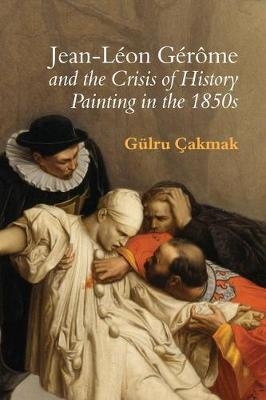
Jean-Léon Gérôme and the Crisis of History Painting in the 1850s
Seiten
2017
Liverpool University Press (Verlag)
978-1-78694-067-4 (ISBN)
Liverpool University Press (Verlag)
978-1-78694-067-4 (ISBN)
This book demonstrates that by the 1850s the historical paintings no longer excited the French public. This provocative study reveals Gérôme, typically dismissed as a conservative painter, as a pioneering innovator who responded swiftly to this crisis in art. In a group of experimental paintings in the late 1850s, he devised a quintessentially modern mode of historical representation.
'A crisis in historical representation unfolded in French visual culture in the first half of the nineteenth century, reaching its climax at the Paris Universal Exhibition of 1855, when artists and critics alike came to a troubling realization: depictions of past heroes that had once held exceptional influence over their viewers now left the public indifferent. This book shows that underneath this crisis was a mounting demand for empirical observation in art, and an emergent modern epistemology that posited the past as foundational and yet inaccessible to the physically and historically specific individual. Since neither the painter nor the viewer could have actually experienced a bygone historical incident as it unfolded, was history painting even feasible in modern times? When historical representation seemed all but impossible to critics and artists of various hues, Gérôme came up with a momentous solution. A small group of paintings constitute the focus of this provocative study on the artist’s early work, whose pivotal role in Gérôme’s oeuvre as well as in the broader history of modernization of art have been so far unrecognized in art historical scholarship. In these, the artist charted a new roadmap for the art of painting in response to the modern sensibility of history.'
'A crisis in historical representation unfolded in French visual culture in the first half of the nineteenth century, reaching its climax at the Paris Universal Exhibition of 1855, when artists and critics alike came to a troubling realization: depictions of past heroes that had once held exceptional influence over their viewers now left the public indifferent. This book shows that underneath this crisis was a mounting demand for empirical observation in art, and an emergent modern epistemology that posited the past as foundational and yet inaccessible to the physically and historically specific individual. Since neither the painter nor the viewer could have actually experienced a bygone historical incident as it unfolded, was history painting even feasible in modern times? When historical representation seemed all but impossible to critics and artists of various hues, Gérôme came up with a momentous solution. A small group of paintings constitute the focus of this provocative study on the artist’s early work, whose pivotal role in Gérôme’s oeuvre as well as in the broader history of modernization of art have been so far unrecognized in art historical scholarship. In these, the artist charted a new roadmap for the art of painting in response to the modern sensibility of history.'
Gülru Çakmak is Assistant Professor in the Department of the History of Art and Architecture at the University of Massachusetts Amherst.
| Erscheinungsdatum | 02.12.2017 |
|---|---|
| Zusatzinfo | 13 Illustrations, color; 36 Illustrations, black and white |
| Verlagsort | Liverpool |
| Sprache | englisch |
| Maße | 163 x 239 mm |
| Themenwelt | Kunst / Musik / Theater ► Kunstgeschichte / Kunststile |
| Kunst / Musik / Theater ► Malerei / Plastik | |
| ISBN-10 | 1-78694-067-1 / 1786940671 |
| ISBN-13 | 978-1-78694-067-4 / 9781786940674 |
| Zustand | Neuware |
| Informationen gemäß Produktsicherheitsverordnung (GPSR) | |
| Haben Sie eine Frage zum Produkt? |
Mehr entdecken
aus dem Bereich

aus dem Bereich
kleine Kulturgeschichte einer brillanten Allianz
Buch | Softcover (2025)
Iudicium (Verlag)
CHF 33,90


