


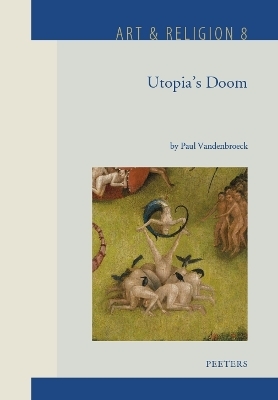
Utopia's Doom
The 'Graal' as Paradise of Lust, the Sect of the Free Spirit and Jheronimus Bosch's so-called 'Garden of Earthly Delights'
Seiten
2017
Peeters Publishers (Verlag)
978-90-429-3468-9 (ISBN)
Peeters Publishers (Verlag)
978-90-429-3468-9 (ISBN)
The so-called Garden of Delights by Jheronimus Bosch (c.
1450–1516), now located in the Museo del Prado in Madrid, was painted
over half a millennium ago yet remains an absolutely iconic work in
European art history. The highly complex and enigmatic image has
frequently been interpreted as a paradisiacal utopia, in which people
indulge playfully in erotic pleasure in harmony with nature. It is a
visual utopia framed before Thomas More had actually coined the word in
a book whose entirely unfrivolous blueprint for society could hardly
differ more from Bosch’s phantasm. More traditional art historians have
identified Bosch’s masterpiece as a painted warning against the sins of
the body, more specifically that of ‘lust’, citing the image of Hell in
the right wing in support.
Paul Vandenbroeck argues that these two interpretations need not
preclude one another: Bosch painted a phantasmagorical false
paradise that leads inexorably to ruin. He drew his inspiration from
folk ideas about a semi-earthly, semi-supernatural erotic paradise or
Grail, in which those who entered could live in a dream-world of
unbridled pleasure. But only until Judgement Day, upon which they would
all wind up in Hell. As far as ‘right-thinking’ town-dwellers were
concerned from their vantage point within a ‘bourgeois civilizing
offensive’, belief in such an existence was dangerous, if not diabolical
nonsense – tantamount to the ‘Cult of Adam’ and the indiscriminate
sexual promiscuity of the late-medieval Sect of the Free Spirit. In
large swathes of countryside throughout Europe, however, people were
familiar with ‘ecstatics’, those ‘born with the caul’, who were able to
access this other world.
Bosch’s magisterial work is simultaneously a reflection on the first and
last times, on passions and moral norms, human beings and Nature. A
Nature which, although also part of God’s creation, was permeated with
malevolent and highly dangerous sexual urges, which human beings were
required to keep in check.
For whom did Bosch paint this enormous triptych? Since the discoveries
of Prof. J.K. Steppe of the Leuven University, art historians have
tended to identify the patron as Henry III of Nassau or, more recently,
his uncle, Engelbert II. This book presents an unexpected alternative
hypothesis.
1450–1516), now located in the Museo del Prado in Madrid, was painted
over half a millennium ago yet remains an absolutely iconic work in
European art history. The highly complex and enigmatic image has
frequently been interpreted as a paradisiacal utopia, in which people
indulge playfully in erotic pleasure in harmony with nature. It is a
visual utopia framed before Thomas More had actually coined the word in
a book whose entirely unfrivolous blueprint for society could hardly
differ more from Bosch’s phantasm. More traditional art historians have
identified Bosch’s masterpiece as a painted warning against the sins of
the body, more specifically that of ‘lust’, citing the image of Hell in
the right wing in support.
Paul Vandenbroeck argues that these two interpretations need not
preclude one another: Bosch painted a phantasmagorical false
paradise that leads inexorably to ruin. He drew his inspiration from
folk ideas about a semi-earthly, semi-supernatural erotic paradise or
Grail, in which those who entered could live in a dream-world of
unbridled pleasure. But only until Judgement Day, upon which they would
all wind up in Hell. As far as ‘right-thinking’ town-dwellers were
concerned from their vantage point within a ‘bourgeois civilizing
offensive’, belief in such an existence was dangerous, if not diabolical
nonsense – tantamount to the ‘Cult of Adam’ and the indiscriminate
sexual promiscuity of the late-medieval Sect of the Free Spirit. In
large swathes of countryside throughout Europe, however, people were
familiar with ‘ecstatics’, those ‘born with the caul’, who were able to
access this other world.
Bosch’s magisterial work is simultaneously a reflection on the first and
last times, on passions and moral norms, human beings and Nature. A
Nature which, although also part of God’s creation, was permeated with
malevolent and highly dangerous sexual urges, which human beings were
required to keep in check.
For whom did Bosch paint this enormous triptych? Since the discoveries
of Prof. J.K. Steppe of the Leuven University, art historians have
tended to identify the patron as Henry III of Nassau or, more recently,
his uncle, Engelbert II. This book presents an unexpected alternative
hypothesis.
| Erscheinungsdatum | 27.04.2018 |
|---|---|
| Reihe/Serie | Art & Religion ; 8 |
| Verlagsort | Leuven |
| Sprache | englisch |
| Themenwelt | Kunst / Musik / Theater ► Kunstgeschichte / Kunststile |
| Kunst / Musik / Theater ► Malerei / Plastik | |
| ISBN-10 | 90-429-3468-9 / 9042934689 |
| ISBN-13 | 978-90-429-3468-9 / 9789042934689 |
| Zustand | Neuware |
| Informationen gemäß Produktsicherheitsverordnung (GPSR) | |
| Haben Sie eine Frage zum Produkt? |
Mehr entdecken
aus dem Bereich

aus dem Bereich
kleine Kulturgeschichte einer brillanten Allianz
Buch | Softcover (2025)
Iudicium (Verlag)
CHF 33,90


