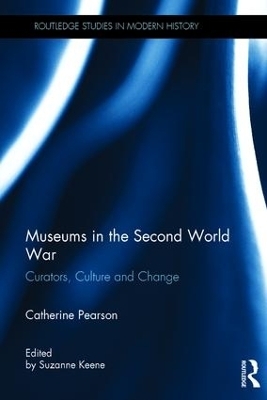
Museums in the Second World War
Routledge (Verlag)
978-1-4724-7968-6 (ISBN)
At the outbreak of war precious objects were stored away and staff numbers reduced, but although many museums were closed, others successfully campaigned to remain open. By providing innovative modern exhibitions and education initiatives they became popular and valued venues for the public. After the war, however, museums returned to their more traditional, collections-centred approach and failed to negotiate the public funding needed for reconstruction based on this narrower view of their role. Hence, in the longer term, the destruction and economic and social consequences of the conflict served to delay aspirations for reconstruction until the 1960s. Through this lens, the history of the museum in the mid-twentieth century appears as one shaped by the effects of war but equally determined by the input of curators, audiences and the state. The museum thus emerges not as an isolated institution concerned only with presenting the past but as a product of the changing conflicts and cultures within society.
Catherine Pearson, Author, Independent Historian and Scholar, UK. She is the editor of the journals of museum curator, E.J. Rudsdale, 1920-1951. Suzanne Keene, Editor, Reader Emeritus at University College London. She has a number of published books on museum collections, most recently co-authoring Museums and Silent Objects: Designing Effective Exhibitions.
Timeline: Major events around the Second World War and the Home Front Introduction: a new perspective PART I: 1918–1939: Between the wars Chapter 1 Between the wars: museums and cultural politics Chapter 2 Charting progress: the Markham report Chapter 3 Museums before the war: the context for reform Part II: 1939–1940: At the start of the war Chapter 4 Confronting conflict: collections, closings and openings Chapter 5 As war begins: from propaganda to recognition PART III: 1941–1944: During wartime Chapter 6 State support: the Council for the Encouragement of Music and the Arts (CEMA) Chapter 7 Temples to the arts Chapter 8 Planning for peacetime PART IV: Reflections on wartime practice Chapter 9 Community engagement, education and exhibitions Chapter 10 Audiences in wartime Chapter 11 Memory and identity Chapter 12 Museum staff and the war PART V: 1944–1949 The aftermath of the war Chapter 13 A national museum service: the final bid Chapter 14 The post-war decades: museums in the aftermath of war PART VI: 1950–1964 From austerity to reconstruction Chapter 15 Towards a regional service Chapter 16 Conclusions: museums forget their past
| Erscheinungsdatum | 26.07.2017 |
|---|---|
| Reihe/Serie | Routledge Studies in Modern History |
| Zusatzinfo | 2 Tables, black and white; 9 Line drawings, black and white; 54 Halftones, black and white; 65 Illustrations, black and white |
| Verlagsort | London |
| Sprache | englisch |
| Maße | 156 x 234 mm |
| Gewicht | 520 g |
| Themenwelt | Kunst / Musik / Theater |
| Reisen | |
| Geschichte ► Allgemeine Geschichte ► Neuzeit (bis 1918) | |
| Geschichte ► Allgemeine Geschichte ► 1918 bis 1945 | |
| Geisteswissenschaften ► Geschichte ► Hilfswissenschaften | |
| Geschichte ► Teilgebiete der Geschichte ► Kulturgeschichte | |
| ISBN-10 | 1-4724-7968-8 / 1472479688 |
| ISBN-13 | 978-1-4724-7968-6 / 9781472479686 |
| Zustand | Neuware |
| Informationen gemäß Produktsicherheitsverordnung (GPSR) | |
| Haben Sie eine Frage zum Produkt? |
aus dem Bereich