


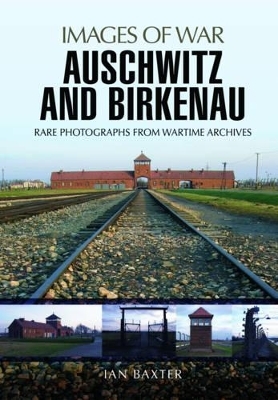
Auschwitz and Birkenau
Seiten
2019
Pen & Sword Military (Verlag)
978-1-4738-5687-5 (ISBN)
Pen & Sword Military (Verlag)
978-1-4738-5687-5 (ISBN)
A fine collection of rare contemporary and modern day images, many never before published of the Auschwitz Birkenau complex.
Auschwitz and Birkenau were separate from each other,by about a 45 minute walk. Auschwitz was adapted to hold political prisoners in 1940 and evolved into a killing machine in 1941. Later that year a new site called Birkenau was found to extend the Auschwitz complex. Here a vast complex of buildings were constructed to hold initially Russian POWs and later Jews as a labour pool for the surrounding industries including IG Farben. Following the January 1943 Wannsee Conference, Birkenau evolved into a murder factory using makeshift houses which were adapted to kill Jews and Russian POWs. Later due to sheer volume Birkenau evolved into a mass killing machine using gas chambers and crematoria, while Auschwitz, which still held prisoners, became the administrative centre. The images show first Auschwitz main camp and then Birkenau and are carefully chosen to illustrate specific areas, like the Women's Camp, Gypsy Camp, SS quarters, Commandant's House, railway disembarkation, the 'sauna', disinfection area and the Crematoria. Maps covering Auschwitz and Birkenau explain the layout. This book is shocking proof of the scale of the Holocaust.
Auschwitz and Birkenau were separate from each other,by about a 45 minute walk. Auschwitz was adapted to hold political prisoners in 1940 and evolved into a killing machine in 1941. Later that year a new site called Birkenau was found to extend the Auschwitz complex. Here a vast complex of buildings were constructed to hold initially Russian POWs and later Jews as a labour pool for the surrounding industries including IG Farben. Following the January 1943 Wannsee Conference, Birkenau evolved into a murder factory using makeshift houses which were adapted to kill Jews and Russian POWs. Later due to sheer volume Birkenau evolved into a mass killing machine using gas chambers and crematoria, while Auschwitz, which still held prisoners, became the administrative centre. The images show first Auschwitz main camp and then Birkenau and are carefully chosen to illustrate specific areas, like the Women's Camp, Gypsy Camp, SS quarters, Commandant's House, railway disembarkation, the 'sauna', disinfection area and the Crematoria. Maps covering Auschwitz and Birkenau explain the layout. This book is shocking proof of the scale of the Holocaust.
Ian Baxter is an avid collector of WW2 photographs and prolific author. His previous books in this Series include Hitler's Boy Soldiers, Nazi Concentration Camp Commandants and The Crushing of Poland. He lives near Chelmsford, Essex.
| Erscheinungsdatum | 24.01.2017 |
|---|---|
| Zusatzinfo | 300 black and white illustrations |
| Verlagsort | South Yorkshire |
| Sprache | englisch |
| Maße | 189 x 246 mm |
| Themenwelt | Kunst / Musik / Theater ► Fotokunst |
| Geschichte ► Allgemeine Geschichte ► 1918 bis 1945 | |
| Geschichte ► Teilgebiete der Geschichte ► Militärgeschichte | |
| Sozialwissenschaften ► Politik / Verwaltung | |
| ISBN-10 | 1-4738-5687-6 / 1473856876 |
| ISBN-13 | 978-1-4738-5687-5 / 9781473856875 |
| Zustand | Neuware |
| Informationen gemäß Produktsicherheitsverordnung (GPSR) | |
| Haben Sie eine Frage zum Produkt? |
Mehr entdecken
aus dem Bereich

aus dem Bereich
Deutschland 1933 bis 1945
Buch | Hardcover (2025)
S. Fischer (Verlag)
CHF 47,60
ein Psychologe erlebt das Konzentrationslager
Buch | Hardcover (2024)
Kösel (Verlag)
CHF 30,80


