


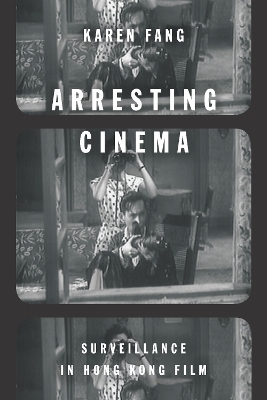
Arresting Cinema
Surveillance in Hong Kong Film
Seiten
2017
|
New edition
Stanford University Press (Verlag)
978-1-5036-0070-6 (ISBN)
Stanford University Press (Verlag)
978-1-5036-0070-6 (ISBN)
When Ridley Scott envisioned Blade Runner's set as "Hong Kong on a bad day," he nodded to the city's overcrowding as well as its widespread use of surveillance. But while Scott brought Hong Kong and surveillance into the global film repertoire, the city's own cinema has remained outside of the global surveillance discussion.
In Arresting Cinema, Karen Fang delivers a unifying account of Hong Kong cinema that draws upon its renowned crime films and other unique genres to demonstrate Hong Kong's view of surveillance. She argues that Hong Kong's films display a tolerance of—and even opportunism towards—the soft cage of constant observation, unlike the fearful view prevalent in the West. However, many surveillance cinema studies focus solely on European and Hollywood films, discounting other artistic traditions and industrial circumstances. Hong Kong's films show a more crowded, increasingly economically stratified, and postnational world that nevertheless offers an aura of hopeful futurity. Only by exploring Hong Kong surveillance film can we begin to shape a truly global understanding of Hitchcock's "rear window ethics."
In Arresting Cinema, Karen Fang delivers a unifying account of Hong Kong cinema that draws upon its renowned crime films and other unique genres to demonstrate Hong Kong's view of surveillance. She argues that Hong Kong's films display a tolerance of—and even opportunism towards—the soft cage of constant observation, unlike the fearful view prevalent in the West. However, many surveillance cinema studies focus solely on European and Hollywood films, discounting other artistic traditions and industrial circumstances. Hong Kong's films show a more crowded, increasingly economically stratified, and postnational world that nevertheless offers an aura of hopeful futurity. Only by exploring Hong Kong surveillance film can we begin to shape a truly global understanding of Hitchcock's "rear window ethics."
Karen Fang is Associate Professor of English at the University of Houston and a member of the Film Committee for the Museum of Fine Arts in Houston.
Introduction: A Race of Peeping Toms? "Rear Window Ethics" in Hong Kong
1. Watching the Watchman: Michael Hui's Surveillance Comedies
2. On the "China Watch": Prosperity and Paranoia in Reunification-Era Cinema
3. "Only" a Policeman: Joint Venture Cinema and the Mediatization of the
4. "Representing the Chinese Government": Hong Kong Undercover in An Age of Self-Censorship
Conclusion: Toward a Global Surveillance Cinema
| Erscheinungsdatum | 10.01.2017 |
|---|---|
| Zusatzinfo | 60 halftones |
| Verlagsort | Palo Alto |
| Sprache | englisch |
| Maße | 152 x 229 mm |
| Themenwelt | Kunst / Musik / Theater ► Film / TV |
| Geschichte ► Teilgebiete der Geschichte ► Kulturgeschichte | |
| Sozialwissenschaften ► Ethnologie ► Volkskunde | |
| Sozialwissenschaften ► Kommunikation / Medien ► Medienwissenschaft | |
| Sozialwissenschaften ► Soziologie | |
| ISBN-10 | 1-5036-0070-X / 150360070X |
| ISBN-13 | 978-1-5036-0070-6 / 9781503600706 |
| Zustand | Neuware |
| Informationen gemäß Produktsicherheitsverordnung (GPSR) | |
| Haben Sie eine Frage zum Produkt? |
Mehr entdecken
aus dem Bereich



aus dem Bereich
Die Revolution des Gemeinen Mannes
Buch | Softcover (2024)
C.H.Beck (Verlag)
CHF 16,80
Eine Geschichte des Geschmacks
Buch | Hardcover (2025)
C.H.Beck (Verlag)
CHF 49,95
vom Mittelalter bis zur Gegenwart
Buch | Softcover (2024)
C.H.Beck (Verlag)
CHF 16,80


