


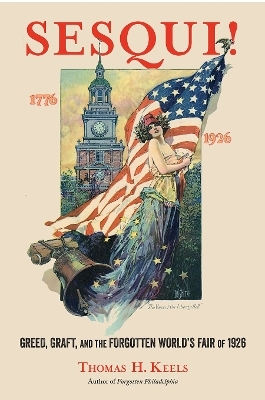
Sesqui!
Greed, Graft, and the Forgotten World's Fair of 1926
Seiten
2017
Temple University Press,U.S. (Verlag)
978-1-4399-0329-2 (ISBN)
Temple University Press,U.S. (Verlag)
978-1-4399-0329-2 (ISBN)
- Titel z.Zt. nicht lieferbar
- Versandkostenfrei
- Auch auf Rechnung
- Artikel merken
In 1916, Philadelphia department-store magnate John Wanamaker launched plans for a Sesqui-Centennial International Exposition in 1926. It would be a magnificent world's fair to celebrate the 150th anniversary of the Declaration of Independence. The “Sesqui” would also transform sooty, industrial Philadelphia into a beautiful Beaux Arts city.
However, when the Sesqui opened on May 31, 1926, in the remote, muddy swamps of South Philadelphia, the fair was unfinished, with a few shabbily built and mostly empty structures. Crowds stayed away in droves: fewer than five million paying customers attended, costing the city millions of dollars. Philadelphia became a national scandal-a city so corrupt that one political boss could kidnap an entire world’s fair.
In his fascinating history Sesqui!, noted historian Thomas Keels situates this ill-fated celebration-a personal boondoggle by the all-powerful Congressman William S. Vare-against the transformations taking place in America during the 1920s. Keels provides a comprehensive account of the Sesqui as a meeting ground for cultural changes sweeping the country: women’s and African-American rights, anti-Semitism, eugenics, Prohibition, and technological advances.
However, when the Sesqui opened on May 31, 1926, in the remote, muddy swamps of South Philadelphia, the fair was unfinished, with a few shabbily built and mostly empty structures. Crowds stayed away in droves: fewer than five million paying customers attended, costing the city millions of dollars. Philadelphia became a national scandal-a city so corrupt that one political boss could kidnap an entire world’s fair.
In his fascinating history Sesqui!, noted historian Thomas Keels situates this ill-fated celebration-a personal boondoggle by the all-powerful Congressman William S. Vare-against the transformations taking place in America during the 1920s. Keels provides a comprehensive account of the Sesqui as a meeting ground for cultural changes sweeping the country: women’s and African-American rights, anti-Semitism, eugenics, Prohibition, and technological advances.
Thomas H. Keels is a historian and lecturer who has authored or co-authored seven books and numerous articles on Philadelphia history, including Forgotten Philadelphia: Lost Architecture of the Quaker City (Temple), Philadelphia Graveyards and Cemeteries, and Wicked Philadelphia: Sin in the City of Brotherly Love. A confirmed taphophile, Keels has been a tour guide at Laurel Hill Cemetery, Philadelphia’s premier Victorian necropolis, for two decades. Visit him online at http://www.thomaskeels.com/.
| Erscheinungsdatum | 16.03.2017 |
|---|---|
| Zusatzinfo | 100 halftones |
| Verlagsort | Philadelphia PA |
| Sprache | englisch |
| Maße | 152 x 229 mm |
| Themenwelt | Kunst / Musik / Theater |
| Sachbuch/Ratgeber ► Geschichte / Politik ► Allgemeines / Lexika | |
| Sachbuch/Ratgeber ► Geschichte / Politik ► Regional- / Landesgeschichte | |
| Geisteswissenschaften ► Geschichte ► Regional- / Ländergeschichte | |
| Geschichte ► Teilgebiete der Geschichte ► Kulturgeschichte | |
| Technik | |
| ISBN-10 | 1-4399-0329-8 / 1439903298 |
| ISBN-13 | 978-1-4399-0329-2 / 9781439903292 |
| Zustand | Neuware |
| Informationen gemäß Produktsicherheitsverordnung (GPSR) | |
| Haben Sie eine Frage zum Produkt? |
Mehr entdecken
aus dem Bereich



aus dem Bereich
Die Revolution des Gemeinen Mannes
Buch | Softcover (2024)
C.H.Beck (Verlag)
CHF 16,80
Eine Geschichte des Geschmacks
Buch | Hardcover (2025)
C.H.Beck (Verlag)
CHF 49,95


