


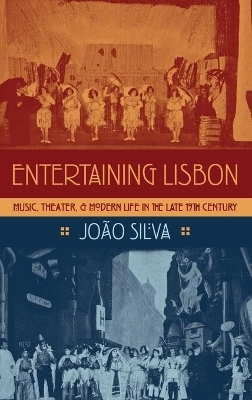
Entertaining Lisbon
Music, Theater, and Modern Life in the Late 19th Century
Seiten
2016
Oxford University Press Inc (Verlag)
978-0-19-021570-5 (ISBN)
Oxford University Press Inc (Verlag)
978-0-19-021570-5 (ISBN)
Entertaining Lisbon explores Portuguese entertainment as a form of negotiation between local, national, and transnational influences on identity. Connecting gender, class, ethnicity, and technology with theatrical repertoires, street sounds, and domestic music making, author João Silva investigates popular entertainment in Portugal and its connections with modern life and the rise of nationalism.
During the decades leading up to 1910, Portugal saw vast material improvements under the guise of modernization while in the midst of a significant political transformation - the establishment of the Portuguese First Republic. Urban planning, everyday life, and innovation merged in a rapidly changing Lisbon. Leisure activities for the citizens of the First Republic began to include new forms of musical theater, including operetta and the revue theater. These theatrical forms became an important site for the display of modernity, and the representation of a new national identity.
Author João Silva argues that the rise of these genres is inextricably bound to the complex process through which the idea of Portugal was presented, naturalized, and commodified as a modern nation-state. Entertaining Lisbon studies popular entertainment in Portugal and its connections with modern life and nation-building, showing that the promotion of the nation through entertainment permeated the market for cultural goods. Exploring the Portuguese entertainment market as a reflection of ongoing negotiations between local, national, and transnational influences on identity, Silva intertwines representations of gender, class, ethnicity, and technology with theatrical repertoires, street sounds, and domestic music making. An essential work on Portuguese music in the English language, Entertaining Lisbon is a critical study for scholars and students of musicology interested in Portugal, and popular and theatrical musics, as well as historical ethnomusicologists, cultural historians, and urban planning researchers interested in the development of material culture.
During the decades leading up to 1910, Portugal saw vast material improvements under the guise of modernization while in the midst of a significant political transformation - the establishment of the Portuguese First Republic. Urban planning, everyday life, and innovation merged in a rapidly changing Lisbon. Leisure activities for the citizens of the First Republic began to include new forms of musical theater, including operetta and the revue theater. These theatrical forms became an important site for the display of modernity, and the representation of a new national identity.
Author João Silva argues that the rise of these genres is inextricably bound to the complex process through which the idea of Portugal was presented, naturalized, and commodified as a modern nation-state. Entertaining Lisbon studies popular entertainment in Portugal and its connections with modern life and nation-building, showing that the promotion of the nation through entertainment permeated the market for cultural goods. Exploring the Portuguese entertainment market as a reflection of ongoing negotiations between local, national, and transnational influences on identity, Silva intertwines representations of gender, class, ethnicity, and technology with theatrical repertoires, street sounds, and domestic music making. An essential work on Portuguese music in the English language, Entertaining Lisbon is a critical study for scholars and students of musicology interested in Portugal, and popular and theatrical musics, as well as historical ethnomusicologists, cultural historians, and urban planning researchers interested in the development of material culture.
João Silva received his Ph.D. from Newcastle University, and is a member of INET-MD, a research center based in the Universidate Nova de Lisboa.
Table of Contents
Acknowledgements
Introduction
Chapter 1: The long nineteenth-century in Portugal and the transformation of Lisbon
Chapter 2: Opera, Operetta, and Revista: Music and Entertainment in Lisbon
Chapter 3: Song Collection in Portugal: Between Domestic Entertainment and Scientific Objectivity
Chapter 4. Programs, Postcards, Coplas and Sheet Music
Chapter 5: The mechanization of everyday life: mechanical instruments, phonography and modernity
Conclusions
References
Index
| Erscheinungsdatum | 16.09.2016 |
|---|---|
| Reihe/Serie | Currents in Latin American and Iberian Music |
| Verlagsort | New York |
| Sprache | englisch |
| Maße | 239 x 163 mm |
| Gewicht | 621 g |
| Themenwelt | Kunst / Musik / Theater ► Musik ► Klassik / Oper / Musical |
| Kunst / Musik / Theater ► Musik ► Pop / Rock | |
| Kunst / Musik / Theater ► Theater / Ballett | |
| ISBN-10 | 0-19-021570-4 / 0190215704 |
| ISBN-13 | 978-0-19-021570-5 / 9780190215705 |
| Zustand | Neuware |
| Informationen gemäß Produktsicherheitsverordnung (GPSR) | |
| Haben Sie eine Frage zum Produkt? |
Mehr entdecken
aus dem Bereich



aus dem Bereich
Essays und Gespräche
Buch | Hardcover (2025)
Wallstein Erfolgstitel (Verlag)
CHF 29,90


