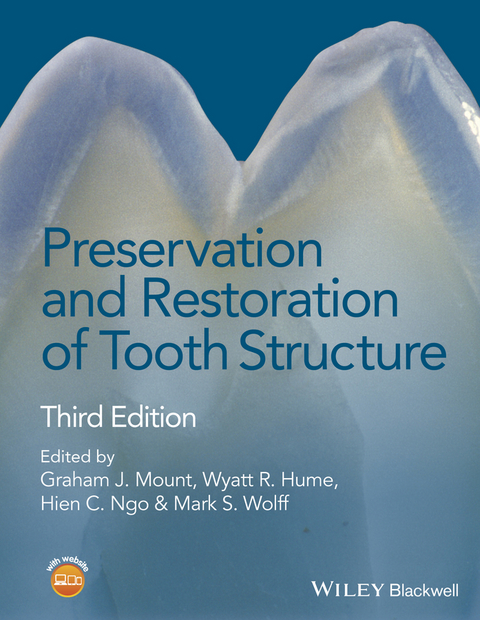
Preservation and Restoration of Tooth Structure (eBook)
John Wiley & Sons (Verlag)
978-1-118-76656-9 (ISBN)
Combining the approaches of preventative and restorative dentistry, this is a revised and updated guide to the clinical techniques and procedures necessary for managing tooth disorders and disease.
- Introduces minimally invasive dentistry as a model to control dental disease and then restore the mouth to optimal form, function, and aesthetics
- Contains several student-friendly features, including a new layout, line drawings and clinical photographs to illustrate key concepts
- Covers fundamental topics, including the evolutionary biology of the human oral environment; caries management and risk assessment; remineralization; principles of cavity design; lifestyle factors; choices between restorative materials and restoration management
- Includes a companion website with self-assessment exercises for students and a downloadable image bank for instructors
Graham J. Mount is a Visiting Research Fellow at the School of Dentistry, University of Adelaide, Australia and has a lifetime track record of promoting and delivering advances in the quality of patient care in areas related to both prevention and tooth restoration.
Wyatt R. Hume is a Senior Consultant with the Academy for Academic Leadership in Atlanta, former Professor and Chair of Restorative Dentistry at the University of California, San Francisco and former Dean of the School of Dentistry, University of California, Los Angeles, USA.
Hien C. Ngo is Professor and Dean of the School of Dentistry, University of Sharjah, United Arab Emirates.
Mark S. Wolff is Professor and Chair of the Department of Cariology and Comprehensive Care and Associate Dean for Pre-doctoral Clinical Education at the New York University College of Dentistry, USA.
Combining the approaches of preventative and restorative dentistry, this is a revised and updated guide to the clinical techniques and procedures necessary for managing tooth disorders and disease. Introduces minimally invasive dentistry as a model to control dental disease and then restore the mouth to optimal form, function, and aesthetics Contains several student-friendly features, including a new layout, line drawings and clinical photographs to illustrate key concepts Covers fundamental topics, including the evolutionary biology of the human oral environment; caries management and risk assessment; remineralization; principles of cavity design; lifestyle factors; choices between restorative materials and restoration management Includes a companion website with self-assessment exercises for students and a downloadable image bank for instructors
Graham J. Mount is a Visiting Research Fellow at the School of Dentistry, University of Adelaide, Australia and has a lifetime track record of promoting and delivering advances in the quality of patient care in areas related to both prevention and tooth restoration. Wyatt R. Hume is a Senior Consultant with the Academy for Academic Leadership in Atlanta, former Professor and Chair of Restorative Dentistry at the University of California, San Francisco and former Dean of the School of Dentistry, University of California, Los Angeles, USA. Hien C. Ngo is Professor and Dean of the School of Dentistry, University of Sharjah, United Arab Emirates. Mark S. Wolff is Professor and Chair of the Department of Cariology and Comprehensive Care and Associate Dean for Pre-doctoral Clinical Education at the New York University College of Dentistry, USA.
Preservation and Restoration of Tooth Structure 3
Contents 7
Contributors 9
Acknowledgments 11
About the companion website 13
Introduction 15
1 The Oral Environment and the Main Causes of Tooth Structure Loss 17
The Human Oral Environment in Health 18
The sialo?microbial?dental complex in a state of balance 18
Tooth Structure 18
Enamel 18
Dentine 20
Dental pulp 22
Tooth root and cementum 23
Periodontal tissues 23
Saliva 23
Composition and function of saliva 23
Saliva flow rate 24
Biofilms, Diet and ‘Mineral Maintenance’ 24
Biofilm pH relative to acid food 25
Biofilm pH relative to bacterial metabolism of food components 25
The Oral Environment in Disease 26
Imbalance within the sialo?microbial dental complex 26
Dental Caries 27
The pathogenesis of the early carious lesion 27
Demineralization outweighs remineralization at the ionic level 28
Subsurface demineralization of enamel 28
Pathogenesis of the advancing coronal lesion 28
Dental Corrosion (Erosion) 30
Sources of acid?causing corrosion 31
Mechanical Wear on Tooth Crowns 32
Mechanical wear as a physiological process 32
Abrasion 32
Attrition 33
Mechanical Wear as a Pathological Process 34
The toothbrush?related cervical lesion 34
Acid?accelerated wear 35
Abfraction 36
Tooth fracture, cusp fracture and enamel flaking 36
Crown fracture 37
Note 37
Bibliography 37
Further Reading 37
2 Dental Caries: Management of Early Lesions and the Disease Process 39
Development of Carious Lesions 40
Site 1: Fissures, Pits and Other Defects on Tooth Surfaces 40
Anatomy of the fissure system 40
Early stages of the Site 1 carious lesion: intact surface 41
Detection of early lesions 41
Pit and fissure sealing 42
Slightly more advanced pit and fissure lesions: initial breakdown of the surface 45
Larger lesions: moderate involvement of dentine, as evidenced by change of colour and/or radiolucency 45
Site 2: Tooth Surfaces below the Contact Area between Teeth (Approximal Surfaces) 45
Early stages of the carious lesion: intact surface 45
Initial surface breakdown: next stage of development of the approximal carious lesion 46
Site 3: Carious Lesions in Enamel or Exposed Root Surface in Areas of the Tooth Crown Adjacent to the Gingiva 47
Early stages of the carious lesion in enamel 47
Initial enamel surface breakdown 47
Early stages of the carious lesion on an exposed root surface 47
Substantially larger carious lesions of the root surface 48
Bibliography 48
3 Dental Caries: Activity and Risk Assessment as a Logical and Effective Path to Both Prevention and Cure 49
Introduction 50
Assessing the Risk of Developing Caries in the Future 50
Caries Activity Assessment 51
Methods of Assessing Activity and Risk 51
The Cariogram 51
Caries Management by Risk Assessment (CAMBRA) 52
The Traffic Light?Matrix (TL?M) System 53
Attitude 53
Disease status 54
Contributory risk factors in the TL?M system 54
Saliva 54
Assessment of the biofilm 58
Dietary analysis and caries risk 59
Fluoride 60
Modifying factors 61
Conclusion 64
Bibliography 64
4 Non?Carious Tooth Structure Loss: Diagnosis, Risk and Activity Assessment and Clinical Management 67
Non?Carious Loss of Tooth Surface Structure 68
The ‘MI’ approach to managing non?carious tooth surface loss 68
Corrosion (Erosion) 68
Activity of corrosion (erosion) 68
Specific contributory factors 69
Prevention and monitoring 70
Restorative approach to corrosion (erosion) 71
Abrasion 71
Restorative approach to abrasion 72
Attrition 72
Identification and evidence of active tooth grinding 72
Prevention of tooth grinding 72
Restorative approach to attrition 73
Cusp Fracture and Tooth Fracture 73
External Tooth Resorptions 74
Trauma?induced (non?infective) resorptions 74
Infection?induced resorptions 76
Bibliography 81
5 Aids to Remineralization 83
Introduction 84
Fluoride Therapy in Dentistry 84
Mechanism of action: enhancing remineralization and inhibiting demineralization 84
Mechanisms of action against bacteria 84
The intra?oral fluoride reservoir 84
In?office topical fluoride therapy 85
Safety issues with in?office fluoride applications 85
At?home fluoride products 87
Calcium?Based Remineralizing Agents 87
Functionalized ??tricalcium phosphate 87
Casein phosphopeptide?amorphous calcium phosphate 88
Amorphous calcium phosphate 88
Nano?hyroxyapatite 88
Arginine bicarbonate 89
Calcium carbonate 89
Dicalcium phosphate dihydrate 89
Calcium sodium phosphosilicate bioactive glass (NovaMin®) 89
Antimicrobials 89
Chlorhexidine 90
Sugar alcohols 91
Communication and Behavioural Modification in Establishing Oral Health 92
Bibliography 93
Conclusion 93
6 Systems for Classifying Defects of the Exposed Tooth Surface 97
Introduction 98
Black’s Classification of Carious Lesions 98
Alternative Systems for the Description of Lesions 99
A description of lesions by Site and Size 99
The International Caries Detection and Assessment System (ICDAS) and the International Caries Classification and Management System (ICCMS) 100
Conclusion 101
Bibliography 101
7 Principles of Cavity Design for the Restoration of Advanced Lesions 103
Introduction 104
Site 1 Lesions 104
Site 1 – Size 1, designated 1.1 104
Site 1 – Size 2, designated 1.2 106
Site 1 – Size 3, designated 1.3 107
Site 1 – Size 4, designated 1.4 108
Site 2 Lesions 109
Site 2 – Size 0, designated 2.0 113
Site 2 – Size 1, designated 2.1 113
Site 2 – Size 1 Internal occlusal fossa approach (tunnel cavity), designated 2.1 115
Site 2 – Size 1 – Slot cavity, designated 2.1 116
Site 2 – Size 1 – Proximal approach, designated 2.1 116
Site 2 – Size 2, designated 2.2 117
Site 2 – Size 3, designated 2.3 120
Site 2 – Size 4, designated 2.4 123
2.4 Posterior teeth 124
Site 3 Lesions 125
Site 3 – Size 0, designated 3.0 125
Site 3 – Size 1, designated 3.1 126
Site 3 – Size 2, designated 3.2 127
Site 3 – Size 3, designated 3.3 128
Site 3 – Size 4, designated 3.4 130
Bibliography 131
8 Instruments Used in Cavity Preparation 133
Rotary Cutting Instruments 134
Classification of burs 134
‘Annoyance Factor’ 134
Selection of burs 134
Size and Shape of Rotary Cutting Instruments 136
Elimination of inverted cone 136
Cutting efficiency 137
Linear surface speed 137
Application of load 137
Lubrication 137
Visual contact with the bur head 138
Speed Groups 138
Air Abrasion Techniques 140
Description 140
History 141
Available equipment 141
Clinical application 141
Clinical efficiency 143
Recommendations for use 143
Occupational hazards 144
Forthcoming Developments 144
Pulsed Erbium Lasers (Er:YAG and Er,Cr:YSGG) 144
History 144
Modus operandi of lasers 145
Clinical application 146
Sound effects 146
Analgesic effect 146
Effect on bonding 148
Further research 148
Chemo?Mechanical Caries Removal (Carisolv) 148
History 149
Clinical indications 150
Conventional Hand Instruments 151
Gingival margin trimmers 151
Spoon excavators 152
Bibliography 152
9 Glass?Ionomer Materials 155
General Description 156
The basic glass powder 156
The liquid 157
Modifications to the basic formula 157
Methods of dispensing 160
Mixing 161
Setting reaction of auto?cure materials 163
Three stages of the setting reaction 165
Rate of setting 165
Setting reaction of resin?modified glass?ionomer 165
Water balance 167
Adhesion to tooth structure 168
Placement routine 170
Clinical Properties of Glass?Ionomers 173
Biocompatibility 173
Solubility and disintegration 176
Clinical Considerations 179
Type I – Luting 179
Type II.1 – Restorative aesthetic 179
Type II.2 – Restorative reinforced 180
Type III – Lining and base cements 180
The Lamination or ‘Sandwich’ Technique 180
Principles of lamination 182
Bibliography 183
10 Resin?Based Composite Restorative Materials 185
Introduction 186
Composition and Use of Resin?Based Composites 186
Anterior RBC restorations 187
Posterior RBC restorations 188
Classification of RBCs by filler particle size and loading 191
Enamel Bonding 192
Dentine Bonding 192
Conclusion 195
Bibliography 195
11 Silver Amalgam 197
Silver Amalgam as a Restorative Material 198
The Influence of Amalgam on Cavity Form 198
Progressive Advances in Silver Amalgam Formulation 199
Further modifications to the formula 200
Increase in copper content 200
Control of mercury content 200
Trituration 201
By hand 201
By machine 201
Construction of a matrix 201
Condensation 202
Carving and shaping 202
Burnishing 203
Final polish and occlusal adjustment 203
The Mercury Hazard 205
Potentially available forms of mercury 205
Mercury release during dental procedures 205
WHO statement on the future use of amalgam 206
Allergy to amalgam 206
Concerns for dental staff 207
Environmental concerns 207
Note 207
Bibliography 207
12 Pulpal Responses, Pulp Protection and Pulp Therapy 209
Dentine and Pulp 210
Causes of Damage to Dentine and Pulp 210
Dentinal caries 210
Microleakage in restored teeth 210
Mechanical, thermal or chemical trauma 210
Responses of Dentine and Pulp to Insult 210
Defence within dentine 210
Mild acute injury 210
Moderate to severe acute injury 210
Chronic injury 211
Pulpal Inflammation in Response to Bacteria 211
Chronic inflammation 211
Acute inflammation 211
Inflammation in Response to Mechanical, Thermal and Chemical Insults 215
Reversible acute inflammation 215
Acute inflammation leading to pulp death 215
Treatment of the dead pulp 215
Periapical inflammation 215
Pulpal Pain and Sensation 215
‘Cervical sensitivity’ 215
Heightened sensibility due to pulpal inflammation 216
Tests of Pulpal and Periapical Status 216
Avoidance of Pulpal Damage Due to Caries 216
Indirect pulp therapy 216
Clinical routine 217
Choice of temporary restoration material 221
Avoidance of Pulpal Damage during Cavity Preparation 221
Generation of heat 221
Drying the dentine 221
Recovery from physical insult 222
Protective Measures during Restoration Placement 222
Minimizing bacterial microleakage 222
Chemical toxicity 222
Recovery from chemical insult 222
Chemical diffusion and fluid flow through dentine 222
Risks to the Pulp from Plastic Restorative Materials 223
Glass?ionomer cement 223
Composite resin 223
Dental amalgam 224
Risks to the Pulp with Luted Restorations 224
Materials Used in Pulp Protection 224
Varnishes and other surface treatments 224
Liners and bases 224
Vital Pulp Therapy 225
Treatment of pulpitis under intact dentine 225
Treatment of the Exposed Pulp 226
Cvek pulpotomy 226
Deciduous and permanent tooth pulpotomy 227
Bibliography 227
13 Choosing Between Restoration Modalities 229
Introduction 230
Glass-Ionomer Restorative Materials 230
Advantages 230
Disadvantages 231
Resin-Based Composite 231
Advantages 231
Disadvantages 231
Amalgam 232
Advantages 232
Disadvantages 232
Gold 233
Advantages 233
Disadvantages 233
Ceramics 233
Advantages 233
Disadvantages 233
Porcelain Fused to Metal 234
Advantages 234
Disadvantages 234
Factors Governing the Selection of a Restorative Material 234
Restoration and maintenance of physical properties of a tooth 234
Choice of restorative material according to site and size of lesion 235
Extracoronal restorations 237
Bibliography 237
14 Caries in Young Children: Special Considerations in Aetiology and Management 239
Introduction 240
Early childhood caries (ECC) 240
Special Predisposing Conditions for Caries in Young Children 240
Colonization of the mouth with cariogenic bacteria 240
Dietary characteristics that promote caries in young children 241
Lack of tooth cleaning 241
Newly erupted enamel 241
Enamel hypoplasia as predisposing factor for caries in young children 242
Prevention and Caries Management for Young Children 243
General caries preventive strategies for young children 243
Identifying children at moderate to high risk for caries 243
Caries management for moderate to high caries risk young children 243
Pit and fissure sealants for permanent molars 244
Glass?ionomer sealants 244
Resin sealants 245
Selection of materials 247
Bibliography 249
15 Oral Care of Older People 251
Introduction 252
Who are old people? 252
Defining biological ageing in a meaningful way 252
Epidemiology of older people 252
Oral Health Epidemiology of Older People 253
Tooth loss 253
Dental caries 253
Periodontal problems 253
Oral cancer 253
Dry mouth 253
Evidence-Based Prevention in the Elderly 254
Dependency Levels and Hypothetical Case Studies 254
No Dependency / Full Independence 255
Case Study 1: no dependency / full independence 255
Pre-dependency / Less Independence 256
Case study 2: pre-dependency / less independence 256
Medium Dependency 257
Case study 3: medium dependency 257
High Dependency 258
Case study 4: high dependency 258
Discussion 259
Formal care pathways 259
Summary 259
Bibliography 259
16 Lifestyle Factors Affecting Tooth Structure Loss 261
Introduction 262
Salivary Dysfunction 262
Salivary secretion and flow 263
Clinical salivary parameters 263
Systematic assessment 264
Aetiological factors in depressed salivary flow 264
Impact of medications 266
Caffeine intake, hydration, and salivary flow 267
Alcohol intake, saliva and dental disease 268
Other drug use and salivary dysfunction 268
Diabetes mellitus and saliva 268
Psychological stress and salivary flow 269
Hormonal variations and salivary flow 269
Gum chewing and salivary function 269
Lifestyle Factors More Broadly Relative to Diseases Causing Loss of Tooth Structure 269
Exposure to fluoride 270
Fermentable substrates in the diet 270
Bacterial infection: transmission of S. mutans 271
Frequent intake of acid in food or drinks 272
Endogenous acids 272
Eating disorders 272
Cigarette smoking 273
Modifications in Treatment 275
Dental caries and general health 275
Anti?bacterial therapy 276
Home care programmes for patients with salivary dysfunction 277
Home care advice summary for ‘lifestyle’ patients 277
Bibliography 278
Further Reading 279
17 Periodontal Considerations in Tooth Restoration 281
Normal Gingival Tissue 282
Epithelial attachment 282
Problems which Compromise Periodontal Tissue 283
Gingivitis 283
Effect of Restorative Dentistry on Gingival Tissue 285
Treatment procedures 286
Maintenance of occlusion 287
Procedures during restorative work 288
Modification to gingival architecture 291
Bibliography 291
18 Occlusion as It Relates to Restoration of Individual Teeth 293
Basic Principles of Occlusion 294
The intercuspal relationship of normal teeth in the adult 294
The envelope of movement 294
Factors which may modify anterior or lateral guidance 296
Factors Leading to Occlusal Change 296
Damage arising from excessive wear 300
Restoration of occlusal harmony 301
Restoration over time 303
Bibliography 303
19 Failures of Individual Restorations and Their Management 305
Failure of Tooth Structure 306
Continuing caries 306
Failure of the enamel margin 306
Failure of the dentine margin 307
Bulk loss of tooth structure 307
Split root 308
Loss of vitality 309
Failure of Restorative Material 309
Failure of the margin of the material 309
Amalgam 309
Composite resin 310
Glass?ionomer materials 310
Gold 311
Loss of luting cement 311
Fracture or collapse of a restorative material 311
Amalgam 311
Composite resin 312
Porcelain 312
Total Loss of a Restoration 312
Rigid restorations 312
Direct plastic restorations 312
Change of Restorative Material 312
Glass?ionomer 313
Composite resin 313
Amalgam 313
Gold 313
Porcelain 314
Bibliography 314
Index 315
EULA 329
| Erscheint lt. Verlag | 6.4.2016 |
|---|---|
| Sprache | englisch |
| Themenwelt | Kunst / Musik / Theater |
| Medizin / Pharmazie ► Gesundheitsfachberufe | |
| Medizin / Pharmazie ► Medizinische Fachgebiete ► Chirurgie | |
| Medizin / Pharmazie ► Zahnmedizin ► Chirurgie | |
| Schlagworte | Ästhetische Zahnheilkunde • Ãsthetische Zahnheilkunde • caries lesions • cavity design</p> • dental disease • dentistry • Esthetic Dentistry • <p>Minimally invasive dentistry • Mid • Operative Dentistry • preventative dentistry • Remineralization • Restaurative Zahnheilkunde • restorative dentistry • tooth structure • Zahnheilkunde • Zahnmedizin |
| ISBN-10 | 1-118-76656-3 / 1118766563 |
| ISBN-13 | 978-1-118-76656-9 / 9781118766569 |
| Informationen gemäß Produktsicherheitsverordnung (GPSR) | |
| Haben Sie eine Frage zum Produkt? |
 PDF (Adobe DRM)
Kopierschutz: Adobe-DRM
Adobe-DRM ist ein Kopierschutz, der das eBook vor Mißbrauch schützen soll. Dabei wird das eBook bereits beim Download auf Ihre persönliche Adobe-ID autorisiert. Lesen können Sie das eBook dann nur auf den Geräten, welche ebenfalls auf Ihre Adobe-ID registriert sind.
Details zum Adobe-DRM
Dateiformat: PDF (Portable Document Format)
Mit einem festen Seitenlayout eignet sich die PDF besonders für Fachbücher mit Spalten, Tabellen und Abbildungen. Eine PDF kann auf fast allen Geräten angezeigt werden, ist aber für kleine Displays (Smartphone, eReader) nur eingeschränkt geeignet.
Systemvoraussetzungen:
PC/Mac: Mit einem PC oder Mac können Sie dieses eBook lesen. Sie benötigen eine
eReader: Dieses eBook kann mit (fast) allen eBook-Readern gelesen werden. Mit dem amazon-Kindle ist es aber nicht kompatibel.
Smartphone/Tablet: Egal ob Apple oder Android, dieses eBook können Sie lesen. Sie benötigen eine
Geräteliste und zusätzliche Hinweise
Buying eBooks from abroad
For tax law reasons we can sell eBooks just within Germany and Switzerland. Regrettably we cannot fulfill eBook-orders from other countries.
aus dem Bereich