


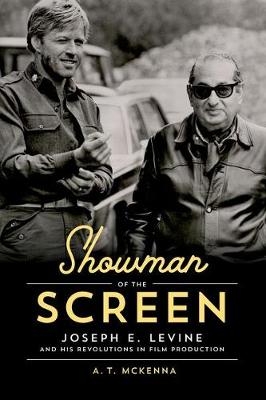
Showman of the Screen
Joseph E. Levine and His Revolutions in Film Promotion
Seiten
2016
The University Press of Kentucky (Verlag)
978-0-8131-6871-5 (ISBN)
The University Press of Kentucky (Verlag)
978-0-8131-6871-5 (ISBN)
- Keine Verlagsinformationen verfügbar
- Artikel merken
Short, immaculately dressed, and shockingly foul-mouthed, Joseph E. Levine (1905-1987) was larger than life. He rose from poverty in Boston's West End to become one of postwar Hollywood's most prolific independent promoters, distributors, and producers. In the first biography of this controversial pioneer, A.T. McKenna traces Levine's rise as an influential packager of popular culture.
Short, immaculately dressed, and shockingly foul-mouthed, Joseph E. Levine (1905--1987) was larger than life. He rose from poverty in Boston's West End to become one of postwar Hollywood's most prolific independent promoters, distributors, and producers. Alternately respected and reviled, this master of movie promotion was responsible for bringing films as varied as Godzilla: King of the Monsters! (1956), Hercules (1958), The Graduate (1967), The Lion in Winter (1968), and A Bridge Too Far (1977) to American audiences .
In the first biography of this controversial pioneer, A. T. McKenna traces Levine's rise as an influential packager of popular culture. He explores the mogul's pivotal role in many significant industry innovations from the 1950s to the 1970s, examining his use of saturation release tactics and bombastic advertising campaigns. Levine was also a trailblazer in promoting European art house cinema in the 1960s. He made Federico Fellini's 8½ (1963) a hit in America, feuded with Jean-Luc Godard over their production of Contempt (1963), and campaigned aggressively for Sophia Loren to become the first actress to win an Oscar for a foreign language performance for her role in Two Women (1960).
Despite his significant accomplishments and prominent role in shaping film distribution and promotion in the post-studio era, Levine is largely overlooked today. McKenna's in-depth biography corrects misunderstandings and misinformation about this colorful figure, and offers a sober assessment of his contributions to world cinema. It also illuminates Levine's peculiar talent for movie- and self-promotion, as well as his extraordinary career in the motion picture business.
Short, immaculately dressed, and shockingly foul-mouthed, Joseph E. Levine (1905--1987) was larger than life. He rose from poverty in Boston's West End to become one of postwar Hollywood's most prolific independent promoters, distributors, and producers. Alternately respected and reviled, this master of movie promotion was responsible for bringing films as varied as Godzilla: King of the Monsters! (1956), Hercules (1958), The Graduate (1967), The Lion in Winter (1968), and A Bridge Too Far (1977) to American audiences .
In the first biography of this controversial pioneer, A. T. McKenna traces Levine's rise as an influential packager of popular culture. He explores the mogul's pivotal role in many significant industry innovations from the 1950s to the 1970s, examining his use of saturation release tactics and bombastic advertising campaigns. Levine was also a trailblazer in promoting European art house cinema in the 1960s. He made Federico Fellini's 8½ (1963) a hit in America, feuded with Jean-Luc Godard over their production of Contempt (1963), and campaigned aggressively for Sophia Loren to become the first actress to win an Oscar for a foreign language performance for her role in Two Women (1960).
Despite his significant accomplishments and prominent role in shaping film distribution and promotion in the post-studio era, Levine is largely overlooked today. McKenna's in-depth biography corrects misunderstandings and misinformation about this colorful figure, and offers a sober assessment of his contributions to world cinema. It also illuminates Levine's peculiar talent for movie- and self-promotion, as well as his extraordinary career in the motion picture business.
A. T. McKenna is associate professor of film history at the USC-SJTU Institute of Cultural and Creative Industry. He coauthored The Man Who Got Carter: Michael Klinger, Independent Production, and the British Film Industry, 1960-1980 and coedited Beyond the Bottom Line: The Producer in Film and Television Studies.
| Erscheinungsdatum | 13.10.2016 |
|---|---|
| Reihe/Serie | Screen Classics |
| Zusatzinfo | 30 b/w images |
| Verlagsort | Lexington |
| Sprache | englisch |
| Maße | 152 x 229 mm |
| Themenwelt | Literatur ► Biografien / Erfahrungsberichte |
| Kunst / Musik / Theater ► Film / TV | |
| ISBN-10 | 0-8131-6871-6 / 0813168716 |
| ISBN-13 | 978-0-8131-6871-5 / 9780813168715 |
| Zustand | Neuware |
| Informationen gemäß Produktsicherheitsverordnung (GPSR) | |
| Haben Sie eine Frage zum Produkt? |
Mehr entdecken
aus dem Bereich



aus dem Bereich
unser Eingliederungsversuch in eine geschlossene Gesellschaft
Buch | Softcover (2025)
Knaur (Verlag)
CHF 25,20


