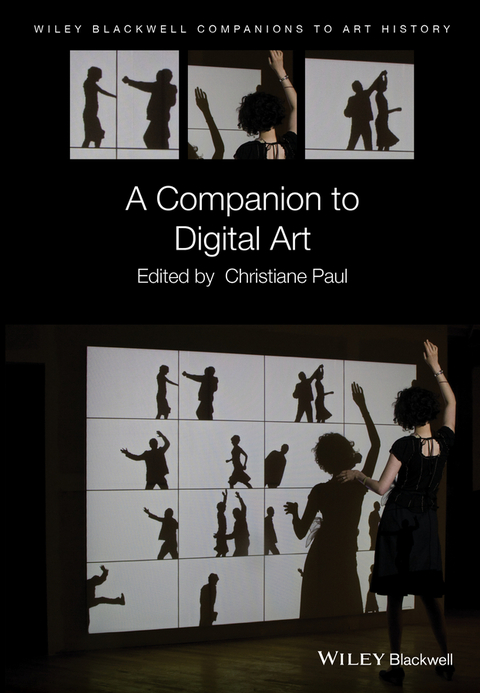
A Companion to Digital Art (eBook)
John Wiley & Sons (Verlag)
978-1-118-47521-8 (ISBN)
- Showcases the critical and theoretical approaches in this fast-moving discipline
- Explores the history and evolution of digital art; its aesthetics and politics; as well as its often turbulent relationships with established institutions
- Provides a platform for the most influential voices shaping the current discourse surrounding digital art, combining fresh, emerging perspectives with the nuanced insights of leading theorists
- Tackles digital art's primary practical challenges - how to present, document, and preserve pieces that could be erased forever by rapidly accelerating technological obsolescence
- Up-to-date, forward-looking, and critically reflective, this authoritative new collection is informed throughout by a deep appreciation of the technical intricacies of digital art
Christiane Paul is Associate Professor in the School of Media Studies at the New School, New York, USA, and also Adjunct Curator of New Media Arts at the Whitney Museum of American Art. Prof. Paul is a noted curator who oversees the Whitney's artport website and has for more than a decade conceived and administered the museum's new media exhibitions, including Data Dynamics (2001), Profiling (2007), and Cory Arcangel: Pro Tools (2011). Other curatorial work includes The Public Private (Kellen Gallery, The New School, 2013); Biennale Quadrilaterale (Rijeka, Croatia, 2009-10); Feedforward - The Angel of History (LABoral, Spain, 2009); and INDAF Digital Art Festival (Incheon, Korea, 2009). She is the author of Digital Art (2003), New Media in the White Cube and Beyond (2008), and co-editor with Margot Lovejoy and Victoria Vesna of Context Providers - Conditions of Meaning in Media Arts (2011).
Reflecting the dynamic creativity of its subject, this definitive guide spans the evolution, aesthetics, and practice of today s digital art, combining fresh, emerging perspectives with the nuanced insights of leading theorists. Showcases the critical and theoretical approaches in this fast-moving discipline Explores the history and evolution of digital art; its aesthetics and politics; as well as its often turbulent relationships with established institutions Provides a platform for the most influential voices shaping the current discourse surrounding digital art, combining fresh, emerging perspectives with the nuanced insights of leading theorists Tackles digital art s primary practical challenges how to present, document, and preserve pieces that could be erased forever by rapidly accelerating technological obsolescence Up-to-date, forward-looking, and critically reflective, this authoritative new collection is informed throughout by a deep appreciation of the technical intricacies of digital art
Christiane Paul is Associate Professor in the School of Media Studies at the New School, New York, USA, and also Adjunct Curator of New Media Arts at the Whitney Museum of American Art. Prof. Paul is a noted curator who oversees the Whitney's artport website and has for more than a decade conceived and administered the museum's new media exhibitions, including Data Dynamics (2001), Profiling (2007), and Cory Arcangel: Pro Tools (2011). Other curatorial work includes The Public Private (Kellen Gallery, The New School, 2013); Biennale Quadrilaterale (Rijeka, Croatia, 2009-10); Feedforward - The Angel of History (LABoral, Spain, 2009); and INDAF Digital Art Festival (Incheon, Korea, 2009). She is the author of Digital Art (2003), New Media in the White Cube and Beyond (2008), and co-editor with Margot Lovejoy and Victoria Vesna of Context Providers - Conditions of Meaning in Media Arts (2011).
List of Figures viii
Notes on Contributors xi
Acknowledgments xix
Introduction: From Digital to Post-Digital--Evolutions of an Art Form 1
Christiane Paul
Part I Histories of Digital Art 21
1 The Complex and Multifarious Expressions of Digital Art and Its Impact on Archives and Humanities 23
Oliver Grau
2 International Networks of Early Digital Arts 46
Darko Fritz
3 Art in the Rear-View Mirror: The Media-Archaeological Tradition in Art 69
Erkki Huhtamo Copyrighted Material
4 Proto-Media Art: Revisiting Japanese Postwar Avant-garde Art 111
Machiko Kusahara
5 Generative Art Theory 146
Philip Galanter
6 Digital Art at the Interface of Technology and Feminism 181
Jennifer Way
7 The Hauntology of the Digital Image 203
Charlie Gere
8 Participatory Art: Histories and Experiences of Display 226
Rudolf Frieling
Part II Aesthetics of Digital Art 247
9 Small Abstract Aesthetics 249
Max Bense
10 Aesthetics of the Digital 265
Sean Cubitt
11 Computational Aesthetics 281
M. Beatrice Fazi and Matthew Fuller
12 Participatory Platforms and the Emergence of Art 297
Olga Goriunova
13 Interactive Art: Interventions in/to Process 310
Nathaniel Stern
14 The Cultural Work of Public Interactives 330
Anne Balsamo
Part III Network Cultures: The Politics of Digital Art 353
15 Shockwaves in the New World Order of Information and Communication 355
Armin Medosch
16 Critical Intelligence in Art and Digital Media 384
Konrad Becker
17 The Silver Age of Social Media: Nettime.org and the Avant-Garde of the '90s 400
McKenzie Wark
18 Art in the Corporatized Sphere: The Impact of Commercial Social Media on Online Artistic Practice 413
Kyle Chayka
19 Artistic Visualization 426
Lev Manovich
20 Critical Play: The Productive Paradox 445
Mary Flanagan
Part IV Digital Art and the Institution 461
21 Contemporary Art and New Media: Digital Divide or Hybrid Discourse? 463
Edward A. Shanken
22 One of Us!: On the Coupling of New Media Art and Art Institutions 482
Richard Rinehart
23 The Digital Arts In and Out of the Institution--Where to Now? 494
Sarah Cook with Aneta Krzemien´ Barkley
24 The Nuts and Bolts of Handling Digital Art 516
Ben Fino-Radin
25 Trusting Amateurs with Our Future 537
Jon Ippolito
26 Enabling the Future, or How to Survive FOREVER 553
Annet Dekker
27 Exhibition Histories and Futures: The Importance of Participation and Audiences 575
Beryl Graham
Index 597
Notes on Contributors
Anne Balsamo serves as the Dean of the School of Media Studies at The New School in New York City. Previously she was a faculty member at the University of Southern California in the Annenberg School of Communication and the Interactive Media Division of the School of Cinematic Arts. In 2002 she co-founded Onomy Labs, Inc., a Silicon Valley technology design and fabrication company that builds cultural technologies. From 1999 to 2002 she was a member of RED (Research on Experimental Documents), a collaborative research/design group at Xerox PARC that created experimental reading devices and new media genres. Her book Designing Culture: The Technological Imagination at Work (2011) offers a manifesto for rethinking the role of culture in the process of technological innovation in the 21st century. Her first book, Technologies of the Gendered Body: Reading Cyborg Women (1996), investigated the social and cultural implications of emergent biotechnologies.
Konrad Becker is a researcher, artist, and organizer. He is director of the Institute for New Culture Technologies/t0 and World-Information.Org, a cultural intelligence provider. As co-founder of the Public Netbase project in Vienna (1994–2006) he initiated numerous pioneering media projects in various domains, including electronic music. He has conceptualized and produced international conferences, as well as exhibitions and cultural interventions, and his work has been characterized by extensive cooperation with collectives and protagonists of new artistic practices. As an interdisciplinary researcher he investigates cultural and social implications of technology in information societies. His publications include texts on the politics of the infosphere that have been translated into several languages. His latest books in English include Dictionary of Operations (2012), Strategic Reality Dictionary (2009), Critical Strategies in Art and Media, co-edited with Jim Fleming (2010), Deep Search: The Politics of Search beyond Google, co-edited with Felix Stalder (2009). http://www.world-information.net.
Max Bense (1910–1990) was a German writer and philosopher of science, logic, aesthetics, and semiotics. Bense studied mathematics, physics, and philosophy in Bonn, Cologne (Germany), and Basle (Switzerland). From 1949 onward he was a professor of the philosophy of technology, scientific theory, and mathematical logic at the Technical University of Stuttgart where he taught until 1976. In the late 1950s and the 1960s he was the key figure of the Stuttgart School, thought of as an experimental testing ground for rational aesthetics. Influenced by cybernetics and computer art, Bense devoted himself to creating a foundation for aesthetics based in information theory. He coined the term “information aesthetics” and tried to develop a scientifically sound and quantifiable aesthetic. Among his publications are Aesthetic Information (1957), Mathematics and Beauty (1960), Aesthetica: An Introduction to New Aesthetics (1965), An Introduction to Information Theoretical Aesthetics (1969), and The Representation and Grounding of Realities: The Sum of Semiotic Perspectives (1986).
Kyle Chayka is a writer and curator living in Brooklyn. He has contributed to publications including The New Yorker, The New Republic, ARTnews, and Modern Painters, covering art’s intersection with technology and the rise of artists working on the Internet. His writing can be found in Reading Pop Culture: A Portable Anthology (2013) and he is the author of The Printed Gun: How 3D Printing Is Challenging Gun Control (2013). Chayka is the curator of Dying on Stage: New Painting in New York at Garis & Hahn Gallery and co-curator of Shortest Video Art Ever Sold and National Selfie Portrait Gallery at Moving Image art fair in New York and London.
Sarah Cook is a curator of contemporary art, writer, and new media art historian. She is the author (with Beryl Graham) of Rethinking Curating: Art After New Media (2010) and co-editor (with Sara Diamond) of Euphoria & Dystopia (2011), an anthology of texts about art and technology drawn from over a decade’s research at the world-renowned Banff New Media Institute. Sarah Cook received her PhD in curating new media art from the University of Sunderland (2004) where she co-founded the online resource for curators CRUMB (http://www.crumbweb.org). She lectures and publishes widely and has curated exhibitions in Canada, the USA, New Zealand, Mexico City, across Europe, and online, which have been reviewed in publications including Art Monthly, ArtForum, Mute, Rhizome, and we-make-money-not-art. She has been invited an speaker at museums and galleries worldwide including Stedelijk Museum (Amsterdam), Tate (London), Centro Nacional de las Artes (Mexico), National Gallery of Canada (Ottawa), Istanbul Modern (Istanbul), and Fundacion Telefonica (Buenos Aires).
Sean Cubitt is Professor of Film and Television at Goldsmiths, University of London, Professorial Fellow of the University of Melbourne, and Honorary Professor of the University of Dundee. His publications include Timeshift: On Video Culture (1991), Videography: Video Media as Art and Culture (1993), Digital Aesthetics (1998), Simulation and Social Theory (2001), The Cinema Effect (2005), and EcoMedia (2005). He is the series editor for Leonardo Books at MIT Press. His current research focuses on the history and philosophy of visual technologies, media art history, as well as ecocriticism and mediation.
Annet Dekker is an independent researcher, curator, and writer and core tutor at Piet Zwart Institute, Rotterdam. In 2009 she initiated the online platform http://aaaan.net with Annette Wolfsberger; they coordinate artists-in-residences and set up strategic and sustainable collaborations with (inter)national arts organizations. Previously Annet worked as web curator for SKOR (2010–2012), was program manager at Virtueel Platform (2008–2010), head of exhibitions, education, and artists-in-residence at the Netherlands Media Art Institute (1999–2008), and editor of several publications on digital art and issues of preservation. In 2008 she began PhD research into strategies for documenting net art at the Centre for Cultural Studies, Goldsmiths University, London.
M. Beatrice Fazi is Research Fellow in Digital Humanities & Computational Culture at the Sussex Humanities Lab (University of Sussex, UK). Her research explores questions at the intersection of philosophy, science, and technology. Her current work investigates the limits of formal reasoning in relation to computation, and addresses the ways in which these limits shape the ontology of computational aesthetics. Through doing so, she aims to offer a reconceptualization of contingency within formal axiomatic systems, vis-à-vis technoscientific notions of incompleteness and incomputability.
Ben Fino-Radin is a New York-based media archaeologist specializing in the preservation of digital contemporary art and culture. Fino-Radin serves as Digital Repository Manager at the Museum of Modern Art’s department of conservation, and as Adjunct Professor in NYU’s Moving Image Archiving and Preservation program. In private practice Fino-Radin has advised museums and artists, including the Whitney Museum of American Art, artist Cory Arcangel, and the art collective JODI. Fino-Radin holds an MS and MFA in Library and Information Science and Digital Art, respectively, from Pratt Institute and is an alumnus of Rhizome at the New Museum where he formerly served as Digital Conservator.
Mary Flanagan pushes the boundaries of medium and genre across writing, visual arts, and design to innovate in these fields with a critical play-centered approach. As an artist she has created over twenty major works ranging from game-inspired systems to computer viruses and embodied interfaces to interactive texts,which are exhibited internationally. As a scholar interested in how human values are in play across technologies and systems, Flanagan has written more than twenty critical essays and chapters on games, empathy, gender and digital representation, art and technology, and responsible design. Her recent books include Critical Play (2009) and Values at Play in Digital Games, with Helen Nissenbaum (2014). Flanagan’s work has been supported by grants and commissions from organizations including the British Arts Council, the National Endowment for the Humanities, the ACLS, and the National Science Foundation. Flanagan is the Sherman Fairchild Distinguished Professor in Digital Humanities at Dartmouth College, Massachusetts.
Rudolf Frieling graduated from the Free University in Berlin and received a PhD from the University of Hildesheim, Germany. As a curator, he worked at the International VideoFest Berlin (1988–1994) and at the ZKM Center for Art and Media in Karlsruhe (1994–2006). During that period he directed and co-edited the multimedia and publishing projects Media Art Action (1997), Media Art Interaction (2000), Media Art Net 1/2 (2004/2005), and 40yearvideoart.de-part 1 (2006). Since 2006 he has been Curator of Media Arts at SFMOMA where he has curated the survey shows In Collaboration: Early Works from the Media Arts...
| Erscheint lt. Verlag | 2.3.2016 |
|---|---|
| Reihe/Serie | Blackwell Companions to Art History |
| Blackwell Companions to Art History | Blackwell Companions to Art History |
| Sprache | englisch |
| Themenwelt | Kunst / Musik / Theater ► Allgemeines / Lexika |
| Sozialwissenschaften ► Kommunikation / Medien | |
| Sozialwissenschaften ► Politik / Verwaltung | |
| Sozialwissenschaften ► Soziologie | |
| Schlagworte | Aesthetics • Art & Applied Arts • Art History • art theory • Communication & Media Studies • Computer-generated art • Critical theory • Cultural Studies • Digital Art • Digital Culture & the Information Age • Digitale Kultur im Informationszeitalter • digitale Kunst • Digital Media • Electronic Media • Kommunikation u. Medienforschung • Kulturwissenschaften • Kunst • Kunsttheorie • Kunst u. Angewandte Kunst • media history • Media Theory • Multimedia • Neue Medien • New Media • philosophy of art • Social Media |
| ISBN-10 | 1-118-47521-6 / 1118475216 |
| ISBN-13 | 978-1-118-47521-8 / 9781118475218 |
| Informationen gemäß Produktsicherheitsverordnung (GPSR) | |
| Haben Sie eine Frage zum Produkt? |
 EPUB (Adobe DRM)
Kopierschutz: Adobe-DRM
Adobe-DRM ist ein Kopierschutz, der das eBook vor Mißbrauch schützen soll. Dabei wird das eBook bereits beim Download auf Ihre persönliche Adobe-ID autorisiert. Lesen können Sie das eBook dann nur auf den Geräten, welche ebenfalls auf Ihre Adobe-ID registriert sind.
Details zum Adobe-DRM
Dateiformat: EPUB (Electronic Publication)
EPUB ist ein offener Standard für eBooks und eignet sich besonders zur Darstellung von Belletristik und Sachbüchern. Der Fließtext wird dynamisch an die Display- und Schriftgröße angepasst. Auch für mobile Lesegeräte ist EPUB daher gut geeignet.
Systemvoraussetzungen:
PC/Mac: Mit einem PC oder Mac können Sie dieses eBook lesen. Sie benötigen eine
eReader: Dieses eBook kann mit (fast) allen eBook-Readern gelesen werden. Mit dem amazon-Kindle ist es aber nicht kompatibel.
Smartphone/Tablet: Egal ob Apple oder Android, dieses eBook können Sie lesen. Sie benötigen eine
Geräteliste und zusätzliche Hinweise
Buying eBooks from abroad
For tax law reasons we can sell eBooks just within Germany and Switzerland. Regrettably we cannot fulfill eBook-orders from other countries.
aus dem Bereich