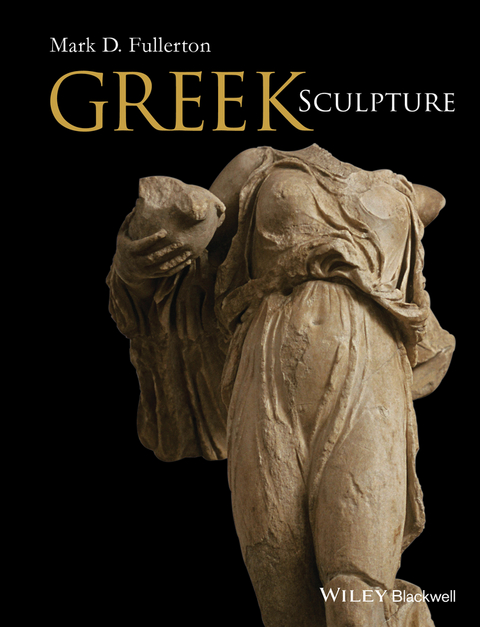
Greek Sculpture (eBook)
John Wiley & Sons (Verlag)
978-1-119-11530-4 (ISBN)
- Compares the evolution of Greek sculpture over the centuries to works of contemporaneous Mediterranean civilizations
- Emphasizes looking closely at the stylistic features of Greek sculpture, illustrating these observations where possible with original works rather than copies
- Places the remarkable progress of stylistic changes that took place in Greek sculpture within a broader social and historical context
- Facilitates an understanding of why Greek monuments look the way they do and what ideas they were capable of expressing
- Focuses on the most recent interpretations of Greek sculptural works while considering the fragile and fragmentary evidence uncovered
Mark D. Fullerton is Professor of History of Art and Classics at The Ohio State University. He is the author of The Archaistic Style in Roman Statuary (1990), Greek Art (2000), and co-editor of Ancient Art and its Historiography (2003).
Greek Sculpture presents a chronological overview of the plastic and glyptic art forms in the ancient Greek world from the emergence of life-sized marble statuary at the end of the seventh century BC to the appropriation of Greek sculptural traditions by Rome in the first two centuries AD. Compares the evolution of Greek sculpture over the centuries to works of contemporaneous Mediterranean civilizations Emphasizes looking closely at the stylistic features of Greek sculpture, illustrating these observations where possible with original works rather than copies Places the remarkable progress of stylistic changes that took place in Greek sculpture within a broader social and historical context Facilitates an understanding of why Greek monuments look the way they do and what ideas they were capable of expressing Focuses on the most recent interpretations of Greek sculptural works while considering the fragile and fragmentary evidence uncovered
Mark D. Fullerton is Professor of History of Art and Classics at The Ohio State University. He is the author of The Archaistic Style in Roman Statuary (1990), Greek Art (2000), and co-editor of Ancient Art and its Historiography (2003).
Preface
CHAPTER 1 - Beginnings and Before: Greek Sculpture in the Iron Age (ca.1000-600)
BOX - Uses of Sculpture in Ancient Greece
CHAPTER 2 - The Search for Order: Sculptural Schemata and Regional Styles (ca. 600-550)
BOX - Marble, the Monumental, and Egypt: Materials and Processes
CHAPTER 3. Free-Standing Sculpture in the Later Sixth Century: Style and Penhellenism (ca. 550-500):
BOX - Chronology and Herodotus
CHAPTER 4. Sixth Century Architectural Sculpture
BOX - The Greek Architectural Orders and Vitruvius
CHAPTER 5. The Change to Classical: Democratic Athens and the Persian Conflict (ca. 500-460)
BOX - Bronze Casting Techniques - "Copies and Originals"
CHAPTER 6. The Temple of Zeus at Olympia: Panhellenism and the Early Classical (ca. 470-450)
BOX - Literary Sources I - Pausanias
CHAPTER 7. Classical Moment I: The Parthenon, Pericles, and the Power of Persuasion (ca. 450-430)
BOX - The Parthenon Marbles and the Acropolis Museum
CHAPTER 8. Classical Moment II: Sculptors and Statuary in the Mid-Fifth Century
BOX - Literary Sources II - Ancient Art Histories
CHAPTER 9. Unfinished Business: Pericles' Programs and the Archidamian War (ca. 430-420)
BOX - The Evidence of Inscriptions
CHAPTER 10. An Attic Tragedy: The Fall of Athens and The Transition to Late Classical (ca. 420-390)
BOX - Painting and Perceptualism
CHAPTER 11. Idealism and Individuality I: Late Classical Architectural Sculpture
(ca. 390-330)
BOX - Itinerant Artists and Regional Schools
CHAPTER 12. Idealism and Individuality II: Late Classical Statuary and Relief Sculpture (ca. 390-330)
BOX - The Role of the Sculptor
CHAPTER 13. Sculpture in Hellenistic Greece I: The Rise of Macedon and the Kingdoms of the Diadochs (ca. 330-200)
BOX - The Nike of Samothrace and Hellenistic Chronology
CHAPTER 14. Sculpture in Hellenistic Greece II: Greek Styles and Roman Taste (ca. 200-50)
BOX - Ars revixit, Hellenistic Classicism, and Roman Patronage
| Erscheint lt. Verlag | 16.3.2016 |
|---|---|
| Sprache | englisch |
| Themenwelt | Literatur |
| Kunst / Musik / Theater ► Kunstgeschichte / Kunststile | |
| Kunst / Musik / Theater ► Malerei / Plastik | |
| Geschichte ► Allgemeine Geschichte ► Vor- und Frühgeschichte | |
| Geschichte ► Allgemeine Geschichte ► Altertum / Antike | |
| Geisteswissenschaften ► Geschichte ► Regional- / Ländergeschichte | |
| Geisteswissenschaften ► Sprach- / Literaturwissenschaft ► Anglistik / Amerikanistik | |
| Geisteswissenschaften ► Sprach- / Literaturwissenschaft ► Literaturwissenschaft | |
| Schlagworte | Altertum /Bildende Kunst • Ancient & Classical Greek & Hellenistic History • ancient art • Ancient Culture • ancient marble • Ancient sculpture • ancient statuary</p> • ancient statues • Art & Applied Arts • Art History & Criticism • Classical Art • classical sculpture • Classical Studies • Greek statuary • Griechenland /Kultur, Künste • Griechenland /Kultur, Künste • Hellenistic Art • Hellenistic Sculpture • Hellenistische Geschichte, Geschichte der griechischen Antike • Humanistische Studien • Klassisches Altertum • Kunstgeschichte • Kunstgeschichte u. -kritik • Kunst u. Angewandte Kunst • <p>Greek sculpture • Skulptur |
| ISBN-10 | 1-119-11530-2 / 1119115302 |
| ISBN-13 | 978-1-119-11530-4 / 9781119115304 |
| Informationen gemäß Produktsicherheitsverordnung (GPSR) | |
| Haben Sie eine Frage zum Produkt? |
 PDF (Adobe DRM)
Kopierschutz: Adobe-DRM
Adobe-DRM ist ein Kopierschutz, der das eBook vor Mißbrauch schützen soll. Dabei wird das eBook bereits beim Download auf Ihre persönliche Adobe-ID autorisiert. Lesen können Sie das eBook dann nur auf den Geräten, welche ebenfalls auf Ihre Adobe-ID registriert sind.
Details zum Adobe-DRM
Dateiformat: PDF (Portable Document Format)
Mit einem festen Seitenlayout eignet sich die PDF besonders für Fachbücher mit Spalten, Tabellen und Abbildungen. Eine PDF kann auf fast allen Geräten angezeigt werden, ist aber für kleine Displays (Smartphone, eReader) nur eingeschränkt geeignet.
Systemvoraussetzungen:
PC/Mac: Mit einem PC oder Mac können Sie dieses eBook lesen. Sie benötigen eine
eReader: Dieses eBook kann mit (fast) allen eBook-Readern gelesen werden. Mit dem amazon-Kindle ist es aber nicht kompatibel.
Smartphone/Tablet: Egal ob Apple oder Android, dieses eBook können Sie lesen. Sie benötigen eine
Geräteliste und zusätzliche Hinweise
Buying eBooks from abroad
For tax law reasons we can sell eBooks just within Germany and Switzerland. Regrettably we cannot fulfill eBook-orders from other countries.
aus dem Bereich