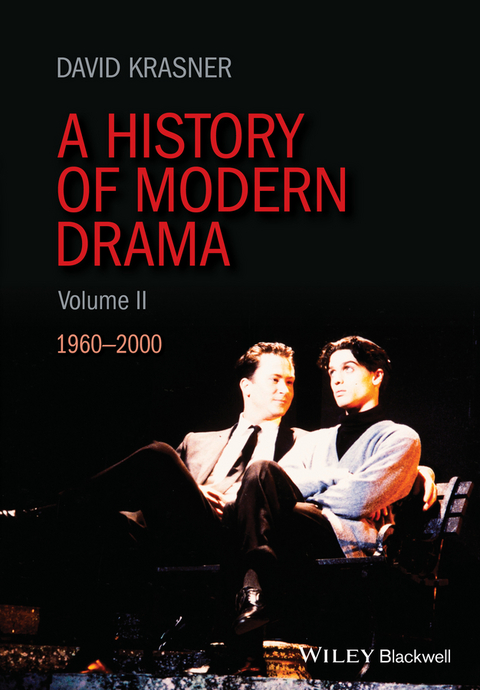
A History of Modern Drama, Volume II (eBook)
John Wiley & Sons (Verlag)
978-1-118-89320-3 (ISBN)
A History of Modern Drama: Volume II explores a remarkable breadth of topics and analytical approaches to the dramatic works, authors, and transitional events and movements that shaped world drama from 1960 through to the dawn of the new millennium.
- Features detailed analyses of plays and playwrights, examining the influence of a wide range of writers, from mainstream icons such as Harold Pinter and Edward Albee, to more unorthodox works by Peter Weiss and Sarah Kane
- Provides global coverage of both English and non-English dramas - including works from Africa and Asia to the Middle East
- Considers the influence of art, music, literature, architecture, society, politics, culture, and philosophy on the formation of postmodern dramatic literature
- Combines wide-ranging topics with original theories, international perspective, and philosophical and cultural context
Completes a comprehensive two-part work examining modern world drama, and alongside A History of Modern Drama: Volume I, offers readers complete coverage of a full century in the evolution of global dramatic literature.
David Krasner is Professor and Dean of the School of the Arts at Dean College in Franklin, Massachusetts. He is the author and editor of numerous books on modern drama, African American theatre, dramatic theory and criticism, and acting, including A History of Modern Drama: Volume I (2012), and Theatre in Theory: An Anthology (editor, 2008), both published by Wiley Blackwell.
A History of Modern Drama: Volume II explores a remarkable breadth of topics and analytical approaches to the dramatic works, authors, and transitional events and movements that shaped world drama from 1960 through to the dawn of the new millennium. Features detailed analyses of plays and playwrights, examining the influence of a wide range of writers, from mainstream icons such as Harold Pinter and Edward Albee, to more unorthodox works by Peter Weiss and Sarah Kane Provides global coverage of both English and non-English dramas including works from Africa and Asia to the Middle East Considers the influence of art, music, literature, architecture, society, politics, culture, and philosophy on the formation of postmodern dramatic literature Combines wide-ranging topics with original theories, international perspective, and philosophical and cultural context Completes a comprehensive two-part work examining modern world drama, and alongside A History of Modern Drama: Volume I, offers readers complete coverage of a full century in the evolution of global dramatic literature.
David Krasner is Professor and Dean of the School of the Arts at Dean College in Franklin, Massachusetts. He is the author and editor of numerous books on modern drama, African American theatre, dramatic theory and criticism, and acting, including A History of Modern Drama: Volume I (2012), and Theatre in Theory: An Anthology (editor, 2008), both published by Wiley Blackwell.
Preface and Acknowledgments
Men make their own history, but they do not make it just as they please; they do not make it under circumstances chosen by themselves, but under circumstances directly encountered, given and transmitted from the past. The tradition of all the dead generations weighs like a nightmare on the brain of the living.
– Karl Marx1
Theatre is the vanishing life of a collective contemporaneity of truths.
– Alain Badiou2
A people makes a poem, a poem makes a people.
– Jacques Rancière3
A History of Modern Drama, Volume II, picks up where Volume I leaves off, providing an analysis of selected dramas and dramatists from 1960 through 2000. My aim is to trace methodologies of modern drama during this period, an era marked, as Rodney Simard observes, by Harold Pinter and Edward Albee “among the first generation of postmoderns, accepting the laurel of Beckett, the last of the moderns.”4 Likewise, I begin with Harold Pinter, who receives the arbitrary but significant mantel from Beckett as the first postmodernist, and end with Sarah Kane. There is symmetry to this arrangement: Pinter begins this volume because he dovetails with Samuel Beckett who concluded Volume I; analyzing Kane is an appropriate end because her innovative and compelling dramas written during the late 1990s bring to a close a modernist/postmodernist movement that, I shall argue, started around 1960. She is, moreover, a link to Georg Büchner, the playwright who began Volume I and whose plays were, serendipitously, directed by Sarah Kane. Büchner and Kane serve, in many regards, as bookends to this two-volume history of modern drama.
This book is intended for three audiences simultaneously: for the general or undergraduate reader who has some background in the subject and wants to increase their awareness of modern drama’s capacious themes and ideas; for graduate students and scholars interested in historiography, dramaturgy, and larger social contexts, issues, and philosophies – perspectives that fall under the rubric of “modern drama”; and for practitioners who wish to consider my particular viewpoint in order to prepare for productions and performances. My objective is to examine the perspectives of the era, to provide close readings of the plays of this period by selecting representative dramas that stand in for others, and to tie themes together. With this in mind, my purpose in analyzing modern drama is not to examine all of the plays written during this period, still less to propose an all-consuming critical reading of the subject. The content of modern drama from 1960 to 2000 is, like Volume I, enormous, discontinuous, and non-teleological. A book many times this size could hardly provide a full account, owing to the diversity, range, and sweep of modern drama throughout the globe. What was once a modernism containing sizable yet relatively manageable contributing dramas and dramatists is now an increasingly unwieldy and turgid condition, encompassing playwrights from multiple nations, ethnicities, and regions. Volume I enjoyed the advantage of plays that have gained recognition, what Pierre Bourdieu calls “the accumulation of symbolic capital,” consisting in “making a name for oneself, a known, recognized name, a capital of consecration implying a power to consecrate objects (with a trademark signature) or persons (through publication, exhibition, etc.) and therefore to give value.”5 By contrast, the plays in this volume, relatively new, have yet to prove by and large their sustainability and “symbolic capital.” Furthermore, modernism itself becomes increasingly dispersed when detached from a solely Anglo-European realm; I intend to examine both Western and non-Western dramas. Finally, dramatists during this 40-year period were more individualistic; while they drew on the foundations of their predecessors, playwrights experimented in ways that dispersed the meaning, form, and content of modern drama. Discerning a comprehensive analysis of modern drama circa 1960 to 2000 isn’t a simplistic collation of multiple plays and playwrights; rather, this study should be grasped as a whole with parts and fragments feeding into various meanings and ideas – some in agreement and others contradicting previous meanings of “modern drama.”
My efforts in defining the plays and period judder between the individual and the aggregate, illuminating, at the risk of a cliché, a mosaic inside a kaleidoscope. Rather than a chronological survey or an encyclopedic account of modern drama, my design is twofold: first, to analyze representative plays by regions, nationalities, and themes, divided into Parts – United Kingdom and Ireland, the United States, Western and Eastern Europe, and Postcolonial dramas – even if dramatists have little if any commonality with other playwrights in the same regional or national cluster. Drama, like literature and art, often has a national function. In Imagined Communities: Reflections on the Origin and Spread of Nationalism, Benedict Anderson argues that works of art, literature, music, and drama help to form national communities by their advocacy and broad appeal to spectators, bound together by language, territories, ideas, and communal concerns. Fiction, newspapers, print media (and now social media) in general, and I would add drama, as Anderson notes, seep “quietly and continuously into reality, creating that remarkable confidence of community in anonymity which is the hallmark of modern nations.”6 Second, I have selected individual plays and playwrights as representative of larger themes. The latter means that many dramas and dramatists will be excluded. The absence of particular dramas and dramatists will admittedly rub some readers the wrong way. I have made every effort within this volume to be cognizant of dramatists who enjoy a popular but niche following. I have, naturally, mandarin biases, particular tastes, soft spots as well as blind spots. I accept responsibility for the selection, knowing that subjectivity will inform judgment, while attempting to cast as wide a net as possible within the limits of a single volume.
I am interested in “imaginative” dramas containing ideas that provoke and entertain in order to develop a “philosophic-historic overview” of modern and postmodern drama from 1960 to 2000. I define “philosophic-historic overview” as the pursuit of scholarly rigor that observes micro and macro thinking, that applies philosophy, sociology, and politics within the analysis, and that situates the dramas within their respective historic environments. Merely analyzing “big” leads to melodramatic grandiosity associated with Oswald Spengler and Arnold Toynbee, historians whose broad sweep suffers from what some critics call their reliance on top-down “meta-narratives”;7 thinking synchronically and narrowly, however, avoids commitment to the overall landscape, emphasizing individual dramas which are often far removed from the aggregative and diachronic process. The purpose of a philosophic-historic overview is to examine the details yet avoid the thicket of minutia, to view modern drama, in other words, through a microscope and a telescope. My aim is to understand the larger picture by disassembling big ideas into small gestures and dramatic arcs that comprise the subject. As a result, I hope to illuminate similarities and differences, thematic consistencies and inconsistencies, antipathies, anomalies, and contradictions. By investigating the ways in which representative plays and playwrights define modernism and postmodernism from 1960 to the end of the twentieth century, I hope to provide shape to shared and antithetical features; discern patterns, undercurrents, and cross-purposes; and spotlight cohesion in light of multiple nations, cultures, and perspectives.
This book, like the previous volume, focuses on playwrights and plays rather than actors, directors, designers, or production history, an approach that cuts against the grain of “performance studies,” a field of research that seeks (among other things) to disassemble barriers of written dramatic text and performance event. While I recognize the value of performance studies, to incorporate production history would make this volume unmanageably large. Still, I will pay homage to actors, directors, designers, producers, researchers, theatre companies, and audiences who have broken ground in specific productions by drawing from them as often as possible. Playwrights do not write in a vacuum and never have; they write for actors, directors, theatres, and audiences. Like the previous volume, I will pay particular attention to the historical context and philosophical underpinnings of the plays, noting influences not merely by actors and directors, but also how plays emerged in the framework of societies, cultures, politics, and philosophy. I will also, as before, quote extensively from scholars who have preceded me. To pretend that my thoughts are “original” when I know others before me have offered similar ideas is disingenuous. If this means quoting multiple sources, I accept the criticism.
The artist Lee Krasner, wife of Jackson Pollack and who together with Pollack and others forged the modern art school known as “abstract expressionism” during the 1950s and 1960s, reportedly claimed she once saw her husband throw a book...
| Erscheint lt. Verlag | 3.3.2016 |
|---|---|
| Sprache | englisch |
| Themenwelt | Kunst / Musik / Theater ► Theater / Ballett |
| Geisteswissenschaften ► Sprach- / Literaturwissenschaft ► Anglistik / Amerikanistik | |
| Geisteswissenschaften ► Sprach- / Literaturwissenschaft ► Literaturwissenschaft | |
| Schlagworte | 20th-century drama • 20th Century English Literature • August Wilson • Brian Friel • Carlos Fuentes • Caryl Churchill • Comparative & World Literature • David Mamet • Drama • Drama and Literature • Drama and philosophy • drama history • Dramaturgy • Dramen • Edward Albee • Englische Literatur / 20. Jhd. • Harold Pinter • History of Modern Drama Volume I • Literatur • Literature • Literaturwissenschaft • Martin McDonagh • modern drama • Peter Weiss • Postmodern Drama • Postmodernism • Sam Shepard • Samuel Beckett • Sarah Kane • Suzan-Lori Parks • theater and performance • Theater History • Theatre and Performance • Theatre history • Theatricality • Tom Stoppard • tony kushner • Vergleichende Literaturwissenschaft u. Weltliteratur • world drama |
| ISBN-10 | 1-118-89320-4 / 1118893204 |
| ISBN-13 | 978-1-118-89320-3 / 9781118893203 |
| Informationen gemäß Produktsicherheitsverordnung (GPSR) | |
| Haben Sie eine Frage zum Produkt? |
 EPUB (Adobe DRM)
Kopierschutz: Adobe-DRM
Adobe-DRM ist ein Kopierschutz, der das eBook vor Mißbrauch schützen soll. Dabei wird das eBook bereits beim Download auf Ihre persönliche Adobe-ID autorisiert. Lesen können Sie das eBook dann nur auf den Geräten, welche ebenfalls auf Ihre Adobe-ID registriert sind.
Details zum Adobe-DRM
Dateiformat: EPUB (Electronic Publication)
EPUB ist ein offener Standard für eBooks und eignet sich besonders zur Darstellung von Belletristik und Sachbüchern. Der Fließtext wird dynamisch an die Display- und Schriftgröße angepasst. Auch für mobile Lesegeräte ist EPUB daher gut geeignet.
Systemvoraussetzungen:
PC/Mac: Mit einem PC oder Mac können Sie dieses eBook lesen. Sie benötigen eine
eReader: Dieses eBook kann mit (fast) allen eBook-Readern gelesen werden. Mit dem amazon-Kindle ist es aber nicht kompatibel.
Smartphone/Tablet: Egal ob Apple oder Android, dieses eBook können Sie lesen. Sie benötigen eine
Geräteliste und zusätzliche Hinweise
Buying eBooks from abroad
For tax law reasons we can sell eBooks just within Germany and Switzerland. Regrettably we cannot fulfill eBook-orders from other countries.
aus dem Bereich