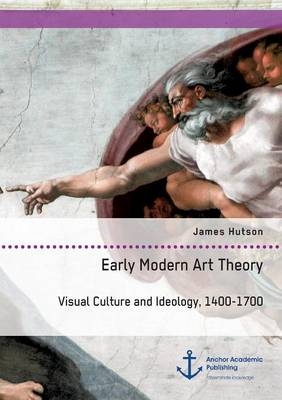
Early Modern Art Theory. Visual Culture and Ideology, 1400-1700
Anchor Academic Publishing (Verlag)
978-3-95489-497-0 (ISBN)
James Hutson is associate professor of art history at Lindenwood University, St. Charles where he also serves as head of Pre-Art Therapy and Conservation, as well as Director of Study Abroad Italy. He has contributed several articles on Renaissance proportion theory, education of artists in the early modern era and intellectual history of the period.
Text sample:
Chapter: Introduction:
Art Theory and Beauty:
Beauty is one of those great mysteries of nature, whose influence we all see and feel; but a general, distinct idea of its essential must be classed among the truths yet undiscovered. If this idea were geometrically clear, men would not differ in their opinions upon the beautiful, and it would be easy to prove what true beauty is. -Johann Winckelmann, History of Ancient Art.
Beauty in Early Modern art and theory will be the focus of this study, which will attempt to reframe and recontextualize our understanding of two concepts: the idea of the Idea and, secondarily, the idea of Beauty. Through a consideration of a wider set of sources than previously considered by scholars, as diverse as philosophy, art, and medicine, among many others, the treatment seeks to enrich and deepend the discussion on these central concepts as well as to historicize through these texts the phenomenon of stylistic change. In this first section, we investigate the foundations for later ideas that will comprise the two primary positions held by Early Modern scholars, artists and critics espoused and then modified by the followers of Plato and Aristotle, an appeal to search for beauty beyond the mind of man and through sense-perceptible nature, respectively; then a brief overview of arts education of the era as it progressed from workshop training and a limited role played by the theories bequeathed by the Middle Ages to the establishment of art academies and theoretical mechanisms that provided the basis for the creation and evaluation of good art. But first, how do we perceive and evaluate beauty to begin with?
Beauty is central to understanding Early Modern art and theory. So ubiquitous is the term beauty and its use to describe the works of art created during the Renaissance and Baroque eras- works by Leonardo da Vinci, Raphael, Michelangelo, Annibale Carracci, Caravaggio, Poussin- that even today one cannot visit the museums, churches and palaces of Europe without hearing the intangible term used by various tour and museum guides.
É molto bella...
Es ist sehr schön...
Il est très belle...
Es muy hermoso...
Tourists, scholars and dilettantes from various countries nod in agreement and look on in silent admiration at these works bequeathed to us from a period that seems both intimately familiar and culturally distant. Seemingly everyone involved - guides, scholars, teachers, students, tourists- inherently knows and agrees what is meant when art under consideration is said to be beautiful. No one would question the veracity of a Vatican guide who describes a scene of Sistine Chapel ceiling as one of the greatest expressions of Renaissance beauty on a digital touch screen before entering the museum. Nor would those from the Western tradition bat an eye while touring the Louvre and seeing hoards of people crowding in to steal a glimpse of the Mona Lisa and her belle et sereine sourire. We seem to agree, as a patchwork of languages, cultures and experiences, on what we mean when we point to a painting and say "this is beautiful."
What is most interesting about this ostensibly collective experiential phenomenon is that the seemingly objective way in which we claim to know beauty is not Modern; it is, in fact, Early Modern, and even ancient. With the development of aesthetics in the eighteenth century came the first signs of an abandonment of programmatic reification and classification of, what was variously and previously called, "beauty," la bellezza, le beau, bellum. Not surprisingly, this coincided with a concept to distinguish Fine Art from other activities, such as craft or science; prior to this art functioned as an intersection between these and other cultural endeavors, like religion. With the arrival of the Age of Reason came a desire for distinction and classification. In the realm of Art and Beauty, Kantian aesthetics sought to critique the faculties of judgment and demons
| Erscheinungsdatum | 25.06.2016 |
|---|---|
| Sprache | englisch |
| Maße | 151 x 217 mm |
| Gewicht | 479 g |
| Themenwelt | Kunst / Musik / Theater ► Kunstgeschichte / Kunststile |
| Schlagworte | Renaissance |
| ISBN-10 | 3-95489-497-1 / 3954894971 |
| ISBN-13 | 978-3-95489-497-0 / 9783954894970 |
| Zustand | Neuware |
| Informationen gemäß Produktsicherheitsverordnung (GPSR) | |
| Haben Sie eine Frage zum Produkt? |
aus dem Bereich