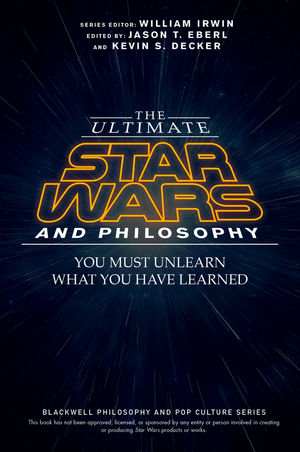
The Ultimate Star Wars and Philosophy (eBook)
John Wiley & Sons (Verlag)
978-1-119-03808-5 (ISBN)
Does it take faith to be a Jedi? Are droids capable of thought? Should Jar Jar Binks be held responsible for the rise of the Empire? Presenting entirely new essays, no aspect of the myth and magic of George Lucas's creation is left philosophically unexamined in The Ultimate Star Wars and Philosophy.
- The editors of the original Star Wars and Philosophy strike back in this Ultimate volume that encompasses the complete Star Wars universe
- Presents the most far-reaching examination of the philosophy behind Star Wars - includes coverage of the entire film catalogue to date as well as the Expanded Universe of novels, comics, television series, games and toys
- Provides serious explorations into the deeper meaning of George Lucas's philosophically rich creation
- Topics explored include the moral code of bounty-hunter favourite Boba Fett, Stoicism and the Jedi Order, the nature of the Dark Side, Anakin and Achilles in a nihilism face-off, feminism and being chained to a giant slug, cloning, de-extinction, fatherhood, Wookiees, loyalty, betrayal, guardians, republics, tyrants, terrorism, civic duty, friendship, family, and more!
- Publishing in time for the global release of Star Wars Episode VII: The Force Awakens on December 18, 2015 - hotly anticipated to become the first film to top $3 billion in worldwide box office sales
Jason T. Eberl is the Semler Endowed Chair for Medical Ethics and Professor of Philosophy at Marian University in Indianapolis, where he teaches bioethics, ethics, and medieval philosophy. He authored Thomistic Principles and Bioethics (2006), and is the editor of Battlestar Galactica and Philosophy (Wiley-Blackwell, 2008) and co-editor of Sons of Anarchy and Philosophy (Wiley-Blackwell, 2013).
Kevin S. Decker is Professor of Philosophy at Eastern Washington University, where he teaches ethics, American and Continental Philosophy, and philosophy of popular culture. He is the editor or co-editor of five previous books on pop culture including Terminator and Philosophy (Wiley-Blackwell, 2009), Ender's Game and Philosophy (Wiley-Blackwell, 2013), The Ultimate South Park and Philosophy (Wiley-Blackwell, 2013) and Who is Who? The Philosophy of Doctor Who (2013).
Together, Eberl and Decker are the editors of Star Wars and Philosophy (2005).
Does it take faith to be a Jedi? Are droids capable of thought? Should Jar Jar Binks be held responsible for the rise of the Empire? Presenting entirely new essays, no aspect of the myth and magic of George Lucas s creation is left philosophically unexamined in The Ultimate Star Wars and Philosophy. The editors of the original Star Wars and Philosophy strike back in this Ultimate volume that encompasses the complete Star Wars universe Presents the most far-reaching examination of the philosophy behind Star Wars includes coverage of the entire film catalogue to date as well as the Expanded Universe of novels, comics, television series, games and toys Provides serious explorations into the deeper meaning of George Lucas s philosophically rich creation Topics explored include the moral code of bounty-hunter favourite Boba Fett, Stoicism and the Jedi Order, the nature of the Dark Side, Anakin and Achilles in a nihilism face-off, feminism and being chained to a giant slug, cloning, de-extinction, fatherhood, Wookiees, loyalty, betrayal, guardians, republics, tyrants, terrorism, civic duty, friendship, family, and more!
Jason T. Eberl is the Semler Endowed Chair for Medical Ethics and Professor of Philosophy at Marian University in Indianapolis, where he teaches bioethics, ethics, and medieval philosophy. He authored Thomistic Principles and Bioethics (2006), and is the editor of Battlestar Galactica and Philosophy (Wiley-Blackwell, 2008) and co-editor of Sons of Anarchy and Philosophy (Wiley-Blackwell, 2013). Kevin S. Decker is Professor of Philosophy at Eastern Washington University, where he teaches ethics, American and Continental Philosophy, and philosophy of popular culture. He is the editor or co-editor of five previous books on pop culture including Terminator and Philosophy (Wiley-Blackwell, 2009), Ender's Game and Philosophy (Wiley-Blackwell, 2013), The Ultimate South Park and Philosophy (Wiley-Blackwell, 2013) and Who is Who? The Philosophy of Doctor Who (2013). Together, Eberl and Decker are the editors of Star Wars and Philosophy (2005).
Acknowledgments: Legacy of the Force ix
Introduction: "The Circle is Now Complete" 1
I The Philosophical Menace 5
1 The Platonic Paradox of Darth Plagueis: How Could a Sith Lord Be Wise? 7
Terrance MacMullan
2 "You Are Asking Me to Be Rational": Stoic Philosophy and the Jedi Order 20
Matt Hummel
3 The Jedi Knights of Faith: Anakin, Luke, and Søren (Kierkegaard) 31
William A. Lindenmuth
4 Anakin and Achilles: Scars of Nihilism 42
Don Adams
5 Dark Times: The End of the Republic and the Beginning of Chinese Philosophy 53
Kevin S. Decker
II Attack of the Morals 65
6 Chasing Kevin Smith: Was It Immoral for the Rebel Alliance to Destroy Death Star II? 67
Charles C. Camosy
7 The Ballad of Boba Fett: Mercenary Agency and Amoralism in War 79
David LaRocca
8 How Guilty is Jar Jar Binks? 90
Nicolas Michaud
9 "Know the Dark Side": A Theodicy of the Force 100
Jason T. Eberl
III Revenge of the Alliance 115
10 "Like My Father before Me": Loss and Redemption of Fatherhood in Star Wars 117
Charles Taliaferro and Annika Beck
11 The Friends of a Jedi: Friendship, Family, and Civic Duty in a Galaxy at War 127
Greg Littmann
12 Light Side, Dark Side, and Switching Sides: Loyalty and Betrayal in Star Wars 136
Daniel Malloy
13 Guardians and Tyrants in the Republics of Star Wars and Plato 148
Adam Barkman and Kyle Alkema
IV A New Hermeneutic 159
14 Pregnant Padme and Slave Leia: ´ Star Wars' Female Role Models 161
Cole Bowman
15 Docile Bodies and a Viscous Force: Fear of the Flesh in Return of the Jedi 172
Jennifer L. McMahon
16 Of Battle Droids and Zillo Beasts: Moral Status in the Star Wars Galaxy 183
James M. Okapal
V Metaphysics Strikes Back 193
17 Why the Force Must Have a Dark Side 195
George A. Dunn
18 What is It Like to Be a Jedi? A Life in the Force 208
Marek McGann
19 "Never Tell Me the Odds": An Inquiry Concerning Jedi Understanding 219
Andrew Zimmerman Jones
VI Return of the Non-Human 229
20 Mindless Philosophers and Overweight Globs of Grease: Are Droids Capable of Thought? 231
Dan Burkett
21 Can Chewie Speak? Wittgenstein and the Philosophy of Language 240
Rhiannon Grant and Myfanwy Reynolds
22 Can the Zillo Beast Strike Back? Cloning, De-extinction, and the Species Problem 250
Leonard Finkelman
VII The Fandom Awakens 261
23 "In That Time . . . " in a Galaxy Far, Far Away: Epic Myth-Understandings and Myth-Appropriation in Star Wars 263
John Thompson
24 Star Wars, Emotions, and the Paradox of Fiction 274
Lance Belluomini
25 The Mind of Blue Snaggletooth: The Intentional Stance, Vintage Star Wars Action Figures, and the Origins of Religion 287
Dennis Knepp
26 Gospel, Gossip, and Ghent: How Should We Understand the New Star Wars? 296
Roy T. Cook and Nathan Kellen
Contributors: Troopers of the 501st Legion 308
Index 317
1
The Platonic Paradox of Darth Plagueis: How Could a Sith Lord Be Wise?
Terrance MacMullan
“Did you ever hear the tragedy of Darth Plagueis the Wise?” When Anakin's friend and mentor Chancellor Palpatine casually asks him this question as they enjoy a Mon Calamari ballet on Coruscant, you can almost hear Anakin wonder to himself, “How could a Sith be wise?” Believed extinct for a thousand years, the Sith had a terrifying reputation as malicious agents of irrepressible evil. From a certain point of view, particularly that of a Jedi, the idea of a wise Sith is quite odd, if not outright impossible.
Another sage who would've been confounded by the idea of a wise Sith was Plato of Athens (429–347 BCE). As a Sith, Plagueis was a devotee of the Dark Side of the Force, which grants enormous powers to those brave enough to become living conduits for passions like hatred and anger. Such a person would be the exact opposite of what Plato would call “wise.” For Plato, wisdom is a virtue that is inextricably bound to humility and justice: it is found in the soul of the person who has learned to subdue their spirit and appetite through the exercise of reason. “Plagueis the Wise Lord of the Sith” therefore would present an insurmountable paradox to Plato: if Plagueis is a master of using, rather than calming, his spirit and indulging his appetites, how could he possibly be wise? How is it that he was able to live for well over a century without suffering the self-destruction that Plato foresees for anyone who does not rein in spirit and appetite? This paradox opens horizons for reflection on the themes of ethics, wisdom, and freedom. It also raises the possibility that Plato's ideal of wisdom is too narrow, and that a different philosophy of life might better explain the existence of a wise Dark Lord of the Sith.
Respect for the Difference between Knowledge and Wisdom
No philosopher is more tightly linked with wisdom than Plato. Indeed, when we think of philosophy as meaning “the love of wisdom” (philo means “love of,” and sophia is usually translated as “wisdom”), where wisdom is the virtue associated with rationality, moderation, and moral goodness, we are in fact using a definition developed by Plato. Like most philosophers of the ancient world, Plato distinguished knowledge (or gnosis in Greek) from wisdom. Knowledge is the straightforward matter of experienced information about the world: once Han Solo gets close enough to a mysterious, large object in space and registers the effect of a tractor beam, he knows that the Death Star is no moon. However, wisdom is a subtler thing: on board the Millennium Falcon, Obi-Wan doesn't know what the thing is either, but he's wise enough to exhort Han to turn the Falcon around before they're seized by a tractor beam. Plato quotes his master Socrates in the Apology as saying that “the wisest of you … is he who has realized … that in respect of wisdom he is really worthless.”1 This ideal of wisdom rests on the virtue of humility: in the face of a universe of immense possibilities, the wisdom of a mortal creature is worth little or nothing. This is why Plato would have approved of Dexter Jettster's gentle scolding of Obi-Wan in Attack of the Clones: it was unwise to think that the knowledge contained in the Jedi Archives could ever be totally comprehensive. Unlike Jedi archivist Jocasta Nu, who somewhat proudly proclaims, “If an item does not appear in our records, it does not exist,” a truly wise Jedi would know she could not know all there is to know!
Before Plato, sophia had very different meanings. Friedrich Nietzsche (1844–1900) tells us that sophia, in its original sense, meant something like discerning taste.2 So the original lovers of sophia were people who had cultivated a nuanced appreciation for the finer things, perhaps like the suave scoundrel Lando Calrissian, who – despite his Bespin mining installation being infested by Imperial forces ready to abduct his friends – can't help but pause and admire Leia's beauty! During the time of Socrates and Plato, the word sophia had evolved to carry a grittier connotation, close to something like practical “know-how.”3 In this second sense, the canny and resourceful Han Solo, not Yoda, would be the wisest philosopher.
The philosophical rivals of Plato and Socrates, the Sophists, were teachers of rhetoric and masters of persuasion, adept at swaying the masses. Sophists rejected the idea that there were universal standards for things like Justice, Truth, and Beauty, arguing instead that these ideals vary greatly, depending on one's point of view. One of these Sophists, Thrasymachus, was an intimidating thinker who would've been admired by the Sith. His arguments with Socrates and Plato also give us a clear sense of why Plato would find Plagueis paradoxical. Where Plato believed that there's no way to understand justice apart from wisdom, Thrasymachus argued that there was no way to understand justice apart from power. Where Socrates and his philosophical friends struggle to find an all-encompassing definition of justice, Thrasymachus cuts through their debate by asserting forcefully that “the just is nothing else than the advantage of the stronger.”4
This is precisely the worldview of the Sith, for whom talk of right without might is a childish fairytale and the wise man who thinks he can somehow transcend the vagaries of power is a fool. We see the Sith follow Thrasymachus's teaching during the siege of Naboo in The Phantom Menace when Darth Sidious orders Nute Gunray to commence the Trade Federation's invasion. Expressing more concern for his own wrinkled hide than any actual ethical principles, Gunray timidly asks Sidious, “Is that legal?” Sidious hisses a reply that would've made Thrasymachus smile: “I will make it legal.” Sidious knows that the law is just a tool waiting to be used by anyone wise enough to see that there is no justice beyond power, and that enough power can make anything just. In Revenge of the Sith, when Palpatine is revealed to be Sidious and is confronted by Mace Windu, who tells him, “The Senate will decide your fate,” Sidious exclaims, “I am the Senate!” Sidious learned this philosophy of life from his master, Darth Plagueis, who long before the invasion of Naboo taught him that the Sith will triumph over the Jedi because “[t]he Sith are not placid stars but singularities. Rather than burn with a muted purpose, we warp space and time to twist the galaxy to our own design.”5
Plato opposed this cynical view that might makes right. He knew that Athens had transformed, from an admired city-state that had bravely turned back the massive invading forces of the Persian Empire at the battles of Salamis and Platea, into yet another despised empire that was shattered by the Spartans during the Peloponnesian War. This occurred because the Athenians were swayed to the “Dark Side” teachings of the Sophists, convincing themselves that the powerful doing as they will is not injustice, but rather “a necessary law of their nature [that] they rule wherever they can.”6 Plato argued that this idea ultimately destroys whomever follows it, whether an individual or an entire city-state. Instead of a notion of justice as “might makes right,” Plato sought a definition of justice that doesn't rest merely on power, but ultimately on wisdom.
“Unlimited Power!”
Plato would have admired the Code of the Jedi that brought millennia of peace and prosperity to the Galactic Republic after the Battle of Ruusan:
There is no emotion; there is peace.
There is no ignorance; there is knowledge.
There is no passion; there is serenity.
There is no death; there is the Force.
Consider now the Sith Code as taught by Darth Bane:
Peace is a lie, there is only passion.
Through passion, I gain strength.
Through strength, I gain power.
Through power, I gain victory.
Through victory, my chains are broken.
The Force shall free me.
Where the Jedi seek peace through mindfulness and control of their feelings, the Sith hope to use passion, power, and strength for the ultimate goal of freedom. As Plagueis explains the difference, “Remember why the Sith are more powerful than the Jedi, Sidious: because we are not afraid to feel.”7 The Sith want to be free from convention, morality, government, law, and ultimately even the limits of the Force itself. This sort of freedom is what philosophers refer to as negative freedom because it is freedom from control, a freedom that says, “Don't limit me!”8 But Plato teaches that no wise person should ever walk this path, as it is ultimately self-destructive. The truly wise see that this sort of freedom is not liberation: it is its own cage.
Plato asks us to imagine that our soul has three parts: the rational, the spirited, and the appetitive. When...
| Erscheint lt. Verlag | 14.8.2015 |
|---|---|
| Reihe/Serie | The Blackwell Philosophy and Pop Culture Series |
| The Blackwell Philosophy and Pop Culture Series | The Blackwell Philosophy and Pop Culture Series |
| Mitarbeit |
Herausgeber (Serie): William Irwin |
| Sprache | englisch |
| Themenwelt | Kunst / Musik / Theater ► Film / TV |
| Geisteswissenschaften ► Philosophie ► Allgemeines / Lexika | |
| Geisteswissenschaften ► Philosophie ► Östliche Philosophie | |
| Sozialwissenschaften ► Kommunikation / Medien ► Medienwissenschaft | |
| Sozialwissenschaften ► Soziologie | |
| Schlagworte | Bad • Concept • Cultural • Cultural Studies • Culture • Death • Empire • EPIC • Father • Filmforschung • Film Studies • Generation • immoral • JAR • Jedi • Kulturwissenschaften • Landscape • Luke • Modern • mythic • New • Opera • Philosophie • Philosophy • Phrases • Pop • popular culture • Rebel • responsible • Rise • Second • significance • Skin • space • Star • Terrorist • try • Volkskultur • World |
| ISBN-10 | 1-119-03808-1 / 1119038081 |
| ISBN-13 | 978-1-119-03808-5 / 9781119038085 |
| Informationen gemäß Produktsicherheitsverordnung (GPSR) | |
| Haben Sie eine Frage zum Produkt? |
 EPUB (Adobe DRM)
Kopierschutz: Adobe-DRM
Adobe-DRM ist ein Kopierschutz, der das eBook vor Mißbrauch schützen soll. Dabei wird das eBook bereits beim Download auf Ihre persönliche Adobe-ID autorisiert. Lesen können Sie das eBook dann nur auf den Geräten, welche ebenfalls auf Ihre Adobe-ID registriert sind.
Details zum Adobe-DRM
Dateiformat: EPUB (Electronic Publication)
EPUB ist ein offener Standard für eBooks und eignet sich besonders zur Darstellung von Belletristik und Sachbüchern. Der Fließtext wird dynamisch an die Display- und Schriftgröße angepasst. Auch für mobile Lesegeräte ist EPUB daher gut geeignet.
Systemvoraussetzungen:
PC/Mac: Mit einem PC oder Mac können Sie dieses eBook lesen. Sie benötigen eine
eReader: Dieses eBook kann mit (fast) allen eBook-Readern gelesen werden. Mit dem amazon-Kindle ist es aber nicht kompatibel.
Smartphone/Tablet: Egal ob Apple oder Android, dieses eBook können Sie lesen. Sie benötigen eine
Geräteliste und zusätzliche Hinweise
Buying eBooks from abroad
For tax law reasons we can sell eBooks just within Germany and Switzerland. Regrettably we cannot fulfill eBook-orders from other countries.
aus dem Bereich