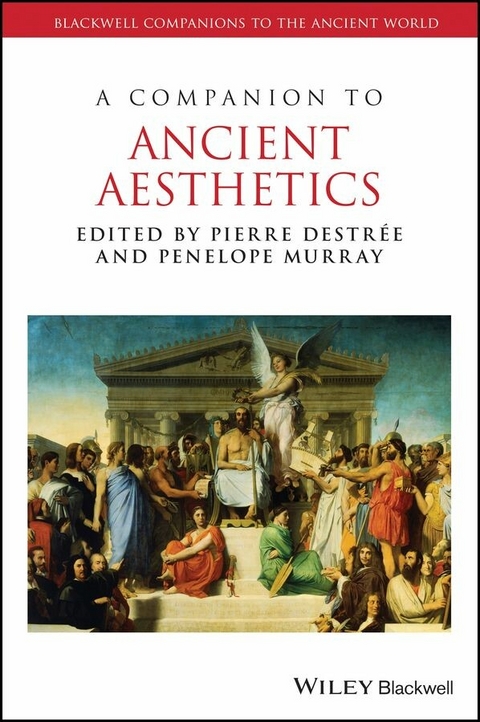
The first of its kind, A Companion to Ancient Aesthetics presents a synoptic view of the arts, which crosses traditional boundaries and explores the aesthetic experience of the ancients across a range of media-oral, aural, visual, and literary.
- Investigates the many ways in which the arts were experienced and conceptualized in the ancient world
- Explores the aesthetic experience of the ancients across a range of media, treating literary, oral, aural, and visual arts together in a single volume
- Presents an integrated perspective on the major themes of ancient aesthetics which challenges traditional demarcations
- Raises questions about the similarities and differences between ancient and modern ways of thinking about the place of art in society
Pierre Destrée is Associate Researcher at the FNRS and Associate Professor at the University of Louvain, Belgium, where he teaches ancient philosophy. He is the author of a French translation of Aristotle's Poetics (2014) and editor of Plato and the Poets (with F.G. Herrmann, 2011), Plato and Myth: Studies on the Use and Status of Platonic Myths (with C. Collobert and F. Gonzalez, 2012); The Cambridge Companion to Aristotle's Politics (with M. Deslauriers, 2013) and What is Up to Us? Causality and Responsibility in Ancient Philosophy (with R. Salles and M. Zingano, 2014).
Penelope Murray was Senior Lecturer and a founding member of the Department of Classics at the University of Warwick, UK, before retiring in 2008. She continues to work on early Greek poetry and poetics, on philosophical responses to Athenian song-culture, especially the views of Plato, and on ancient literary criticism. Her publications include Genius: The History of an Idea (Blackwell, 1989); Plato on Poetry (1996); Classical Literary Criticism (2000); Music and The Muses: The Culture of Mousike in the Classical Athenian City (edited with P. Wilson, 2004).
Pierre Destrée is Associate Researcher at the FNRS and Associate Professor at the University of Louvain, Belgium, where he teaches ancient philosophy. He is the author of a French translation of Aristotle's Poetics (2014) and editor of Plato and the Poets (with F.G. Herrmann, 2011), Plato and Myth: Studies on the Use and Status of Platonic Myths (with C. Collobert and F. Gonzalez, 2012); The Cambridge Companion to Aristotle's Politics (with M. Deslauriers, 2013) and What is Up to Us? Causality and Responsibility in Ancient Philosophy (with R. Salles and M. Zingano, 2014). Penelope Murray was Senior Lecturer and a founding member of the Department of Classics at the University of Warwick, UK, before retiring in 2008. She continues to work on early Greek poetry and poetics, on philosophical responses to Athenian song-culture, especially the views of Plato, and on ancient literary criticism. Her publications include Genius: The History of an Idea (Blackwell, 1989); Plato on Poetry (1996); Classical Literary Criticism (2000); Music and The Muses: The Culture of Mousike in the Classical Athenian City (edited with P. Wilson, 2004).
Illustrations viii
Notes on Contributors ix
Acknowledgments xiv
Introduction 1
Pierre Destrée and Penelope Murray
Part I Art in Context 15
1 Greece 17
Richard P. Martin
2 Figures of the Poet in Greek Epic and Lyric 31
Deborah Steiner
3 The Hellenistic World 47
Graham Zanker
4 Rome 68
Thomas Habinek
5 Music and Dance in Greece and Rome 81
Eleonora Rocconi
6 Greek Sculpture 94
Rosemary Barrow
7 Painting and Private Art Collections in Rome 109
Agnès Rouveret
8 Architecture and Society 128
Catherine Saliou
Part II Reflecting on Art 141
9 Literary Criticism and the Poet's Autonomy 143
Andrew Ford
10 Poetic Inspiration 158
Penelope Murray
11 The Canons of Style 175
Jeffrey Walker
12 Sense and Sensation in Music 188
Armand D'Angour
13 Dance and Aesthetic Perception 204
Anastasia?]Erasmia Peponi
14 Greek Painting and the Challenge of Mimes¯ is 218
Hariclia Brecoulaki
15 Ways of Looking at Greek Vases 237
François Lissarrague
16 Displaying Sculpture in Rome 248
Thea Ravasi
17 Perceiving Colors 262
M. Michela Sassi
18 The Beauties of Architecture 274
Edmund Thomas
19 Stylistic Landscapes 291
Nancy Worman
20 Conceptualizing the (Visual) "Arts" 307
Michael Squire
Part III Aesthetic Issues 327
21 Mimesis 329
Paul Woodruff
22 Fiction 341
Stephen Halliwell
23 Imagination 354
Anne Sheppard
24 Beauty 366
David Konstan
25 Unity, Wholeness, and Proportion 381
Malcolm Heath
26 The Sublime 393
James I. Porter
27 Poikilia 406
Adeline Grand?]Clément
28 Wonder 422
Christine Hunzinger
29 Tragic Emotions 438
Christof Rapp
30 Laughter 455
Ralph M. Rosen
31 Pleasure 472
Pierre Destrée
32 Art and Morality 486
Elizabeth Asmis
33 Art and Value 505
Michael Silk
Index of Subjects 518
Index of Ancient Texts Discussed 527
Notes on Contributors
Elizabeth Asmis is Professor of Classics at the University of Chicago. She is the author of Epicurus’ Scientific Method (1984) and numerous articles on Greco-Roman philosophy. Her recent work focuses on reception in antiquity, with special attention to the philosophy of the Roman period.
Rosemary Barrow is a Reader in Classical Art and Reception at the University of Roehampton. Besides articles on art history and the classical tradition, she has published books on classical reception in nineteenth-century art such as Lawrence Alma-Tadema (2001) and The Use of Classical Art & Literature by Victorian Painters (2007), and is co-author of The Classical Tradition: Art, Literature, Thought, with Michael Silk and Ingo Gildenhard (2014). Her next solo project is a forthcoming monograph exploring the gendered body in Greek and Roman sculpture.
Hariclia Brecoulaki is an archeologist and holds a research position at the Institute of Historical Research, Department of Greek and Roman Antiquity (The National Hellenic Research Foundation). Her work mainly focuses on issues related to Greek painting from the Late Bronze Age to the Roman period, with a particular interest in the technological aspects of ancient polychromy. Her publications include the books L’esperienza del colore nella pittura funeraria dell’Italia preromana V–III secolo a.C. (2001), La peinture funéraire de Macédoine. Emplois et fonctions de la couleur, IV–IIème s. av. J.-C. (2006), and Mycenaean Painting in Context: New Discoveries, Old Finds Reconsidered (co-edited with J. Davis and Sh. Stocker), in press.
Armand D’Angour is Fellow and Tutor in Classics at Jesus College, Oxford. His publications include articles on ancient Greek music and on Greek and Roman poetry; his book The Greeks and the New: Novelty in Ancient Greek Imagination and Experience was published in 2011. He was commissioned by the International Olympic Committee to compose a Pindaric Ode to Athens for the 2004 Olympic Games, and by the Mayor of London for the London Olympics 2012. A pianist and cellist by training, in 2013 he was awarded a Fellowship by the British Academy to pursue research into the reconstruction of the sounds and effects of ancient Greek music.
Pierre Destrée is a Senior Research Fellow at the FNRS, and an Associate Professor at the University of Louvain, where he teaches ancient philosophy. He is the author of numerous journal articles and book chapters on Greek ethics, and aesthetics. He is the author of a French translation of Aristotle’s Poetics (2014), and he is now working on a book on aesthetic pleasures in ancient Greek philosophy. He has edited several volumes, including Akrasia in Greek Philosophy: From Socrates to Plotinus (ed. with Ch. Bobonich, 2007); Plato and the Poets (ed. with F.G. Herrmann, 2011; Plato and Myth: Studies on the Use and Status of Platonic Myths (ed. with C. Collobert and F. Gonzalez, 2012); A Cambridge Companion to Aristotle’s Politics (ed. with M. Deslauriers, 2013); What Is Up to Us? Studies on Agency and Responsibility in Ancient Philosophy (ed. with R. Salles and M. Zingano, 2014).
Andrew Ford is the Ewing Professor of Greek Language and Literature at Princeton University. His work has focused on the intersections between the practice of Greek poets, critical theory, and ancient literary criticism. He is the author most recently of Aristotle as Poet: The Song to Hermias and Its Contexts (2011).
Adeline Grand-Clément is lecturer in Ancient Greek History at the University of Toulouse (UT2J), and member of the research team PLH-ERASME. Her main research is about cultural, social, and anthropological history, and her work has been particularly concerned with exploring cultural differences in perception, aesthetics, and sensibilities, especially in the field of colors. She is also interested in the modern reception of Greek art and in the history of European archaeology. Her first book was published in 2011: La fabrique des couleurs. Histoire du paysage sensible des Grecs anciens (VIIIe–Ve s. av. n. è.) and she has written several articles on Archaic sensitivity to colors and on ancient polychromy. Her future research will broaden to the religious experience engaging all the senses (sight, smell, touch, sound, taste), focusing on their interplay during rituals.
Thomas Habinek is Professor and Chair of Classics at the University of Southern California. He publishes widely on Latin literature, ancient rhetoric, and Roman cultural history. His current research examines the relationship between physics and artistic theory and practice from antiquity through the early modern period.
Stephen Halliwell is Professor of Greek at the University of St Andrews. He has taught at the universities of Oxford, London, Cambridge, and Birmingham, as well as holding visiting professorships in Belgium, Canada, Italy, and the USA. His books include Aristotle’s Poetics (1986), The Aesthetics of Mimesis (2002: awarded the Premio Europeo d’Estetica 2008), Greek Laughter (2008, winner of the Criticos Prize), and Between Ecstasy and Truth: Interpretations of Greek Poetics from Homer to Longinus (2011).
Malcolm Heath is Professor of Greek at the University of Leeds. His publications include The Poetics of Greek Tragedy (1987), Political Comedy in Aristophanes (1987), Unity in Greek Poetics (1989), Hermogenes On Issues (1995), Interpreting Classical Texts (2002), Menander: A Rhetor in Context (2004), and Ancient Philosophical Poetics (2012). He has translated Aristotle’s Poetics for Penguin Classics (1996).
Christine Hunzinger is Associate Professor of Greek at the University of Paris-Sorbonne. She has worked on thauma in Archaic Greek epic (PhD dissertation 1997, University Paris-Sorbonne) and has also written on various aspects of the representation of the marvelous in Archaic and Classical Greek literature, especially on wonder in Herodotus.
David Konstan is Professor of Classics at New York University and Professor Emeritus of Classics and Comparative Literature at Brown University. He is a past president of the American Philological Association, a Fellow of the American Academy of Arts and Sciences, and Honorary Fellow of the Australian Academy of the Humanities. Among his publications are Roman Comedy (1983), Sexual Symmetry: Love in the Ancient Novel and Related Genres (1994), Greek Comedy and Ideology (1995), Friendship in the Classical World (1997), Pity Transformed (2001), The Emotions of the Ancient Greeks: Studies in Aristotle and Classical Literature (2006), Terms for Eternity: Aiônios and aïdios in Classical and Christian Texts (with Ilaria Ramelli, 2007), “A Life Worthy of the Gods”: The Materialist Pyschology of Epicurus (2008), and Before Forgiveness: The Origins of a Moral Idea (2010). His most recent book is Beauty: The Fortunes of an Ancient Greek Idea (2015).
François Lissarrague is a member of the Centre Anhima (EHESS) in Paris, formerly Centre Louis Gernet, founded by J.P. Vernant. He specializes in ancient Greek iconography. His main area of interest is the interpretation of Attic imagery: of the symposium, the Dionysiac world, warriors, and women. He is the author of many books and articles. Those of his books translated into English include The City of Images (1989), The Aesthetics of the Greek Banquet (1990), Heroes and Gods of Antiquity (with Irene Aghion and Claire Barbillon) (1996), and Greek Vases: The Athenians and Their Images (2000). The most recent is La Cité des Satyres, une anthropologie ludique (2013).
Richard P. Martin is the Antony and Isabelle Raubitschek Professor in Classics at Stanford University, USA. Using ethnographic methods, he has written on Homer, Hesiod, Pindar, Aristophanes, and a range of cultural phenomena involving early Greek poetry, myth, and religion.
Penelope Murray was a founder member of the Department of Classics at the University of Warwick, where she taught for many years, retiring in 2008. She has written extensively on ancient poetics and her books include Plato on Poetry (1996), Classical Literary Criticism (Penguin, 2000), and Music and the Muses: the Culture of Mousike in the Classical Athenian City (ed. with Peter Wilson, 2004). She is currently working on a book on the Muses for Routledge.
Anastasia-Erasmia Peponi is Professor of Classics at Stanford University. Her special interests include lyric poetry (ancient and modern), Greek philosophy (especially Plato), the relationship between the verbal and the visual in ancient and early modern cultures, and theory of dance. Over the last years she has been working on several aspects of Greek aesthetics. Her recent publications include Frontiers of Pleasure: Models of Aesthetic Response in Greek Thought (2012) and (ed.) Performance and Culture in Plato’s Laws (2013).
James I. Porter is Professor of Classics and Comparative Literature at UC Irvine. His books include, The Origins of Aesthetic Thought in Ancient Greece: Matter, Sensation, and Experience (2010) and, most recently, The...
| Erscheint lt. Verlag | 28.4.2015 |
|---|---|
| Reihe/Serie | Blackwell Companions to the Ancient World |
| Blackwell Companions to the Ancient World | Blackwell Companions to the Ancient World |
| Sprache | englisch |
| Themenwelt | Literatur |
| Kunst / Musik / Theater ► Allgemeines / Lexika | |
| Geschichte ► Allgemeine Geschichte ► Altertum / Antike | |
| Geisteswissenschaften ► Philosophie | |
| Geisteswissenschaften ► Sprach- / Literaturwissenschaft ► Anglistik / Amerikanistik | |
| Geisteswissenschaften ► Sprach- / Literaturwissenschaft ► Literaturwissenschaft | |
| Schlagworte | Aesthetics • Altertum • Ancient aesthetics, aesthetics, Greek poetry, Greek epic and lyric, the Hellenistic world, music and dance in antiquity, literary patronage in Rome, politics in Rome, Roman art, Roman art collections, Roman architecture, Greek architecture, Greek painting, mimesis, Greek vases, Roman sculpture, beauty, poikilia, the sublime, aesthetic pleasure • Ancient Culture • Art & Applied Arts • Art History & Theory • Ästhetik • Ãsthetik • Classical Studies • Humanistische Studien • Klassisches Altertum • Kunstgeschichte • Kunstgeschichte u. -theorie • Kunst u. Angewandte Kunst • Philosophie • Philosophy |
| ISBN-13 | 9781119009771 / 9781119009771 |
| Informationen gemäß Produktsicherheitsverordnung (GPSR) | |
| Haben Sie eine Frage zum Produkt? |
 EPUB (Adobe DRM)
Kopierschutz: Adobe-DRM
Adobe-DRM ist ein Kopierschutz, der das eBook vor Mißbrauch schützen soll. Dabei wird das eBook bereits beim Download auf Ihre persönliche Adobe-ID autorisiert. Lesen können Sie das eBook dann nur auf den Geräten, welche ebenfalls auf Ihre Adobe-ID registriert sind.
Details zum Adobe-DRM
Dateiformat: EPUB (Electronic Publication)
EPUB ist ein offener Standard für eBooks und eignet sich besonders zur Darstellung von Belletristik und Sachbüchern. Der Fließtext wird dynamisch an die Display- und Schriftgröße angepasst. Auch für mobile Lesegeräte ist EPUB daher gut geeignet.
Systemvoraussetzungen:
PC/Mac: Mit einem PC oder Mac können Sie dieses eBook lesen. Sie benötigen eine
eReader: Dieses eBook kann mit (fast) allen eBook-Readern gelesen werden. Mit dem amazon-Kindle ist es aber nicht kompatibel.
Smartphone/Tablet: Egal ob Apple oder Android, dieses eBook können Sie lesen. Sie benötigen eine
Geräteliste und zusätzliche Hinweise
Buying eBooks from abroad
For tax law reasons we can sell eBooks just within Germany and Switzerland. Regrettably we cannot fulfill eBook-orders from other countries.
aus dem Bereich