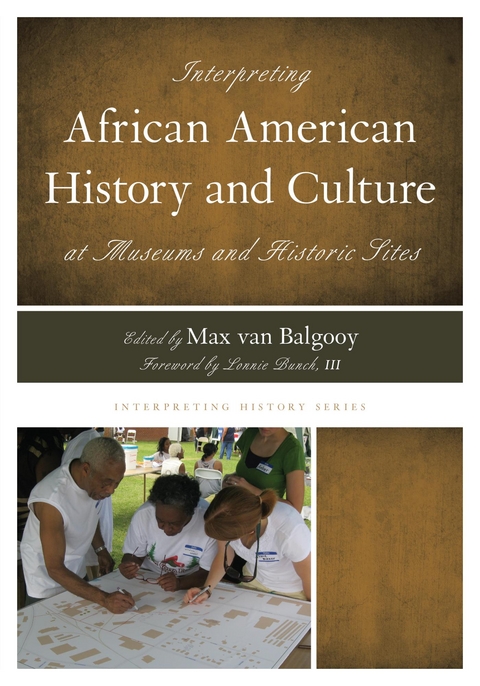
Interpreting African American History and Culture at Museums and Historic Sites (eBook)
210 Seiten
Rowman & Littlefield Publishers (Verlag)
978-0-7591-2280-2 (ISBN)
Max A. van Balgooy is president of Engaging Places LLC, a design and strategy firm that connects people and historic places. He works with a wide range of historic sites on interpretive planning and business strategy, from Drayton Hall to Taliesin West. These experiences provide a rich source of ideas for EngagingPlaces.net, where he blogs regularly about the opportunities and challenges facing historic sites and house museums. He serves on the AASLH Council and teaches in the museum studies program at George Washington University, and received his degrees in history from Pomona College and the University of Delaware (Hagley Fellow).
Foreword by Lonnie G. Bunch, IIIAcknowledgmentsIntroductionChapter 1: Pride and Prejudice: Interpreting Slavery at the Homes of Five Founding Fathers, Amanda SeymourChapter 2: Developing Comprehensive and Conscientious Interpretation of Slavery at Historic Sites and Museums, Kristin L. Gallas and James DeWolf PerryChapter 3: Interpreting Difficult Knowledge, Julia RoseChapter 4: Expanding Interpretation at Historic Sites: When Change Brings Conflict, David W. YoungChapter 5: There is a Doctor in the House--and he's Black, Michelle L. McClellanChapter 6: Finding Sarah Bickford, William PetersonChapter 7: Documenting Local African American Community History, Lila Teresa ChurchChapter 8: Interpreting the Upper-Ground Railroad, Matthew PinskerChapter 9: Churches as Places of History: The Case of Nineteenth Century Charleston, South Carolina, Bernard E. Powers, Jr.Chapter 10: Imagining Slave Square: Resurrecting History through Cemetery Research and Interpretation, D L HendersonChapter 11: Furnishing Slave Quarters and Free Black Homes: Adding a Powerful Tool to Interpreting African American Life, Martha B. Katz-HymanChapter 12: Six Degrees of Separation: Using Social Media and Digital Platforms to Enhance African American History Projects, Lynn RainvilleChapter 13: Asking Big Questions of a Small Place, George W. McDanielChapter 14: Power in Limits: Narrow Frames Open Up African American Public History, Benjamin FileneChapter 15: Connecting Students with Community History, Stacia KuceyeskiChapter 16: Do You Have What it Takes to be a Freedom Fighter?, Andrea K. JonesChapter 17: Preserving Los Angeles’ African American Historic Places, Jenny Scanlin and Teresa GrimesChapter 18: More Than Just a Building: Interpreting the Legacy of the Frederick Douglass Elementary School, Wendi Manuel-Scott and Sara Howard-O’BrienChapter 19: Soul Soldiers: Giving Voice to Vietnam’s Veterans, Robbie DavisChapter 20: Making African American History Relevant through Co-Creation and Community Service Learning, Robert Connolly and Ana M. ReaChapter 21: The Scottsboro Boys Museum: University-Community Collaboration Yields Unanticipated Results, Ellen Griffith Spears and Shelia WashingtonSelected Bibliography on the Interpretation of African American History and Culture National OrganizationsIndexAbout the Author and Contributors
| Erscheint lt. Verlag | 24.12.2014 |
|---|---|
| Reihe/Serie | Interpreting History |
| Vorwort | Lonnie G. Bunch III |
| Sprache | englisch |
| Themenwelt | Kunst / Musik / Theater |
| Geisteswissenschaften ► Geschichte ► Hilfswissenschaften | |
| Geisteswissenschaften ► Geschichte ► Regional- / Ländergeschichte | |
| Sozialwissenschaften ► Ethnologie | |
| Sozialwissenschaften ► Kommunikation / Medien ► Buchhandel / Bibliothekswesen | |
| Sozialwissenschaften ► Soziologie | |
| Schlagworte | Interpreting History |
| ISBN-10 | 0-7591-2280-6 / 0759122806 |
| ISBN-13 | 978-0-7591-2280-2 / 9780759122802 |
| Informationen gemäß Produktsicherheitsverordnung (GPSR) | |
| Haben Sie eine Frage zum Produkt? |
 EPUB (Adobe DRM)
Kopierschutz: Adobe-DRM
Adobe-DRM ist ein Kopierschutz, der das eBook vor Mißbrauch schützen soll. Dabei wird das eBook bereits beim Download auf Ihre persönliche Adobe-ID autorisiert. Lesen können Sie das eBook dann nur auf den Geräten, welche ebenfalls auf Ihre Adobe-ID registriert sind.
Details zum Adobe-DRM
Dateiformat: EPUB (Electronic Publication)
EPUB ist ein offener Standard für eBooks und eignet sich besonders zur Darstellung von Belletristik und Sachbüchern. Der Fließtext wird dynamisch an die Display- und Schriftgröße angepasst. Auch für mobile Lesegeräte ist EPUB daher gut geeignet.
Systemvoraussetzungen:
PC/Mac: Mit einem PC oder Mac können Sie dieses eBook lesen. Sie benötigen eine
eReader: Dieses eBook kann mit (fast) allen eBook-Readern gelesen werden. Mit dem amazon-Kindle ist es aber nicht kompatibel.
Smartphone/Tablet: Egal ob Apple oder Android, dieses eBook können Sie lesen. Sie benötigen eine
Geräteliste und zusätzliche Hinweise
Buying eBooks from abroad
For tax law reasons we can sell eBooks just within Germany and Switzerland. Regrettably we cannot fulfill eBook-orders from other countries.
aus dem Bereich