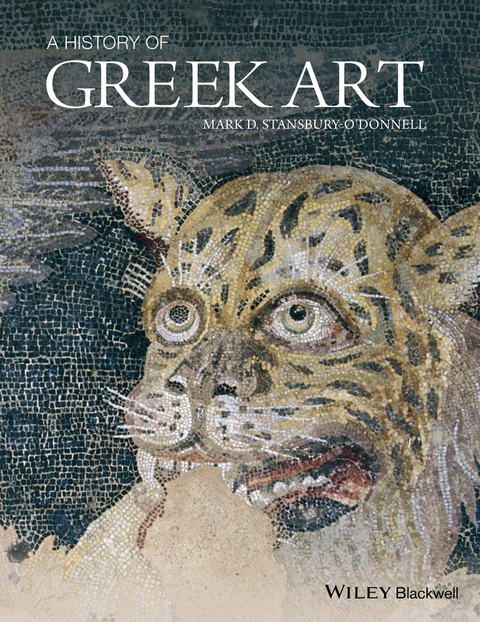
A History of Greek Art (eBook)
John Wiley & Sons (Verlag)
978-1-118-83942-3 (ISBN)
Offering a unique blend of thematic and chronological investigation, this highly illustrated, engaging text explores the rich historical, cultural, and social contexts of 3,000 years of Greek art, from the Bronze Age through the Hellenistic period.
- Uniquely intersperses chapters devoted to major periods of Greek art from the Bronze Age through the Hellenistic period, with chapters containing discussions of important contextual themes across all of the periods
- Contextual chapters illustrate how a range of factors, such as the urban environment, gender, markets, and cross-cultural contact, influenced the development of art
- Chronological chapters survey the appearance and development of key artistic genres and explore how artifacts and architecture of the time reflect these styles
- Offers a variety of engaging and informative pedagogical features to help students navigate the subject, such as timelines, theme-based textboxes, key terms defined in margins, and further readings.
- Information is presented clearly and contextualized so that it is accessible to students regardless of their prior level of knowledge
- A book companion website is available at www.wiley.gom/go/greekart with the following resources: PowerPoint slides, glossary, and timeline
Mark D. Stansbury-O'Donnell is a Professor of Art History at the University of St. Thomas in St. Paul, Minnesota, USA. He is the author of Pictorial Narrative in Ancient Greek Art (1999), Vase Painting, Gender, and Social Identity in Archaic Athens (2006), and Looking at Greek Art (2011).
Mark D. Stansbury-O'Donnell is a Professor of Art History at the University of St. Thomas in St. Paul, Minnesota, USA. He is the author of Pictorial Narrative in Ancient Greek Art (1999), Vase Painting, Gender, and Social Identity in Archaic Athens (2006), and Looking at Greek Art (2011).
List of figures
Acknowledgments
Timeline
About the website
Maps
1 Introduction and Issues in the History of Greek Art
2 The Early and Middle Bronze Ages (c. 3100-1600 BCE)
3 The Late Bronze Age II-III (c. 1600-1075 BCE)
4 The Sub-Mycenaean, Protogeometric, & Geometric Periods (c. 1075-700 BCE)
5 Contexts I: Civic, Domestic, and Funerary
6 The Seventh Century (c. 725/700-625/600 BCE)
7 Contexts II: Sanctuaries and Architecture
8 The Sixth Century (c. 625/600-480 BCE)
9 Narrative
10 The Fifth-Century (c. 480-400 BCE)
11 The Production of Greek Art and its Markets; Textbox: Ancient and Modern Values of Art
12 The Fourth Century to c. 330 BCE
13 Identity
14 The Hellenistic Period (c. 330-30 BCE)
15 Epilogue
Glossary
"Mark Stansbury-O'Donnell has written a thoroughly
contemporary history of Greek art - the first that
effectively integrates discussions of context with sensitive
analysis of style. It provides students with a rich introduction to
the fabric of ancient Greek culture." Tom Carpenter, Ohio
University
"Stansbury-O'Donnell's admirable and
innovative history deserves special praise for the fact that it
devotes as much attention to ancient Greek art's cultural
context as to its chronological and aesthetic development."
J.J. Pollitt, Yale University
"Engaging introduction to Greek art...offers
diachronic framework interspersed with chapters on synchronic
themes, enhanced with comparative timelines including major
monuments, definitions in margins, and profuse high-quality
illustrations." Barbara A. Barletta, University of
Florida
"A marvelous book, beautifully written and lavishly
illustrated, it presents a well-rounded narrative of ancient Greek
material culture. Combining a traditional diachronic approach with
a fresh thematic coverage of the "contexts" of ancient
Greek art, it provides a comprehensive understanding of the Greeks
and their world for students at all levels." Kim S.
Shelton, University of California, Berkeley
"One of the many things that makes
Stansbury-O'Donnell's new survey of Greek art so
refreshing - and so important - is his commitment to
deep contexts. Specifically, he challenges students and teachers to
think beyond the typical evolutionary model of 'ancient Greek
art history,' and instead brilliantly focuses their attention
on the rich cultural matrix that Greek art reflected, generated,
and inspired." Peter Schultz, Concordia
College
"Stansbury-O'Odonnell has created an up-to-date and
stimulating volume that presents an intelligible chronological
survey of Greek Art, interspersed with sections on contextual
issues that examine the material from multiple synchronic
perspectives and standpoints. This work will provide a
valuable starting point for discussion among students on issues
ancient and modern." Craig I. Hardiman, University of Waterloo,
Canada
"With Stansbury-O'Donnell's skills in the
interpretation of Greek art and the critical analysis of its
historiography setting the tone throughout, this book provides
readers at all levels with an insightful, thought-provoking
introduction. Its clear structure, exquisite illustrations and
extensive supporting materials make it the most comprehensive
undergraduate textbook currently on the market." Katharina
Lorenz, University of Nottingham, United Kingdom
"Mark Stansbury-O'Donnell's A History of
Greek Art presents a wide-ranging, magisterial, and superbly
illustrated account of Greek art from the beginning of the Bronze
Age to the end of the Hellenistic period. Its clear structure and
exceedingly well chosen examples are most useful to students and
teachers alike." Thomas Mannack, Beazley Archive, Oxford,
United Kingdom
1
Introduction and Issues in the History of Greek Art
- An Alternative Mini-History of Greek Art
- Some Questions to Consider for this Book
- The Plan of this Book
- A Few Notes About Using this Book
- Textbox: Stylistic Analysis and Sir John Beazley
- References
- Further Reading
The first histories of Greek art were written in the Hellenistic period of the third to first centuries BCE, during the last period covered in this book. By that time, Greek art and culture had spread well beyond the borders of the country of Greece today, and the Greeks themselves lived in cities from Russia and Afghanistan in the east to Spain in the west. Greek art was a common sight in Rome, whether statues expropriated from cities that the Romans had conquered or works commissioned from Greek artists by Roman patrons for their homes and villas.
The oldest extant account of the history of Greek art is a “mini-history” written by the Roman orator Cicero around 46 BCE and appearing in his history of rhetoric and orators entitled Brutus:
Who, of those who pay some attention to the lesser arts, does not appreciate the fact that the statues of Kanachos were more rigid than they ought to have been if they were to imitate reality? The statues of Kalamis are also hard, although they are softer than those of Kanachos. Even the statues of Myron had not yet been brought to a satisfactory representation of reality, although at that stage you would not hesitate to say that they were beautiful. Those of Polykleitos are still more beautiful; in fact, just about perfect, as they usually seem to me. A similar systematic development exists in painting. In the art of Zeuxis, Polygnotos, and Timanthes and the others who did not make use of more than four colors, we praise their forms and their draughtsmanship. But in the art of Aëtion, Nikomachos, Protogenes, and Apelles, everything has come to a stage of perfection.
(Cicero, Brutus 70; tr. Pollitt 1990, 223)
Brief though it is, this passage has the ingredients necessary for a history. Drawing from earlier Greek sources, Cicero names a series of artists in a chronological sequence, presenting us with a relative chronology of people and events, rather than an absolute chronology based on specific dates. He also tells us about the accomplishments of these artists. The first, Kanachos, created statues of the human figure in rigid postures, whereas his successors developed statues that were increasingly softer and more lifelike in appearance. This happened progressively over several generations, and Cicero singles out Polykleitos as nearly perfect in the way he sculpted the human form. We will see later a copy of a bronze statue called the Doryphoros or “Spear-Bearer” by Polykleitos (see Figure 10.7, page 243), but for now we can look at a similar figure from the Parthenon frieze that can be given an absolute date between 442 and 438 BCE based on the inscribed accounts of building expenses for the Parthenon (Figure 1.1). The figure standing in front of the horse touching his head with his left arm stands in a very lifelike pose with the weight to one hip and leg. The muscles and anatomy of the body are articulated accurately and precisely, making him lifelike in appearance. Furthermore, he is a graceful, athletic figure whose nudity allows us to admire his beauty. We can see how Cicero might acclaim a Polykleitan statue of the mid-fifth century BCE as both beautiful and “just about perfect.”
1.1 North frieze of the Parthenon, 442–438 BCE. 3 ft 5¾ in (1.06 m). London, British Museum. Cavalcade.
Photo: © The Trustees of the British Museum.
In his brief history, Cicero articulates an operating principle for Greek art, and in doing so makes his account more historical and interpretive than simply a chronicle of events and facts. He states, twice, that the purpose of art is to represent reality, and this becomes in turn a standard by which he judges the relative degree of success of the different artists. Not only do statues become more lifelike in their appearance, but they also become more beautiful, making a second criterion by which one can judge art and evaluate the achievements of different artists.
Cicero’s two principles, reality and beauty, are not exclusive to Greek sculpture, and are also the standard for his comments on the history of painting. In this even briefer passage, Cicero notes that painters underwent the same type of systematic development, from four-color work that relied on drawing, to presumably a full palette of colors with shading to make two-dimensional figures seem three-dimensional. What Cicero does not tell us directly, however, is that Apelles, the epitome of perfection for painting, was an artist who lived a century after the sculptor Polykleitos, so that the history of painting had a different absolute timetable than the history of sculpture. We have little surviving mural painting from this era, but we might look at a painting done on a ceramic vase about the same time as the Parthenon frieze (Figure 1.2). On the exterior of this vase, a mixing bowl or krater , we see Hermes bringing the infant Dionysos to Papasilenos for safekeeping from Hera, who was once again jealous over an illegitimate child fathered by Zeus. The figures are mostly in outline form with just a few added colors, and the effect is somewhat like the four colors of Polygnotos and Zeuxis mentioned by Cicero. There are some of the three-dimensional effects of perspective and shading, but on the whole, this painting would not seem to have met the standard of illusionistic “perfection” achieved by Apelles a hundred years later.
1.2 Attic white-ground calyx krater attributed to the Phiale Painter, c. 440 BCE. 12 15/16 in (32.8 cm). Vatican, Museo Gregoriano Etrusco Vaticano 559. Hermes bringing the infant Dionysos to Papasilenos.
Photo: Scala/Art Resource, NY.
Cicero’s purpose was not to write a history of Greek art for its own sake, but to use it as an example of parallels to the development of oratory, which was of greater prestige than the “lesser arts” of painting and sculpture. We have to consider that this context filters the principles and protagonists of his history. In writing about oratory, Cicero claims that it reaches its perfection with Roman orators of the first century BCE, surpassing earlier Greek rhetoricians. That Greek painting peaked later than sculpture makes the point that artistic development is not uniform and that oratory in contemporary Rome is just about perfect.
We further have to consider that the Latin terms used by Cicero might have meant something slightly different than the equivalent Greek terms would have meant in his sources. He uses the adjective verus and the noun veritas to describe the purpose of art, words that mean real and reality, as well as truthful and truth. In colloquial use, the meaning of the term with regard to art is “accurate representation of the natural appearance of a thing,” so that a work of art should look like a living human being (Pollitt 1974, 138). Comparing the Parthenon frieze to an earlier work like the statues in Figure 8.9 (page 190), we can readily see that the Parthenon figure is more lifelike, more “real” or “true” in appearance. For Cicero as a Roman, however, there was also a tradition of lifelike individual portraits of citizens, frequently elderly men and women with deeply lined faces and receding hairlines. These portraits are also true, but they would hardly be described as beautiful like the Parthenon figure or the Doryphoros of Polykleitos.
Unlike today’s histories of Greek art, Cicero did not include any illustrations so that his readers could see what he was saying. Rather, Cicero assumes that his audience is already familiar with a number of these artists and with the general outlines of the history of style in Greek art. Indeed, the construct that Cicero presents of Greek art going from less lifelike (stiff) to very lifelike (real) in its representation of the human form, of the human figure being the most important subject of art in both Greece and Rome, and of Greek art of the fifth and fourth centuries BCE achieving a standard of beauty by which Roman or other art was measured, are themes that have dominated the modern histories of Greek art since the eighteenth century, when Johann Winkelmann published what is considered the first modern history of Greek art in 1764.
The modern vocabulary of art history, however, has changed. If one were to describe the Parthenon figure as “realistic ” it would be misleading for a contemporary reader. The youthful male on the frieze is perfectly proportioned and graceful; he does not look like your average, everyday twenty-year-old. We would describe him as idealized rather than realistic. The Terme Boxer that we shall see near the end of the book (see Figure 14.22, page 367) is...
| Erscheint lt. Verlag | 16.12.2014 |
|---|---|
| Sprache | englisch |
| Themenwelt | Kunst / Musik / Theater ► Kunstgeschichte / Kunststile |
| Kunst / Musik / Theater ► Malerei / Plastik | |
| Geschichte ► Allgemeine Geschichte ► Altertum / Antike | |
| Schlagworte | Ancient & Classical Greek & Hellenistic History • Classical Greek Culture • Classical Studies • Greek art, painting, mosaic, sculpture, decorative arts, architecture, Bronze Age Greece, Proto-Geometric and Geometric Periods, Greek architecture, Orientalizing Period, Archaic Period, Fifth-Century Classical, Athenian pottery, Greek vase, Praxiteles, Skopas, Lysippos, Fourth-Century Classical, Hellenistic Period, mosaics, theatricism, antiquarianism, Athens, Epidauros, sculptural workshop, architectural sculpture, terracotta figurines, Mahdia shipwreck, Antikythera shipwreck • Griechenland /Kultur, Künste • Griechenland /Kultur, Künste • Hellenistische Geschichte, Geschichte der griechischen Antike • Humanistische Studien • Kultur der griechischen Antike • Kunstgeschichte |
| ISBN-10 | 1-118-83942-0 / 1118839420 |
| ISBN-13 | 978-1-118-83942-3 / 9781118839423 |
| Informationen gemäß Produktsicherheitsverordnung (GPSR) | |
| Haben Sie eine Frage zum Produkt? |
 EPUB (Adobe DRM)
Kopierschutz: Adobe-DRM
Adobe-DRM ist ein Kopierschutz, der das eBook vor Mißbrauch schützen soll. Dabei wird das eBook bereits beim Download auf Ihre persönliche Adobe-ID autorisiert. Lesen können Sie das eBook dann nur auf den Geräten, welche ebenfalls auf Ihre Adobe-ID registriert sind.
Details zum Adobe-DRM
Dateiformat: EPUB (Electronic Publication)
EPUB ist ein offener Standard für eBooks und eignet sich besonders zur Darstellung von Belletristik und Sachbüchern. Der Fließtext wird dynamisch an die Display- und Schriftgröße angepasst. Auch für mobile Lesegeräte ist EPUB daher gut geeignet.
Systemvoraussetzungen:
PC/Mac: Mit einem PC oder Mac können Sie dieses eBook lesen. Sie benötigen eine
eReader: Dieses eBook kann mit (fast) allen eBook-Readern gelesen werden. Mit dem amazon-Kindle ist es aber nicht kompatibel.
Smartphone/Tablet: Egal ob Apple oder Android, dieses eBook können Sie lesen. Sie benötigen eine
Geräteliste und zusätzliche Hinweise
Buying eBooks from abroad
For tax law reasons we can sell eBooks just within Germany and Switzerland. Regrettably we cannot fulfill eBook-orders from other countries.
aus dem Bereich