


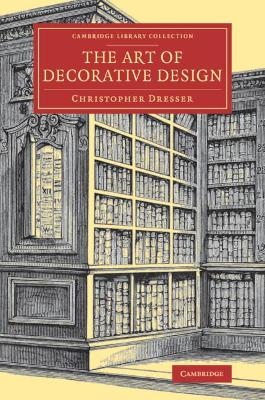
The Art of Decorative Design
Seiten
2019
Cambridge University Press (Verlag)
978-1-108-08040-8 (ISBN)
Cambridge University Press (Verlag)
978-1-108-08040-8 (ISBN)
Christopher Dresser (1834–1904) was arguably the first British industrial designer, working in a variety of media, and this 1862 work was his most influential book. Highly illustrated, it describes how to incorporate ornament into design, and encouraged the rising middle classes to decorate their homes themselves.
Christopher Dresser (1834–1904) was arguably the first British industrial designer, and this 1862 work was his most influential book. He worked in a variety of media, from wallpaper and textile design to metalwork and ceramics, but was also a botanist, and his two professorial roles in fine and ornamental arts, at the South Kensington Museum and the Crystal Palace, included the teaching of botany. Unlike William Morris, Dresser believed that good design could and should be mass-produced by industrial methods, so that it became affordable to all classes. He describes here how decorative ornament should be used in design, the importance of taking inspiration from natural (usually plant) models, and issues of proportion, balance and gradation. The book, which encouraged the rising middle classes to decorate their homes themselves, is highly illustrated: the colour plates can be viewed online at www.cambridge.org/9781108080408, by clicking on the 'Resources' button.
Christopher Dresser (1834–1904) was arguably the first British industrial designer, and this 1862 work was his most influential book. He worked in a variety of media, from wallpaper and textile design to metalwork and ceramics, but was also a botanist, and his two professorial roles in fine and ornamental arts, at the South Kensington Museum and the Crystal Palace, included the teaching of botany. Unlike William Morris, Dresser believed that good design could and should be mass-produced by industrial methods, so that it became affordable to all classes. He describes here how decorative ornament should be used in design, the importance of taking inspiration from natural (usually plant) models, and issues of proportion, balance and gradation. The book, which encouraged the rising middle classes to decorate their homes themselves, is highly illustrated: the colour plates can be viewed online at www.cambridge.org/9781108080408, by clicking on the 'Resources' button.
Preface; 1. Primarily, on the nature and character of ornament; 2. The ministrations of plants to ornament; 3. Grades in decorative art; 4. The affinity of the aesthetic arts; 5. Analysis of ornamental forms; 6. Order; 7. Repetition; 8. Curves; 9. Proportion; 10. Alternation; 11. Adaptation; 12. The power of ornament to express feelings and ideas; 13. Principles common to ornament; Appendix.
| Erscheint lt. Verlag | 4.5.2019 |
|---|---|
| Reihe/Serie | Cambridge Library Collection - Art and Architecture |
| Zusatzinfo | 24 Plates, color; 4 Plates, black and white; 158 Line drawings, unspecified |
| Verlagsort | Cambridge |
| Sprache | englisch |
| Maße | 152 x 230 mm |
| Gewicht | 400 g |
| Themenwelt | Kunst / Musik / Theater ► Kunstgeschichte / Kunststile |
| ISBN-10 | 1-108-08040-5 / 1108080405 |
| ISBN-13 | 978-1-108-08040-8 / 9781108080408 |
| Zustand | Neuware |
| Informationen gemäß Produktsicherheitsverordnung (GPSR) | |
| Haben Sie eine Frage zum Produkt? |
Mehr entdecken
aus dem Bereich

aus dem Bereich
kleine Kulturgeschichte einer brillanten Allianz
Buch | Softcover (2025)
Iudicium (Verlag)
CHF 33,90


