Kitchen and Bath Design Principles (eBook)
John Wiley & Sons (Verlag)
978-1-118-71564-2 (ISBN)
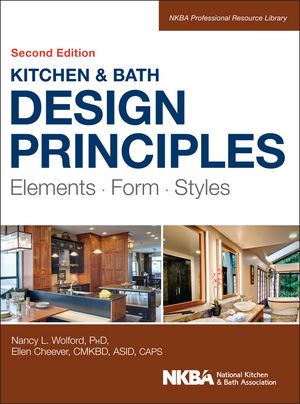
Kitchen and Bath Design Principles is The National Kitchen and Bath Association's complete guide to uniting function and style in these important rooms. This full-color guide is heavily illustrated, with a revised layout and graphic design that presents information more clearly for visual learners. The updated second edition has been expanded to adhere more closely to the standards of interior design, including new information on unity, proportion, scale, and variety, plus a new glossary to clarify unfamiliar terms. Stylistic themes remain a major component, with emphasis on the architecture, furniture, styles, and fashions of each era, and all technical and aesthetic information is presented in clear, concise language. The companion website features a teacher's guide and image bank that facilitate use in the classroom, providing additional examples of design principles in action.
The National Kitchen and Bath Association established the standard guidelines for safe and effective kitchen and bath design, and this book is the complete guide to incorporating code and aesthetics from the very beginning. Function is just as important as style in these rooms, so Kitchen and Bath Design Principles teaches readers to:
- Apply the elements and principles of design to real-life situations
- Discover how best to apply the tools of design in daily business practice
- Explore the global and cultural influences reflected in popular stylistic themes
- Translate the aesthetics of an era into a workable theme for a kitchen or bath
To best serve clients, designers must learn to meet all codes, regulations, and expectations with a balance of substance and style. Kitchen and Bath Design Principles is the industry standard reference, from the industry-leading provider of kitchen and bath design education.
Nancy Wolford, PHD, CID, is Professor Emeritus and former Interior Design Department Chair at Cañada College in Redwood City, California.
Ellen Cheever, CMKBD, ASID, CAPS, has spent the past 42 years redefining the kitchen and bathroom for North American consumers and industry professionals. She is principal of Ellen Cheever & Associates, based in Wilmington, Delaware.
The industry standard, full-color guide to practical kitchen and bath design Kitchen and Bath Design Principles is The National Kitchen and Bath Association's complete guide to uniting function and style in these important rooms. This full-color guide is heavily illustrated, with a revised layout and graphic design that presents information more clearly for visual learners. The updated second edition has been expanded to adhere more closely to the standards of interior design, including new information on unity, proportion, scale, and variety, plus a new glossary to clarify unfamiliar terms. Stylistic themes remain a major component, with emphasis on the architecture, furniture, styles, and fashions of each era, and all technical and aesthetic information is presented in clear, concise language. The companion website features a teacher's guide and image bank that facilitate use in the classroom, providing additional examples of design principles in action. The National Kitchen and Bath Association established the standard guidelines for safe and effective kitchen and bath design, and this book is the complete guide to incorporating code and aesthetics from the very beginning. Function is just as important as style in these rooms, so Kitchen and Bath Design Principles teaches readers to: Apply the elements and principles of design to real-life situations Discover how best to apply the tools of design in daily business practice Explore the global and cultural influences reflected in popular stylistic themes Translate the aesthetics of an era into a workable theme for a kitchen or bath To best serve clients, designers must learn to meet all codes, regulations, and expectations with a balance of substance and style. Kitchen and Bath Design Principles is the industry standard reference, from the industry-leading provider of kitchen and bath design education.
Nancy Wolford, PHD, CID, is Professor Emeritus and former Interior Design Department Chair at Cañada College in Redwood City, California. Ellen Cheever, CMKBD, ASID, CAPS, has spent the past 42 years redefining the kitchen and bathroom for North American consumers and industry professionals. She is principal of Ellen Cheever & Associates, based in Wilmington, Delaware.
PREFACE xiii
ACKNOWLEDGMENTS xv
CHAPTER 1 A BRIEF HISTORY OF KITCHEN AND BATHROOM DESIGN 1
A Brief History of the Kitchen 1
A Brief History of the Bathroom 5
Summary 12
Review Questions 12
CHAPTER 2 THE BASICS OF DESIGN: CREATING CUSTOMIZED DESIGN 13
Skill Is the Executor of a Program 13
Personalizing the Design 18
Summary 25
Review Questions 26
CHAPTER 3 THE ELEMENTS OF DESIGN 27
Line- 29
Shape 41
Identifying Pattern Preferences 52
Space 63
Form 64
Texture 66
Color 68
Light 92
Summary 93
Review Questions 93
CHAPTER 4 THE PRINCIPLES OF DESIGN 95
Balance 96
Rhythm 103
Scale and Proportion 107
Emphasis: The Focal Point 113
Harmony/Unity 121
Summary 121
Review Questions 121
CHAPTER 5 HISTORIC STYLE INFLUENCES TO THE LATE NINETEENTH CENTURY 123
Establishing a Historic Theme for a Kitchen or Bathroom Project 123
Ancient/Classical Period 125
Middle Ages/Gothic Period 129
Renaissance 131
Baroque Period 135
Rococo and French Provincial/Country Periods 137
Georgian Period 140
American Country (or Rustic) Styles 144
Neoclassic Styles 150
Victorian Period and the Rise of Industrialization 157
Summary 159
Review Questions 161
CHAPTER 6 HISTORIC STYLE INFLUENCES: LATE NINETHEENTH CENTURY AND BEYOND 163
Arts and Crafts 164
Art Nouveau 164
Art Deco 168
Bauhaus (International Modern) 172
Scandinavian Modern 173
Midcentury Modern 176
Italian and European Modern Postwar Influences, Urban Contemporary 181
Postmodern 184
Twenty-First Century and Beyond 187
Summary 188
Review Questions 188
CHAPTER 7 OTHER DESIGN INFLUENCES AND ECLECTIC DESIGN 189
Far East 189
Eclectic Design 196
Summary 204
Review Questions 204
APPENDIX A: THEME/HISTORIC STYLES COMPATIBILITY 205
APPENDIX B: HSITORICAL TERMINOLOGY AND THEMES 207
RESOURCES 211
INDEX 213
1
A Brief History of Kitchen and Bathroom Design
It is important for the kitchen and bath designer to understand the historical background of the design of the residential kitchen and bathroom in the United States and how it evolved. These spaces are often taken for granted as being primarily functional, necessary, and convenient rooms that have always been indoors, as they have been in most Western homes for a century or more. Fewer and fewer customers or designers can remember having or using primitive outdoor spaces for these functions, except when hiking or camping or in extremely remote areas. Therefore, giving thought to the actual design of these spaces is a relatively new concept, yet it is an opportunity for the expertise of the kitchen and bath designer.
- Learning Objective 1: Describe the development and evolution of the design of the residential kitchen.
- Learning Objective 2: Describe the development and evolution of the design of the residential bathroom.
A BRIEF HISTORY OF THE KITCHEN
For many centuries of recorded history, the kitchen was outside or in a separate building apart from the primary home to protect the family’s dwelling from fires. The kitchen eventually became attached to the dwelling but was considered by most to be strictly a separate functional work space rather than one that required designing, aesthetic considerations, or integration into the rest of the house. This was especially true for the wealthy, who often had staff handling the meal preparation and cleanup. Aesthetics, close or convenient location to eating/dining space, or ease of function were not considered, nor were they thought to be important. In Colonial America in the seventeenth and eighteenth centuries and into the nineteenth century, the kitchen became more integrated into the home, more a center of family life with the open flame from the fireplace used to warm the home and family as well as prepare the food. The kitchen of the Rundlet-May House (1807) in Portsmouth, New Hampshire, features an enclosed fireplace—an early forerunner of the modern kitchen stove (see Figure 1.1.)
FIGURE 1.1 Historical kitchen
Courtesy of the Society of Preservation of New England Antiquities Photo by David Bohl
The idea of a well-planned, well-designed kitchen was first talked about in the 1920s when Hoosier cabinets were introduced by the Hoosier Company. Later, Cornell University and the US Department of Agriculture Research Station in Beltsville, Maryland, began research on functional kitchen planning. This research continued after World War II by the Small Homes Council of the University of Illinois at Urbana-Champaign. However, the room still remained primarily a workroom, where function (food preparation, storage, and cleanup), mass production of cabinetry, and ease of cleaning, rather than aesthetics or other uses, were the primary considerations (see Figure 1.2).
FIGURE 1.2 1940s kitchen
Courtesy of Kohler Company
Immediately following World War II, several leading midwestern and eastern US cabinet companies introduced color and more wood for cabinetry, which gradually was becoming built in, as well as decorative hardware and a variety of accent cabinet pieces. Built-in appliances and fixtures were introduced in the late 1950s and 1960s, in a myriad of styles and colors. These avant-garde kitchens were widely shown in high-fashion magazines, such as Town & Country and Vogue, as well as the many home design shelter publications that were popular and widely read by consumers (see Figure 1.3).
FIGURE 1.3 1960s kitchen
Courtesy of Sub Zero
In the 1970s, a new design concept was introduced in several well-respected shelter magazines—the great room. Walls were removed between the kitchen and adjacent living spaces, bringing the kitchen out of the strictly separate functional/work-oriented category, to become an integral part of the family public/social space. It also helped to make homes appear to be larger as some walls were removed. The concept of the great room brought mass appeal to the idea of a decorated kitchen—one that was attractive to look at as well as functional to work and entertain in and continues to be popular (see Figure 1.4).
FIGURE 1.4 Great room/kitchen design concept introduced in the 1970s
Design by Carol Swanson-Petterson, CKD; KB Cabinets, Millbrae, CA
The concept of an aesthetically pleasing kitchen (whether a separate space or part of the great room concept) grew in importance throughout the 1970s, 1980s, and into the 1990s as the English bespoke idea of an unfitted kitchen was coupled with consumer interest in highly stylized, traditionally influenced environments attempting to re-create the warmth of a sundrenched villa in Tuscany, a colonial cottage in New England, or the midcentury modern look. Architectural details from these historic or period settings became more and more popular for consumers planning kitchens that were becoming the center of activity in their homes. A traditional kitchen with Old World design details is still popular today (see Figure 1.5).
FIGURE 1.5 Traditional 1990s kitchen
Design by Bryan Reiss, CMKBD and Scott Stultz, codesigners Peter Deane and Kelly Stewart, CMKBD
The concept of a kitchen outdoors returned in the early 2000s, although it is quite different from the simple fire pits or crude adobe ovens of earlier times. This concept created a new wealth of design opportunities for the kitchen designer. The outdoor kitchens range from simple built-in barbecues to elaborate structures that are as extensive, complete, and well thought-out and designed as typical indoor kitchens (see Figure 1.6).
FIGURE 1.6 Outdoor kitchen
Courtesy of Lynx Grills, Inc.
The interest in such aesthetically pleasing spaces continues today. As a kitchen specialist, one may be asked to plan a room that has a European-influenced sleek, uncluttered, and sophisticated style; a mid-twentieth-century modern renovation, or one that is harmonious and calming, inspired by a Far Eastern interior. The designer’s ability to appropriately use the elements and principles of good design as well as understand historic and cultural themes will add great value to functional space planning solutions. Contemporary kitchens today combine convenience, function, and beauty. In the example shown in Figure 1.7, plain, simple cabinets are highlighted with sleek cabinet pulls. Relatively smooth and varied wood-grained countertops and stainless-steel appliances are contrasted with the rough-textured wall treatment.
FIGURE 1.7 Contemporary European-influenced kitchen
Design by German Brun, LEED, AP, codesigner Lizmarie Esparza; Den Architecture, Miami, FL Photo by Greg Clark
A BRIEF HISTORY OF THE BATHROOM
For most of recorded history, the bathroom, as it is known today, did not exist. The outhouse or any convenient outdoor space was the toilet norm, as were outdoor washing facilities, often a stream or other body of water. However, indoor bath spaces strictly for bathing in some sort of tub or with a pitcher and bowl for washing have been around since ancient Greek and Roman times. It took centuries for these activities to come together in a single space. Although luxury homes featured indoor bathrooms with plumbed fixtures in the late 1800s, it was not until the 1920s that most building codes began mandating indoor plumbing for all new residential construction. These new codes paid little attention to the way the bathroom looked or how much space was required, because the space was perceived primarily as utilitarian. At first for typical bathrooms, few choices existed for fixture styles, colors, or fitting finishes. The primary concerns of early bathroom planners were providing safe indoor water supply intake and removal and accommodating three basic, usually white, fixtures in the smallest space possible. They also converted a dressing room, nursery, or other small room that had sufficient space for fixtures (see Figure 1.8).
FIGURE 1.8 Historical bathroom, early twentieth century
Courtesy of Kohler Company
Although many builders, designers, and architects overlooked the potential beauty of the bathroom, American filmmakers and emerging design trendsetters realized how attractive a bathroom could be. Sets in the emerging Hollywood film industry during the 1920s and 1930s suggested the potential beauty and luxury of the bathroom. Major manufacturers expanded their product lines and introduced color in their fixtures. An early Kohler advertisement celebrates this use of color in the bathroom (see Figure 1.9).
FIGURE 1.9 Historical bathroom, 1920s, introducing color
Courtesy of Kohler Company
In 1929, the New York Metropolitan Museum of Art featured an exhibit devoted to the artistic and aesthetic qualities of a residential household, including the bathroom, using black fixtures to contrast with the light tile (see Figure 1.10).
FIGURE 1.10...
| Erscheint lt. Verlag | 5.1.2015 |
|---|---|
| Reihe/Serie | NKBA Professional Resource Library |
| NKBA Professional Resource Library | NKBA Professional Resource Library |
| Sprache | englisch |
| Themenwelt | Kunst / Musik / Theater ► Design / Innenarchitektur / Mode |
| Technik ► Architektur | |
| Schlagworte | Architecture • Architektur • Badezimmer • bath design guide • bath design guidelines • bath planning • bathroom design • bathroom design text • Certified Bath Designer • Certified Kitchen Designer • design certification • Design, Drawing & Presentation • design project management • elements of design • Elements of Style • Ellen Cheever • Entwurf, Zeichnung u. Präsentation • Entwurf, Zeichnung u. Präsentation • Innenarchitektur • Interior design • interior design planning • interior design text • interior stylistic themes • Küche • Kitchen and Bath Design Principles • kitchen and bath reference • Kitchen Design • kitchen design guide • kitchen design guidelines • kitchen design text • Kitchen planning • Küche • Nancy Wolford • National Kitchen and Bath Association • Principles of Design • Residential Design |
| ISBN-10 | 1-118-71564-0 / 1118715640 |
| ISBN-13 | 978-1-118-71564-2 / 9781118715642 |
| Informationen gemäß Produktsicherheitsverordnung (GPSR) | |
| Haben Sie eine Frage zum Produkt? |
 EPUB (Adobe DRM)
Kopierschutz: Adobe-DRM
Adobe-DRM ist ein Kopierschutz, der das eBook vor Mißbrauch schützen soll. Dabei wird das eBook bereits beim Download auf Ihre persönliche Adobe-ID autorisiert. Lesen können Sie das eBook dann nur auf den Geräten, welche ebenfalls auf Ihre Adobe-ID registriert sind.
Details zum Adobe-DRM
Dateiformat: EPUB (Electronic Publication)
EPUB ist ein offener Standard für eBooks und eignet sich besonders zur Darstellung von Belletristik und Sachbüchern. Der Fließtext wird dynamisch an die Display- und Schriftgröße angepasst. Auch für mobile Lesegeräte ist EPUB daher gut geeignet.
Systemvoraussetzungen:
PC/Mac: Mit einem PC oder Mac können Sie dieses eBook lesen. Sie benötigen eine
eReader: Dieses eBook kann mit (fast) allen eBook-Readern gelesen werden. Mit dem amazon-Kindle ist es aber nicht kompatibel.
Smartphone/Tablet: Egal ob Apple oder Android, dieses eBook können Sie lesen. Sie benötigen eine
Geräteliste und zusätzliche Hinweise
Buying eBooks from abroad
For tax law reasons we can sell eBooks just within Germany and Switzerland. Regrettably we cannot fulfill eBook-orders from other countries.
aus dem Bereich