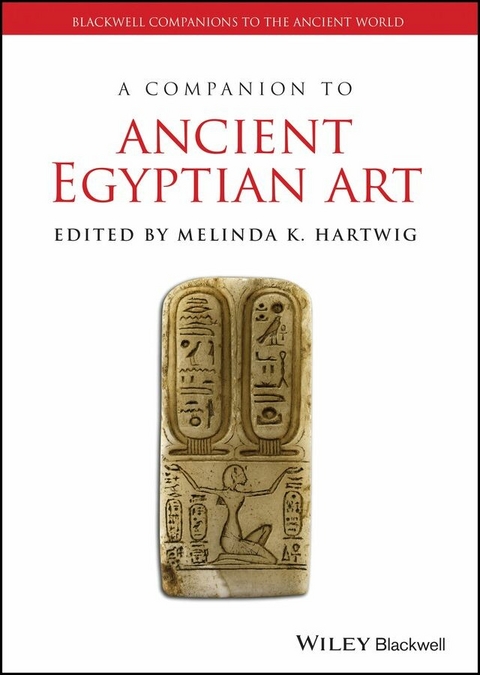
A Companion to Ancient Egyptian Art (eBook)
John Wiley & Sons (Verlag)
978-1-118-32508-7 (ISBN)
• Features contributions from top scholars in their respective fields of expertise relating to ancient Egyptian art
• Provides overviews of past and present scholarship and suggests new avenues to stimulate debate and allow for critical readings of individual art works
• Explores themes and topics such as methodological approaches, transmission of Egyptian art and its connections with other cultures, ancient reception, technology and interpretation,
• Provides a comprehensive synthesis on a discipline that has diversified to the extent that it now incorporates subjects ranging from gender theory to ‘X-ray fluorescence’ and ‘image-based interpretations systems’
Melinda Hartwig is an Associate Professor of Ancient Egyptian and Near Eastern Art and Archaeology at Georgia State University. She is the author of Tomb Painting and Identity in Ancient Thebes, 1419-1372 BCE (2004).
Melinda Hartwig is the Curator of Ancient Egyptian, Nubian and Near Eastern Art at the Michael C. Carlos Museum, Emory University, and Professor Emerita, Georgia State University. She is the author of Tomb Painting and Identity in Ancient Thebes, 1419-1372 BCE (2004).
Notes on Contributors ix
Foreword xiii
Preface xv
Acknowledgments xvii
List of Abbreviations xix
List of Illustrations xxi
List of Plates xxxi
Chronology of Egyptian Kings xxxiii
Chronology of Kushite Rulers xli
Maps xlv
1 WhatIsArt? 1
John Baines
PART I Methodological Approaches 23
2 Historiography of Ancient Egyptian Art 25
Diane Bergman
3 Style 39
Melinda K. Hartwig
4 Connoisseurship 60
Jack A. Josephson
5 Iconography and Symbolism 78
Maya Müller
6 Semiotics and Hermeneutics 98
Valérie Angenot
7 Gender and Sexuality 120
Gay Robins
8 Reception and Perception 141
Alexandra Verbovsek
9 Representing the Other: Non-Egyptians in Pharaonic Iconography 155
Ann Macy Roth
10 Interpreting Ancient Egyptian Material Culture 175
Salima Ikram
PART II Materials and Mediums 189
11 Sculpture 191
Melinda K. Hartwig
12 Relief 219
Alexandra Woods
13 Painting 249
Francesco Tiradritti
14 Coffins, Cartonnage, and Sarcophagi 269
Kathlyn M. Cooney
15 Luxury Arts 293
Arielle P. Kozloff
PART III Concepts in Art 307
16 Ideology and Propaganda 309
Ronald J. Leprohon
17 Religion and Ritual 328
Emily Teeter
18 Narrative 344
Nadja S. Braun
19 The Ordering of the Figure 360
William H. Peck
20 Portraiture 375
Betsy M. Bryan
PART IV Interconnections with the Larger World 397
21 Egyptian Connections with the Larger World: Greece and Rome 399
Barbara Mendoza
22 Egyptian Connections with the Larger World: Ancient Near East 423
Mehmet-Ali Ataç
23 The Art and Architecture of Kushite Nubia 447
Peter Lacovara
PART V Reception of Ancient Egyptian Art in the Modern World 463
24 Egyptomania: Fascination for Egypt and Its Expression in the Modern World 465
Jean-Marcel Humbert
PART VI Technology and Interpretation 483
25 Interpretation 485
Nigel Strudwick
26 Technology 504
Richard Newman
27 Conservation of Egyptian Objects: A Review of Current Practices in the Field and in Museum Settings 522
Susanne Gänsicke
Index 545
"No other work comes close to providing such an introduction to the ideas and bibliography of Egyptian art history; many of its chapters stand alone as thought-provoking essays of particular use to students; and in documenting the state of Egyptian art history it points to several productive paths forward. . . A Companion to Ancient Egyptian Art thus serves not only as an introduction to art-historical theory for Egyptologists but also as a call to arms for the field. We should answer." (College Art Association, October 2015)
"Such a multidisciplinary approach to Egyptian art is new. These articles describe, from a number of different perspectives, how ancient Egyptian art 'worked' and will be of special interest to those who wonder why Pharaonic imagery is so distinctive." (Ancient Egypt, 1 February 2015)
"Edited volumes can vary in consistency and relevance but A Companion to Ancient Egyptian Art is strong in these areas. This work certainly fulfills a need in the current literature of ancient Egyptian art history and I am very glad to have it on my shelf, both for myself and for my students. (I am currently using this volume extensively in an upper-level undergraduate Egyptian art course.)" (Journal of the American Research Center in Egypt, 52, 2016)
Notes on Contributors
- Valérie Angenot teaches Art, Civilizations, and Archaeology of Egypt and the Ancient Near East at the University of Louvain (Belgium), and is Research Associate at the Department of Rhetoric and Semiotics (Languages Sciences) at the University of Liège (Belgium). She is the author of several articles dealing with semiotics and hermeneutics of the ancient Egyptian image.
- Mehmet-Ali Ataç is Associate Professor of Classical and Near Eastern Archaeology at Bryn Mawr College. A scholar of the art of ancient Mesopotamia and its interconnections with the artistic traditions of Syria, Egypt, and Anatolia, he is the author of The Mythology of Kingship in Neo-Assyrian Art (2010).
- John Baines is Research Officer in the University of Oxford. He has held visiting appointments in universities and research institutions in several countries. His chief research interests are in Egyptian art, religion, literature, and the comparative modeling of social forms and institutions. His most recent books are Visual and Written Culture in Ancient Egypt (2007) and High Culture and Experience in Ancient Egypt (2013).
- Diane Bergman is Griffith Librarian in the Sackler Library, one of the Bodleian Libraries of the University of Oxford. Formerly she was the Librarian of the Wilbour Library of Egyptology in the Brooklyn Museum. She has contributed to the establishment of the Online Egyptological Bibliography in the Griffith Institute of the University of Oxford. She is also on the board of the Committee for Egyptology in ICOM (CIPEG).
- Nadja S. Braun received her PhD from the University of Leipzig and is currently Studienrätin at the Hochfranken-Gymnasium Naila. Her PhD thesis Pharao und Priester (2006) is about the conception of sacral kingship. She works across the fields of Egyptology, history, literary studies, and linguistics with the main focus of her research being on the conception of images, visual history, and visual narrative. Her recent publications include Visual History – Bilder machen Geschichte (2009) and The Ancient Egyptian Conception of Images (2010).
- Betsy M. Bryan is Alexander Badawy Professor of Egyptian Art and Archaeology at the Johns Hopkins University and Director of the Johns Hopkins University Archaeology Museum. Her research interests are the social and religious points of convergence in art production and in Egyptian cult. She is preparing the publication of thirteen years of excavation at the Mut Temple precinct in south Karnak.
- Kathlyn M. Cooney is Associate Professor of Egyptian Art and Architecture in the Department of Near Eastern Languages and Cultures at the University of California, Los Angeles. She is a specialist in funerary arts, particularly coffins of the New Kingdom and Dynasty 21, and author of The Cost of Death: The Social and Economic Value of Ancient Egyptian Funerary Art in the Ramesside Period (2007).
- Susanne Gänsicke is Conservator of Objects in the Department of Conservation and Collections Management, Museum of Fine Arts, Boston. She has worked as a site conservator on the New York University Apis Expedition in Memphis, Egypt, and on the Museum of Fine Arts Expedition at Gebel Barkal in Karima, Sudan. She recently taught in the Conservation Field School of the American Research Center in Luxor, Egypt. Her research interests include the study of ancient metalwork and technologies, and issues of site preservation.
- Melinda K. Hartwig is Professor of Ancient Egyptian and Near Eastern Art and Archaeology at Georgia State University and received her PhD from the Institute of Fine Arts, New York University in 2000. She specializes in object-centered, interdisciplinary applications of science and social theory to ancient Egyptian art. Her books include Tomb Painting and Identity in Ancient Thebes (2004) and The Tomb Chapel of Menna (Theban Tomb 69): The Art, Culture and Science of Painting in an Egyptian Tomb (2013).
- Jean-Marcel Humbert has a Doctorate in History (Egyptology), Paris IV-Sorbonne (1975), and is Docteur d'Etat ès-Lettres et Sciences humaines, Paris IV-Sorbonne (1987). A museum curator and Director of the French National Museums (Ministry of Culture) since 1974, he recently retired from his professional career and continues his research as a freelance specialist. He has curated many national and international exhibitions, including Bonaparte and Egypt (2008–2009), Dream of Egypt (1998), Egypt in Paris (1998), and Egyptomania (1994–1995).
- Salima Ikram is Professor of Egyptology in the Department of Sociology, Anthropology, Psychology, and Egyptology at the American University in Cairo. She has authored several books on different aspects of funerary practices of the ancient Egyptians, animal mummies, and numerous articles using material culture to interpret ancient Egyptian culture and society. She has worked on sites throughout Egypt, and reinstalled two galleries in the Cairo Museum.
- Jack A. Josephson, a student of the late Bernard V. Bothmer, is currently Research Associate at the Institute of Fine Arts of New York University and formerly Distinguished Visiting Professor at the American University, Cairo. He has published several volumes on Egyptian art as well as numerous journal articles about art historical topics ranging throughout the 3,000 years of that civilization, although his specialization is Late Period sculpture.
- Arielle P. Kozloff was Curator of Ancient Art at the Cleveland Museum of Art, producing many exhibitions including Egypt's Dazzling Sun: The World of Amenhotep III (1992) and co-authoring its catalog. She has written dozens of articles, book chapters, and catalogs. Favorite subjects include ancient animal imagery, luxury arts (especially of Dynasty 18), re-cut statuary, the history and importance of collecting, and the mechanics of organizing collections and exhibitions. She is now an independent scholar and private consultant.
- Peter Lacovara is Senior Curator of Ancient Egyptian, Nubian and Near Eastern Art at the Michael C. Carlos Museum of Emory University. Before coming to Atlanta, he was at the Museum of Fine Arts, Boston and received his PhD from the University of Chicago. Dr Lacovara has excavated at Abydos, Giza, Gebel Silsila, the Valley of the Kings at Thebes, Hierakonpolis, the city of Deir el-Ballas, and is currently co-directing the Joint Expedition to Malkata with the Metropolitan Museum of Art. His publications include: The New Kingdom Royal City (1997); as co-author, Mummies and Magic: The Funerary Arts of Ancient Egypt (1998); and he also co-edited Ancient Nubia: African Kingdoms on the Nile (2012).
- Ronald J. Leprohon is Professor of Egyptology in the Department of Near and Middle Eastern Civilizations at the University of Toronto. He is the author of The Great Name: Ancient Egyptian Royal Titulary, Writings from the Ancient World 33 (2013). He has also written on versification in non-literary texts, funerary and mythological texts, administration in ancient Egypt, and Egypt's relations with Nubia.
- Barbara Mendoza is an adjunct instructor of Ancient and Medieval Art History in the Art Department of Solano Community College. She graduated in 2006 from the University of California, Berkeley with a PhD in Near Eastern Studies, specializing in Greco-Egyptian Art and Archaeology. She is the author of Bronze Priests of Ancient Egypt from the Middle Kingdom to the Graeco-Roman Period (2008), and articles on her research areas, the intercultural connections between Egypt and Crete, Greco-Roman Egypt, Hellenistic art, and bronze working in the ancient world.
- Maya Müller is an Egyptologist and art historian who has specialized in the history of ancient Egyptian art for more than three decades. After retirement as a curator in the Museum of Cultures, Basel, she is now active in the international working group Textiles of the Nile Valley (Late Antique, Byzantine, and Islamic iconography). Her research focuses on themes from Dynastic Egypt, the realistic portrait, the creative process in art, and the history of Egyptological writing on art.
- Richard Newman is Head of Scientific Research at the Museum of Fine Arts (MFA), Boston. He has written or co-written publications on many kinds of cultural artifacts, most involving works of art in the MFA collections, including ancient Egyptian objects. He works with curators and conservators, addressing a wide range of questions involving authenticity, previous restorations and condition, and detailed technical studies of materials and manufacturing techniques.
- William H. Peck is the former Curator of Ancient Art at the Detroit Institute of Arts and the Co-field Director of the Brooklyn Museum excavations in the Precinct of the Goddess Mut, Karnak. He is the author of Drawings from Ancient Egypt (1978) (with French, German, and Arabic translations) as well as a number of publications on the art of ancient Egypt including “Methods of Representation” in the Egyptian section of the Grove Dictionary of Art.
- Gay Robins studied Egyptology as an undergraduate at the University of Durham, England, and then obtained a DPhil from Oxford University in 1981. From 1979 to 1983 she was the Lady Wallis Budge Research Fellow in Egyptology at Christ's College, Cambridge. She is now Samuel Candler Dobbs Professor of Art History at Emory University. She is the author of numerous articles...
| Erscheint lt. Verlag | 23.12.2014 |
|---|---|
| Reihe/Serie | Blackwell Companions to the Ancient World |
| Blackwell Companions to the Ancient World | Blackwell Companions to the Ancient World |
| Sprache | englisch |
| Themenwelt | Literatur |
| Kunst / Musik / Theater ► Kunstgeschichte / Kunststile | |
| Geschichte ► Allgemeine Geschichte ► Altertum / Antike | |
| Geisteswissenschaften ► Sprach- / Literaturwissenschaft ► Literaturwissenschaft | |
| Schlagworte | Ägypten /Alte Geschichte • Ãgypten /Alte Geschichte • Ägyptologie • Ãgyptologie • Ancient Egyptian History • Archäologie • Archäologie Ãgyptens, Ãgyptologie • archaeology • Archaeology of Egypt / Egyptology • Archaeology of Egypt, Egyptology, Ancient Egyptian History, Art History & Theory, archaeology technology, Tomb painting, Pharaohs, Papyrus, Hieroglyphs, Egyptian Gods and Goddesses, • Archäologie • Archäologie Ägyptens, Ägyptologie • Art & Applied Arts • Art History & Theory • Classical Studies • Geschichte des ägyptischen Altertums • Geschichte des ägyptischen Altertums • Humanistische Studien • Kunstgeschichte • Kunstgeschichte u. -theorie • Kunst u. Angewandte Kunst |
| ISBN-10 | 1-118-32508-7 / 1118325087 |
| ISBN-13 | 978-1-118-32508-7 / 9781118325087 |
| Informationen gemäß Produktsicherheitsverordnung (GPSR) | |
| Haben Sie eine Frage zum Produkt? |
 EPUB (Adobe DRM)
Kopierschutz: Adobe-DRM
Adobe-DRM ist ein Kopierschutz, der das eBook vor Mißbrauch schützen soll. Dabei wird das eBook bereits beim Download auf Ihre persönliche Adobe-ID autorisiert. Lesen können Sie das eBook dann nur auf den Geräten, welche ebenfalls auf Ihre Adobe-ID registriert sind.
Details zum Adobe-DRM
Dateiformat: EPUB (Electronic Publication)
EPUB ist ein offener Standard für eBooks und eignet sich besonders zur Darstellung von Belletristik und Sachbüchern. Der Fließtext wird dynamisch an die Display- und Schriftgröße angepasst. Auch für mobile Lesegeräte ist EPUB daher gut geeignet.
Systemvoraussetzungen:
PC/Mac: Mit einem PC oder Mac können Sie dieses eBook lesen. Sie benötigen eine
eReader: Dieses eBook kann mit (fast) allen eBook-Readern gelesen werden. Mit dem amazon-Kindle ist es aber nicht kompatibel.
Smartphone/Tablet: Egal ob Apple oder Android, dieses eBook können Sie lesen. Sie benötigen eine
Geräteliste und zusätzliche Hinweise
Buying eBooks from abroad
For tax law reasons we can sell eBooks just within Germany and Switzerland. Regrettably we cannot fulfill eBook-orders from other countries.
aus dem Bereich