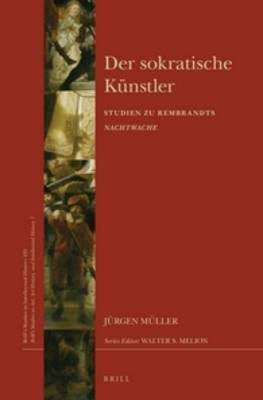
Der sokratische Künstler
Brill (Verlag)
978-90-04-28525-5 (ISBN)
The focus of Müller’s study is a new interpretation of Rembrandt’s Night Watch from 1642, which highlights the painter’s engagement with the classical art theory of Franciscus Junius. Junius’s treatise, "De pictura veterum", was published in Latin in 1637 and in Dutch in 1641. Ultimately, Müller argues that Rembrandt’s group portrait was designed to present a critique of the Italianate/classical concepts of Imitatio in addition to offering an ironic commentary on artworks of the Antique and High Renaissance periods. The Dutch artist takes Raphael’s School of Athens as a reference point, thereby implicitly posing questions about appropriate and inappropriate forms of imitation. The study as a whole shows how complex and witty Rembrandt’s approach to his models could be. Although the Night Watch occupies a central place in the inquiry, the author also engages with other paintings, etchings and drawings in order to sketch the contours of Rembrandt’s ironic image making.
Jürgen Müller, Ph. D. (1991) hat den Lehrstuhl für Mittlere und Neuere Kunstgeschichte an der TU Dresden inne. Er hat zahlreiche Monographien verfasst sowie Bücher und Ausstellungskataloge herausgegeben. Seine Themenschwerpunkte liegen in der Kunst der Frühen Neuzeit, der Film- und Fotogeschichte. Jürgen Müller holds the Chair for Early Modern Art History at the Technical University Dresden. He has written several monographs and edited many books and exhibition catalogues. His fields of interest lie in Northern European Art of the early modern period, film history and history of photography.
VORWORT
EINLEITUNG
Der scheißende Künstler
Methodenfragen und Gang der Untersuchung
I. Rembrandtmythen
1. Das Bild Rembrandts in der klassizistischen Kunstkritik
2. Das Amsterdamer Rembrandtdenkmal
3. Untergehende und Hinübergehende – Rembrandt als revolutionäres Genie
4. Wie Rembrandt zum Erzieher wurde
5. „Nichts von Wert“ – Hans Steinhoffs Film „Rembrandt“ von 1942
II. Ars humilis
1. Die Leidener Anfänge
2. Plötzlichkeit
3. Helldunkel als Erzählform
4. Nah und fern zum Bilde
5. Totlachen
6. Bildironie
7. Erasmus' Adagium „Sileni Alcibiadis“ oder „Schijn Bedrieght“
8. Der Maler als Proteus
III. Silenische Bilder
1. Das Problem der Nachahmung in der niederländischen Kunsttheorie
2. Imitatio oder Dissimulatio? Zur Praxis der Motivübernahme am Beispiel von Michelangelos Cascina-Schlacht
3. Obscuritas picturae
4. „Een antieckse Laechon“
5. Die Blendung Simsons – schöner oder hässlicher Schmerz?
6. Der Raub des Ganymed – Klassizismus als Witz
7. Augenzwinkern
8. Die Judenbraut
IV. Die Nachtwache
1. Rembrandt und Raffael
2. Personen und Figuren
3. Der Mythos von Rembrandts Nachtwache
4. Der Maler als Souverän
5. Komische Motive
6. Rembrandts Nachtwache und Raffaels Schule von Athen
7. Spielende Kinder und die Ikonographie des schlafenden Mars
8. „Handelinghe“ – von richtiger und falscher Nachahmung
9. Stil und Geschichte im „Welttheater“
Bibliographie
Abbildungsverzeichnis
| Reihe/Serie | Brill's Studies on Art, Art History, and Intellectual History ; 235/7 |
|---|---|
| Verlagsort | Leiden |
| Sprache | deutsch |
| Maße | 155 x 235 mm |
| Gewicht | 658 g |
| Themenwelt | Kunst / Musik / Theater ► Kunstgeschichte / Kunststile |
| Kunst / Musik / Theater ► Malerei / Plastik | |
| Geisteswissenschaften ► Geschichte | |
| Geisteswissenschaften ► Philosophie | |
| ISBN-10 | 90-04-28525-3 / 9004285253 |
| ISBN-13 | 978-90-04-28525-5 / 9789004285255 |
| Zustand | Neuware |
| Informationen gemäß Produktsicherheitsverordnung (GPSR) | |
| Haben Sie eine Frage zum Produkt? |
aus dem Bereich