Kitchen & Bath Sustainable Design (eBook)
John Wiley & Sons (Verlag)
978-1-118-95765-3 (ISBN)
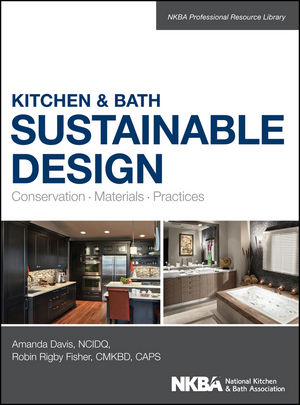
Kitchen & Bath Sustainable Design is the National Kitchen and Bath Association's complete guide to 'greening' these important rooms. The first book to focus exclusively on kitchen and bath sustainability, this full color guide covers every consideration for both remodels and new construction, making it a handy reference for any kitchen and bath professional. Case studies of award-winning projects demonstrate how space, budget, and sustainability can come together to create beautiful, functional, efficient rooms, and illustrations throughout provide visual examples of the techniques discussed. The book includes information on greening one's practice for the client's benefit, plus an appendix of additional resources and instructional materials for classroom use.
Outside of general heating and cooling, kitchen appliances use the bulk of a household's energy. Kitchens and baths together use an average of 300 gallons of water per day for a family of four, and both rooms are high-use areas that require good air quality. Kitchen & Bath Sustainable Design provides a handbook to designing these rooms for sustainability, without sacrificing comfort or livability. With comprehensive guidance on approaching these rooms sustainably, readers will:
- Communicate better with builders, clients, and potential clients
- Understand technical considerations, and the criteria that make a design 'green'
- Conduct a full design analysis, including life cycle costing and efficiency
- Learn the ratings systems and standards in play in the green kitchen and bath
The biggest elements of sustainable interior design-energy efficiency, water use, and materials selection-are all major players in the kitchen and bath. Clients are increasingly demanding attention to sustainability issues, and designers must be up to date on the latest guidelines, best practices, and technology. Kitchen & Bath Sustainable Design is the complete technical and practical guide to green design for the kitchen and bath professional.
Amanda Davis, NCIDQ is Chair of the Interior Design Department at Portland Community College, and a practicing interior designer in Portland, Oregon.
Robin Rigby Fisher, CMKBD, CAPS is an instructor at Portland Community College, and principal of Robin Rigby Fisher Design. Robin also lives in Portland, Oregon.
Amanda Davis, NCIDQ is Chair of the Interior Design Department at Portland Community College, and a practicing interior designer in Portland, Oregon. Robin Rigby Fisher, CMKBD, CAPS is an instructor at Portland Community College, and principal of Robin Rigby Fisher Design. Robin also lives in Portland, Oregon.
PREFACExiii
ACKNOWLEDGMENTS xv
CHAPTER 1 UNDERSTANDING THE NEED FOR SUSTAINABLE DESIGN 1
Triple Bottom-Line Approach 4
Designing for Benefit 11
Summary 20
Review Questions 20
CHAPTER 2 WHAT DEFINES SUSTAINABILITY? 23
Embodied Energy 24
Renewable Resources 26
Affordable Comfort Perspective 35
Summary 39
Review Questions 40
CHAPTER 3 SUSTAINABLE CONSTRUCTION 41
The Path You Take--Beyond Code 42
Window Specification 50
Walls and Insulation 50
Heating and Cooling 60
Water Conservation and Distribution 62
Deconstruction 66
Space Planning 72
Summary 74
Review Questions 75
CHAPTER 4 INDOOR AIR QUALITY 77
Indoor Air Quality--Why Should We Care? 77
Kitchen Ventilation 86
Bathroom Ventilation 88
Makeup Air 91
Summary 103
Review Questions 103
CHAPTER 5 MATERIALS, APPLIANCES, and FIXTURES 105
Getting Started 105
Embodied Energy 112
Life Cycle Assessment 113
Materials 118
Wall Finishes 121
Sealers 134
Fixtures and Fittings 141
Water Heating and Distribution 145
Living Room Appliances 150
Summary 151
Review Questions 151
CHAPTER 6 CREATING AN ENVIRONMENTALLY SUSTAINABLE DESIGN PRACTICE 153
Why Create an Environmentally Sustainable Design Practice? 153
Today's Green Client 166
Incorporating Systems Thinking in Your Business 168
Summary 169
Review Questions 169
APPENDIX A 173
APPENDIX B 177
APPENDIX C 181
APPENDIX D 197
APPENDIX E 201
GLOSSARY 207
RESOURCES 213
INDEX 215
1
Understanding the Need for Sustainable Design
On my first Boy Scout trip, in the mid-1950s, I learned the basic environmental principle that we should leave the campsite as we found it. We were told that the next group of hikers deserved no less and that in fact we should clean the site up if those before us had been careless. I did not as a child understand that the campsite would be global or that the next hikers would include unborn generations.
—John Sitter
- Learning Objective 1: Discuss the concept of designing for benefit rather than austerity.
- Learning Objective 2: Apply sustainable design concepts to kitchen and bath projects.
- Learning Objective 3: Identify the basic needs for applying sustainable practices.
Our world is in dire straits; human impact on the earth is affecting the future of the planet (see Figure 1.1). Consider these facts:
- The average temperature of the earth has risen by more than 1.4° F over the last century.1
- Oceans are warming and becoming more acidic, ice caps are melting, and sea levels are rising.2 From 1880 to 2011, the average sea level rise was 0.07 inches per year, but from 1993 to 2011, the sea level rise was between 0.11 and 0.13 inches per year.3
- Emissions of greenhouse gases (carbon dioxide [CO2], methane, nitrous oxide, and fluorinated gases) have increased due to human activities such as:
- The burning of fossil fuels.
- Anaerobic decay of organic waste in landfills due to industry processes and commercial and household chemicals (see Figure 1.2)
Figure 1.1 World Wildlife Fund Living Planet Report © 2014
World Wildlife Fund, www.panda.org
Figure 1.2 Total US Greenhouse Gas Emissions by Economic Sector in 2011
www.epa.gov/climatechange/ghgemissions/usinventoryreport.html
Global warming or climate change occurs when the greenhouse gases redirect too much radiation toward the earth. Radiant energy, in the form of heat, comes from the sun. In a most amazing natural cycle, unnecessary (and potentially harmful) radiant energy is sent out of the earth's atmosphere into space. With the exponential increase in the amount of greenhouse gases in the earth's atmosphere over the last 150 years, this process is being interrupted. The gases are trapping the energy as heat (see Figure 1.3).
Figure 1.3 The Greenhouse Effect
www.epa.gov/climatestudents/basics/today/greenhouse-effect.html
The term “greenhouse gas” is a blanket term for compounds that exacerbate this situation. These gases are by-products of industry. Waste emissions from the burning of fossil fuels are the leading source of these gases, but they are not completely responsible. Other sources of greenhouse gas include the manufacture of hydrofluorocarbons (refrigerants), emissions from landfills, emissions from livestock, and off-gassing of chemicals.
The construction industry has only added to our current problem. Research shows that the construction industry impacts our global problem with residential buildings accounting for:
- 38.9 percent of total US energy consumption
- 38.9 percent of total US CO2 emissions
- 13 percent of total US water consumption4
TRIPLE-BOTTOM-LINE APPROACH
We can answer the question “Why sustainable design?” with inspiration from the triple-bottom-line (TBL) concept (see Figure 1.4). This book is written in what appears to be the end stages of the worst economic crisis (recession) since the twentieth century's Great Depression. It is an exciting time. With the kitchen and bath remodeling sector experiencing a return to business growth, there is an opportunity to make this return to prosperity a green one. How do things look different now from four years ago? How will they look four years from today? The conversation about sustainable building, design, and remodeling practices is an evolving one.
Figure 1.4 The main parts of the triple bottom line are people, planet, and profit, but as this figure shows, there are subsets that further define the TBL.
NKBA
At the end of the twentieth century, many companies were profiting at the expense of many workers and the natural environment. People, planet, profit is a business concept also known as the triple bottom line (TBL).
The term “TBL” first was used in 1994 by economist John Elkington. At the time, it was a revolutionary approach to business as usual. The TBL asks that businesses create three sectors with measureable outcomes to determine the success of the company. It states that it is not enough simply to look at the final success (profit) of the company as the one bottom line; one must also look at how the business affects the environment (planet) and how the business supports its community (people).
In this book, we examine ways to create sustainable kitchens and baths by understanding the need to become a steward of the environment. Creating a sustainable design practice means planning for benefit: saving your client money, paying homage to the environment, and designing healthy interiors that will enhance your clients' lives.
Event-Oriented Thinking, Systems Thinking, and the Butterfly Effect
There are a thousand hacking at the branches of evil to one who is striking at the root.
—Henry David Thoreau, Walden
The environment is a big issue—one country, one government, one community, one business, or one person cannot resolve all the issues, but if each one of us does our part, then change will occur. It will take a new way of thinking—a paradigm shift.
To make a paradigm shift, we must look at our attitudes, behaviors, and beliefs. This is not a linear process; it is a loop. Let's look at this in a different way:
Midterms are fast approaching, and you are getting a cold. Your homework is piling up, but there is a party this weekend, so you take cold medicine and head out. You spend the next three nights pulling all-nighters, take your midterms, and spend the next few days in bed very sick (see Figure 1.5).
Figure 1.5 Event-oriented thinking says that everything can be explained by a chain of events: If A or B happens, then C will most likely occur—cause and effect.
NKBA
This is event-oriented thinking. This process looks at the world in a linear fashion: A happens, then B, then C. Event-oriented thinking assumes that each event has a cause and that changing the cause will correspondingly change the event. The rest of the system that produced the event need not be considered.
We can't solve problems by using the same kind of thinking we used when we created them.
—Albert Einstein
Now let's look at your cold in a new way.
Midterms are fast approaching, and you are getting a cold. After a few days of being miserable, you start thinking, “I seem to get a cold close to midterms often. Why is that?” You are recognizing a pattern. So, what happens at midterms each time? Well, the amount of work is beginning to pile up, but you are still going out with your friends on Friday and Saturday, not eating well, and your exercise regime has gone by the wayside. Now you are seeing what is influencing the pattern. To make a change, you need to make a shift. What can you do to break the pattern? Perhaps you can only go out on Saturday if all your studying is done, plan your meals in advance, get a workout partner, and focus on your health.
You are on your way to break the cycle. This is systems thinking (see Figure 1.6).
Figure 1.6 Systems thinking: To solve a problem, you need to assess what is happening at the base.
NKBA
System thinking is the process of looking at things as interdependent systems where one part influences another. Event-oriented thinking is linear cause and effect, but systems thinking is circular (a causal loop). Systems thinking is not reacting to a problem; rather, it encourages a more holistic approach to solutions.
The metaphor of the butterfly effect illustrates system thinking. A butterfly flaps its wings, and the small current has the ability to effect change as large as the path of a storm. The concept involves considering that small, almost imperceptible events can alter larger ones. It involves understanding that there is an interdependency of all events on the planet and that all circumstances are sensitive to one another. Much like the butterfly effect, systems thinking reasons that small events can be separated by time and distance and still affect one another.
This is the appropriate way to look at sustainability. Just changing your lamps to compact fluorescent bulbs (CFLs) or light-emitting diodes (LEDs) can be part of the solution; but as a designer, you have the opportunity to effect larger change. You can be part of the solution.
That's what this book is about—arming you with the knowledge and tools to effect change.
Imperceptible Change?
In...
| Erscheint lt. Verlag | 2.12.2014 |
|---|---|
| Reihe/Serie | NKBA Professional Resource Library |
| NKBA Professional Resource Library | NKBA Professional Resource Library |
| Sprache | englisch |
| Themenwelt | Kunst / Musik / Theater ► Design / Innenarchitektur / Mode |
| Technik ► Architektur | |
| Schlagworte | Amanda Ferroggiaro • Architecture • Architektur • Badezimmer • Certified Bath Designer • Certified Kitchen Designer • eco-friendly interior design • environmentally responsible design • green bathroom design • green bathroom standards • Green Design • green design implementation • green interior design • green kitchen design • green kitchen standards • healthy home design • high-traffic green design • Innenarchitektur • Interior design • Küche • Kitchen & Bath Sustainable Design • Küche • Nachhaltiges Bauen • National Kitchen and Bath Association • NKBA • planning energy efficiency • Robin Fisher • sustainability ratings systems • sustainable bathrooms • sustainable building techniques • Sustainable design • sustainable interiors • sustainable kitchens |
| ISBN-10 | 1-118-95765-2 / 1118957652 |
| ISBN-13 | 978-1-118-95765-3 / 9781118957653 |
| Informationen gemäß Produktsicherheitsverordnung (GPSR) | |
| Haben Sie eine Frage zum Produkt? |
 EPUB (Adobe DRM)
Kopierschutz: Adobe-DRM
Adobe-DRM ist ein Kopierschutz, der das eBook vor Mißbrauch schützen soll. Dabei wird das eBook bereits beim Download auf Ihre persönliche Adobe-ID autorisiert. Lesen können Sie das eBook dann nur auf den Geräten, welche ebenfalls auf Ihre Adobe-ID registriert sind.
Details zum Adobe-DRM
Dateiformat: EPUB (Electronic Publication)
EPUB ist ein offener Standard für eBooks und eignet sich besonders zur Darstellung von Belletristik und Sachbüchern. Der Fließtext wird dynamisch an die Display- und Schriftgröße angepasst. Auch für mobile Lesegeräte ist EPUB daher gut geeignet.
Systemvoraussetzungen:
PC/Mac: Mit einem PC oder Mac können Sie dieses eBook lesen. Sie benötigen eine
eReader: Dieses eBook kann mit (fast) allen eBook-Readern gelesen werden. Mit dem amazon-Kindle ist es aber nicht kompatibel.
Smartphone/Tablet: Egal ob Apple oder Android, dieses eBook können Sie lesen. Sie benötigen eine
Geräteliste und zusätzliche Hinweise
Buying eBooks from abroad
For tax law reasons we can sell eBooks just within Germany and Switzerland. Regrettably we cannot fulfill eBook-orders from other countries.
aus dem Bereich