


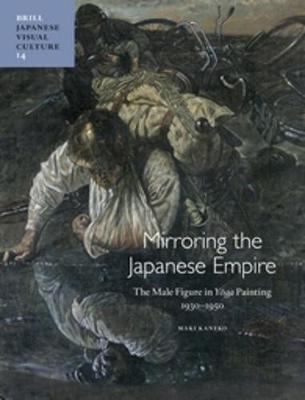
Mirroring the Japanese Empire
The Male Figure in Yōga Painting, 1930–1950
Seiten
2014
Brill (Verlag)
978-90-04-22767-5 (ISBN)
Brill (Verlag)
978-90-04-22767-5 (ISBN)
Maki Kaneko reexamines the iconic male figures created, performed, and/or consumed by several male artists of yōga (Western-style painting) between 1930 and 1950 through the lenses of the politics of gender, race, and the body in late Imperial Japan.
In this groundbreaking study of a subject intricately tied up with the controversies of Japanese wartime politics and propaganda, Maki Kaneko reexamines the iconic male figures created by artists of yōga (Western-style painting) between 1930 and 1950. Particular attention is given to prominent yōga painters such as Fujita Tsuguharu, Yasui Sōtarō, Matsumoto Shunsuke, and Yamashita Kiyoshi—all of whom achieved fame for their images of men either during or after the Asia-Pacific War. By closely investigating the representation of male figures together with the contemporary politics of gender, race, and the body, this profusely illustrated volume offers new insight into artists’ activities in late Imperial Japan. Rather than adhering to the previously held model of unilateral control governing the Japanese Empire’s visual regime, the author proposes a more complex analysis of the role of Japanese male artists and how art functioned during an era of international turmoil.
In this groundbreaking study of a subject intricately tied up with the controversies of Japanese wartime politics and propaganda, Maki Kaneko reexamines the iconic male figures created by artists of yōga (Western-style painting) between 1930 and 1950. Particular attention is given to prominent yōga painters such as Fujita Tsuguharu, Yasui Sōtarō, Matsumoto Shunsuke, and Yamashita Kiyoshi—all of whom achieved fame for their images of men either during or after the Asia-Pacific War. By closely investigating the representation of male figures together with the contemporary politics of gender, race, and the body, this profusely illustrated volume offers new insight into artists’ activities in late Imperial Japan. Rather than adhering to the previously held model of unilateral control governing the Japanese Empire’s visual regime, the author proposes a more complex analysis of the role of Japanese male artists and how art functioned during an era of international turmoil.
Maki Kaneko, Ph.D. (2005), University of East Anglia, is Associate Professor in the Kress Foundation Department of Art History at the University of Kansas. She has published several articles on Japanese visual arts during the Asia-Pacific War.
| Erscheint lt. Verlag | 14.11.2014 |
|---|---|
| Reihe/Serie | Japanese Visual Culture ; 14 |
| Zusatzinfo | 72 Illustrations, color |
| Verlagsort | Leiden |
| Sprache | englisch |
| Gewicht | 883 g |
| Themenwelt | Kunst / Musik / Theater ► Kunstgeschichte / Kunststile |
| ISBN-10 | 90-04-22767-9 / 9004227679 |
| ISBN-13 | 978-90-04-22767-5 / 9789004227675 |
| Zustand | Neuware |
| Informationen gemäß Produktsicherheitsverordnung (GPSR) | |
| Haben Sie eine Frage zum Produkt? |
Mehr entdecken
aus dem Bereich


aus dem Bereich
kleine Kulturgeschichte einer brillanten Allianz
Buch | Softcover (2025)
Iudicium (Verlag)
CHF 33,90
Buch | Hardcover (2025)
Deutscher Kunstverlag
CHF 72,80


