


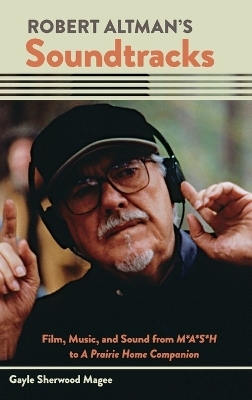
Robert Altman's Soundtracks
Film, Music, and Sound from M*A*S*H to A Prairie Home Companion
Seiten
2014
Oxford University Press Inc (Verlag)
978-0-19-991596-5 (ISBN)
Oxford University Press Inc (Verlag)
978-0-19-991596-5 (ISBN)
Robert Altman's Soundtracks offers a compelling new look at this celebrated director's films through his innovative uses of music and sound. As author Gayle Sherwood-Magee illustrates, Altman's considerable and varied output speaks to the changing film industry over decades from Nashville (1975) to A Prairie Home Companion (2006).
American director Robert Altman (1925-2006) first came to national attention with the surprise blockbuster M*A*S*H (1970), and he directed more than thirty feature films in the subsequent decades. Critics and scholars have noted that music is central to Altman's films, and in addition to his feature films, Altman worked in theater, opera, and the emerging field of cable television. His treatment of sound is a hallmark of his films, alongside overlapping dialogue, improvisation, and large ensemble casts. Several of his best-known films integrate musical performances into the central plot, including Nashville (1975), Popeye (1980), Short Cuts (1993), Kansas City (1996), The Company (2003) and A Prairie Home Companion (2006), his final film. Even such non-musicals as McCabe and Mrs. Miller (1971) have been described as, in fellow director and protégé Paul Thomas Anderson's evocative phrase, as "musicals without people singing."
Robert Altman's Soundtracks considers Altman's celebrated, innovative uses of music and sound in several of his most acclaimed and lesser-known works. In so doing, these case studies serve as a window not only into Altman's considerable and varied output, but also the changing film industry over nearly four decades, from the heyday of the New Hollywood in the late 1960s through the "Indiewood" boom of the 1990s and its bust in the early 2000s. As its frame, the book will consider the continuing attractions of auteurism inside and outside of scholarly discourse, by considering Altman's career in terms of the director's own self-promotion as a visionary and artist; the film industry's promotion of Altman the auteur; the emphasis on Altman's individual style, including his use of music, by the director, critics, scholars, and within the industry; and the processes, tensions, and boundaries of collaboration.
American director Robert Altman (1925-2006) first came to national attention with the surprise blockbuster M*A*S*H (1970), and he directed more than thirty feature films in the subsequent decades. Critics and scholars have noted that music is central to Altman's films, and in addition to his feature films, Altman worked in theater, opera, and the emerging field of cable television. His treatment of sound is a hallmark of his films, alongside overlapping dialogue, improvisation, and large ensemble casts. Several of his best-known films integrate musical performances into the central plot, including Nashville (1975), Popeye (1980), Short Cuts (1993), Kansas City (1996), The Company (2003) and A Prairie Home Companion (2006), his final film. Even such non-musicals as McCabe and Mrs. Miller (1971) have been described as, in fellow director and protégé Paul Thomas Anderson's evocative phrase, as "musicals without people singing."
Robert Altman's Soundtracks considers Altman's celebrated, innovative uses of music and sound in several of his most acclaimed and lesser-known works. In so doing, these case studies serve as a window not only into Altman's considerable and varied output, but also the changing film industry over nearly four decades, from the heyday of the New Hollywood in the late 1960s through the "Indiewood" boom of the 1990s and its bust in the early 2000s. As its frame, the book will consider the continuing attractions of auteurism inside and outside of scholarly discourse, by considering Altman's career in terms of the director's own self-promotion as a visionary and artist; the film industry's promotion of Altman the auteur; the emphasis on Altman's individual style, including his use of music, by the director, critics, scholars, and within the industry; and the processes, tensions, and boundaries of collaboration.
Gayle Sherwood Magee is Associate Professor of Musicology at the School of Music, University of Illinois, Urbana-Champaign.
Table of Contents ; Acknowledgements ; Introduction: Listening to Robert Altman ; Chapter 1: The Sweet Music of Kansas City ; Chapter 2: New Hollywood Song Tracks ; Chapter 3: Nostalgia Trips ; Chapter 4: A New Hollywood Musical ; Chapter 5: Battling the Empire ; Chapter 6: The Wilderness ; Chapter 7: Indiewood and Improvisation ; Chapter 8: The Perfect Servant ; Chapter 9: Midwestern Musicals ; Conclusion: Altman Today ; Index
| Erscheint lt. Verlag | 8.1.2015 |
|---|---|
| Reihe/Serie | Oxford Music/Media Series |
| Zusatzinfo | 92 film stills; 8 music examples |
| Verlagsort | New York |
| Sprache | englisch |
| Maße | 221 x 145 mm |
| Gewicht | 748 g |
| Themenwelt | Kunst / Musik / Theater ► Film / TV |
| Kunst / Musik / Theater ► Musik ► Klassik / Oper / Musical | |
| ISBN-10 | 0-19-991596-2 / 0199915962 |
| ISBN-13 | 978-0-19-991596-5 / 9780199915965 |
| Zustand | Neuware |
| Informationen gemäß Produktsicherheitsverordnung (GPSR) | |
| Haben Sie eine Frage zum Produkt? |
Mehr entdecken
aus dem Bereich

aus dem Bereich
Essays und Gespräche
Buch | Hardcover (2025)
Wallstein Erfolgstitel (Verlag)
CHF 29,90


