


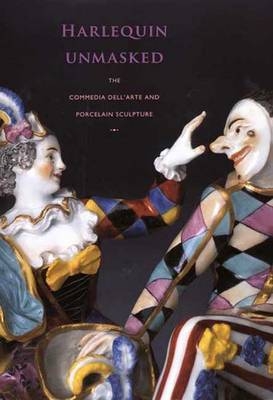
Harlequin Unmasked
The Commedia Dell'arte and Porcelain Sculpture
Seiten
2001
Yale University Press (Verlag)
978-0-300-09009-3 (ISBN)
Yale University Press (Verlag)
978-0-300-09009-3 (ISBN)
- Titel ist leider vergriffen;
keine Neuauflage - Artikel merken
The story of the commedia dell'arte's transformation into sculpture, focusing on nearly 150 porcelain sculptures. It covers: how the figures were made; why they appear as they do; what inspired their gestures and costumes; and how street theatre themes were integrated into court entertainment.
The commedia dell'arte began in Italy as irreverent, improvised street theatre and is best known for its exuberant characters, specifically Harlequin, Pantalone, Pulcinella, Scaramouche, and Colombine, among others. Since the sixteenth century, these personalities have inspired paintings, engravings, and porcelain sculptures. Encompassing theatre, court culture, masquerades, and the decorative arts, this splendidly illustrated and engaging book offers original perspectives on porcelain commedia figures while also making an important contribution to the study of the commedia dell'arte. The volume focuses on nearly 150 porcelain sculptures as it tells the story of the commedia dell'arte's transformation into sculpture. Why were the figures made? Why do they appear as they do? What inspired their gestures and costumes? How did street-theatre themes become integrated into court life and entertainment? Examining these delightful porcelain figures in greater breadth and detail than ever before, this book is essential for those interested in theatre, painting, costume, and the decorative arts.
This catalogue accompanies an exhibition at the Gardiner Museum of Ceramic Art, Toronto, from 21st September 2001 to 20th January 2002.
The commedia dell'arte began in Italy as irreverent, improvised street theatre and is best known for its exuberant characters, specifically Harlequin, Pantalone, Pulcinella, Scaramouche, and Colombine, among others. Since the sixteenth century, these personalities have inspired paintings, engravings, and porcelain sculptures. Encompassing theatre, court culture, masquerades, and the decorative arts, this splendidly illustrated and engaging book offers original perspectives on porcelain commedia figures while also making an important contribution to the study of the commedia dell'arte. The volume focuses on nearly 150 porcelain sculptures as it tells the story of the commedia dell'arte's transformation into sculpture. Why were the figures made? Why do they appear as they do? What inspired their gestures and costumes? How did street-theatre themes become integrated into court life and entertainment? Examining these delightful porcelain figures in greater breadth and detail than ever before, this book is essential for those interested in theatre, painting, costume, and the decorative arts.
This catalogue accompanies an exhibition at the Gardiner Museum of Ceramic Art, Toronto, from 21st September 2001 to 20th January 2002.
| Erscheint lt. Verlag | 10.9.2001 |
|---|---|
| Zusatzinfo | 300 colour pl 300 illustrations |
| Sprache | englisch |
| Maße | 241 x 280 mm |
| Gewicht | 2420 g |
| Themenwelt | Kunst / Musik / Theater ► Kunstgeschichte / Kunststile |
| Kunst / Musik / Theater ► Malerei / Plastik | |
| ISBN-10 | 0-300-09009-9 / 0300090099 |
| ISBN-13 | 978-0-300-09009-3 / 9780300090093 |
| Zustand | Neuware |
| Informationen gemäß Produktsicherheitsverordnung (GPSR) | |
| Haben Sie eine Frage zum Produkt? |
Mehr entdecken
aus dem Bereich



aus dem Bereich
kleine Kulturgeschichte einer brillanten Allianz
Buch | Softcover (2025)
Iudicium (Verlag)
CHF 33,90


