Drawing and Painting Insects (eBook)
224 Seiten
Crowood (Verlag)
978-1-84797-625-3 (ISBN)
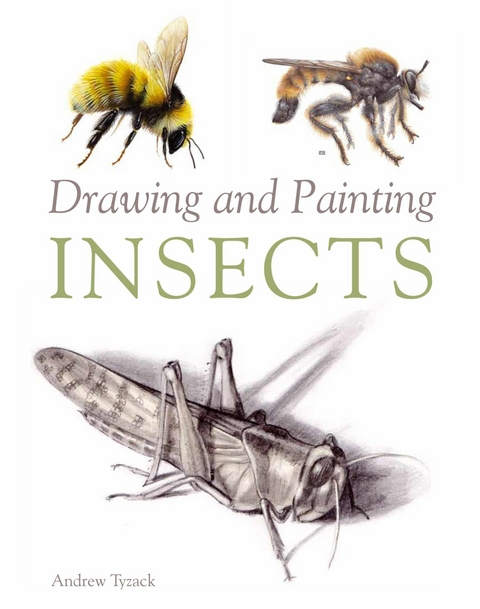
Drawing and Painting Insects is a beautiful and inspiring guide. Whatever your experience, whether new to the subject or a seasoned entomologist, this book will help you capture the beauty of insects by helping you understand their structure and appreciate their behaviour, movement, colour and habitat. Advice on finding insects to draw and paint, including how to raise your own insect models; Guide to the anatomy and life cycles of the insect for the artist; Step-by-step demonstrations of drawings, looking at perspective, tonal values and mark-making techniques; Examples of watercolour and oil paintings representing insects in precise, scientific renditions through to more creative interpretations; Introduction to other uses of insect illustration, including printmaking, sculpture, leather and glass; Illustrated with examples and insights from leading artists. A beautiful and inspiring guide to drawing and painting insects, of inspiration to botanical artists, natural historians, wildlife artists and biologists. Gives advice on finding insects to draw and paint, understanding their structure, appreciating their behaviour, movement, colour, habitat and much more. Superbly illustrated with examples and insights from leading artists - 541 colour illustrations in total. Andrew Tyzack is a graduate from the Royal College of Art and is well known for his painting of beekeepers and engravings of bees.
CHAPTER 2
INSECT ANATOMY FOR THE ARTIST
This chapter is intended to aid knowledge of insect anatomy and hopefully artists, who become more interested in advanced scientific and technical illustration, will go on to study specimens in greater depth.
There are millions of insect species belonging to several extant orders, yet we find that essentially all insects have the same basic structure: a head, thorax, and abdomen with six legs: all have compound eyes, antennae and an exoskeleton. So confronted by this overwhelming variety I have chosen only a few types as representative, hoping that the student will be able to take the basic principles described here and apply them to any insect that crosses their path.
A vigorous training in human anatomy and hours spent drawing from the human model increases an artist’s ability to, not only, draw human figures and portraits but every other form, organic or geometric. After the rigours of the life room it will be found that there is not a great deal of difference in the depiction of an insect or a life model as all forms are subject to the laws of perspective, foreshortening and use of tone. Once learnt and practised, an artist does not have to think too hard about these principles as they soon become second nature. Having a working knowledge of insect anatomy arms an artist with the necessary visual ammunition to shorten this process. ‘De-construction’ through visual analysis becomes second nature and in time the artist is drawing without the hindrance of having to work out every visual problem before them but can now move into a more fluent form of working.
The Insect Exoskeleton And Segmentation
Insects have an exoskeleton housing the insect's soft tissue, as opposed to a vertebrate’s endoskeleton which is internal. As insect muscles are housed within the exoskeleton, locomotion is achieved by these muscles moving the articulating exoskeleton. Muscles are attached to appendages by tendons on the inside of the exoskeleton pulling and levering. Insects can and do outgrow their exoskeletons, in which case they may be moulted and shed as they grow. During a moult the insect emerges from the old exoskeleton with its new soft exoskeleton complete which then has to harden and dry. Wings will be pumped full of haemolymph to expand to full size.
Male Stag Beetle (Lucanus cervus), drawing by Carim Nahaboo.
Privet Hawkmoth (Sphinx ligustri) Caterpillar, oil on canvas by Andrew Tyzack. The spiracles of this large insect larva can be clearly seen on each abdominal segment.
The insect body is joined in two places where the head, thorax and abdomen form the main segments of the exoskeleton. Breathing is achieved through spiracles: openings in the abdominal segments which allow oxygen to be drawn in.
Lepidoptera: Butterflies and Moths
Butterflies and moths are the ‘scaly winged’ order of insects. Almost all species have large membranous wings covered in tiny scales resulting in a marvellous and bewildering array of different colours and patterns. When depicting butterflies and moths, artists gain from detailed knowledge of the wing veins and the shapes they make.
Anatomy of a Moth for the Artist, Death’s-head Hawkmoth (Acherontia atropos), pencil on paper by Andrew Tyzack.
Anatomy of a Butterfly for the Artist, Painted Lady (Vanessa cardui), watercolour by Tim Freed.
Forewing of a Red Admiral (Vanessa atalanta), watercolour by Tim Freed.
Swallow Prominent (Pheosia tremula), pencil on paper by Andrew Tyzack.
Buff Ermine (Spilosoma luteum), watercolour by David Koster.
This understanding allows the artist to appreciate how such an apparently delicate wing could be, nonetheless, so strong and powerful. It is important that their differing markings can be located in an exact position so that the species is clearly recognizable. A moth’s markings can be quite plain or dazzlingly complex, either way there will be markings that need locating correctly for the species to be identifiable.
This is a typical butterfly, possessing two pairs of wings. The forewings are independent of the hindwings. The wings are membranous, veined and covered in minute scales. The thorax is generally spherical and the abdomen is generally cylindrical. The head is generally spherical and the compound eyes small. The antennae are generally capitate and club like at the end.
Orthoptera: Crickets, Grasshoppers and Locusts
Typically, species from Orthoptera have large and elongated hind-legs enabling them to leap large distances and make sound in some cases. Rows of small bumps on the wings are also occasionally used for stridulation (the familiar chirping). The forewings are held tent like and the hindwings are folded within this triangular arch, which open like fans during jumping and flight. They generally have strong and geometric bodies, and their large cylindrical hind-legs with hinge-like knees make for enjoyable and challenging drawings. Their large compound eyes are unsettling, like bulging airman’s goggles, anthropomorphic and inhuman at the same time. Orthopterans have cultural and metaphorical significance – plagues of biblical proportions eating and destroying crops for instance. They are also associated with human habitation where their gentle stridulations are most therapeutic and they are important socially in the Far East. Though the sound of house crickets is now very rare in the UK, bush crickets are kept in cages in Chinese and Japanese homes.
Anatomy of a Locust for the Artist, pencil on paper by Andrew Tyzack.
When Orthoptera open their wings for flight, the hindwings, which are housed within the stiffer forewings, unfold like a fan.
Bush Cricket from Above, watercolour over pencil by Rosanne Guille, illustrating the tent-like form of the cricket’s forewings, beneath which are the membranous hindwings folded like a fan.
Cricket Leaping, woodcut by John Norris Wood.
Hymenoptera: Ants, Bees, Sawflies and Wasps
Hymenoptera are an extremely large order inclusive of the large number of species that are ‘social insects’. Most familiar of the social Hymenoptera are the bumblebees, honeybees, wasps and ants that frequent our gardens; all of these are often feared for their stinging abilities while ants often make themselves known in our gardens by giving us poisonous bites when sunbathing. Hymenoptera are classified by their membranous wings, of which there are normally two pairs. The hindwings are usually attached to the forewing by small hooks to improve aerodynamic ability. They are often very thin waisted and slender.
Anatomy of a Bumblebee for the Artist, pencil on paper by Andrew Tyzack.
Denuded Bumblebee, photograph © Andrew Tyzack.
For the artist Hymenoptera offer many opportunities for the depiction of opposites; charm or menace. Bumblebees are vegetarians and remind us of halcyon summer days, their bumbling flight from one flower to another is redolent of garden, sunshine and warm breezes. Drawing and painting them can be quite problematic as their abundant hair hides their underlying anatomy of round, rotund form so observing them denuded of fur is extremely helpful. Their wings can seem too small for their size and only recently have we come to understand their ability to fly – lift on the wing’s upbeat as well as the usual downbeat provides the extra power. Wasps and hornets are carnivorous and are dynamic and agile. Watching a Queen hornet leave her nest sounds and looks very much like an attack helicopter taking off on a mission. A very narrow ‘waist’ between the conical abdomen and spherical thorax is distinctive and adds an aggressive, lean geometry to her appearance. This narrow waist can be seen in honeybees too, but they have a far more utilitarian appearance reflecting their proletarian and industrious lives.
Honeybee Queen and Drone (Apis mellifera), pencil on paper by Andrew Tyzack.
Hornet Queen (Vespa crabro), mezzotint by Andrew Tyzack.
Flea, wood engraving by Jim Westergard.
Louse, wood engraving by Jim Westergard.
Anatomy of a Flea for the Artist, hand coloured woodcut by John Norris Wood.
Fly on the Wall, wood engraving by Jim Westergard.
Good Night, Sleep Tight, Don’t Let the Bed Bugs Bite
Parasitic Insects
SIPHONAPTERA: FLEAS
An external parasite, the jumping, blood-sucking fleas of the Siphonaptera are well known to anyone with a pet dog or cat; less so human fleas, which have become rare with the better hygiene of the twenty-first century. To come into breeding condition, females feed on the blood of their host animal and are then able to lay their eggs. Fleas have a flattened body enabling easy and rapid movement through the fur, hair or feathers of their hosts. Wingless, fleas possess a powerful jumping ability and...
| Erscheint lt. Verlag | 30.6.2013 |
|---|---|
| Verlagsort | London |
| Sprache | englisch |
| Themenwelt | Kunst / Musik / Theater ► Allgemeines / Lexika |
| Kunst / Musik / Theater ► Malerei / Plastik | |
| Sachbuch/Ratgeber ► Freizeit / Hobby ► Heimwerken / Do it yourself | |
| Sachbuch/Ratgeber ► Freizeit / Hobby ► Malen / Zeichnen | |
| Technik | |
| ISBN-10 | 1-84797-625-5 / 1847976255 |
| ISBN-13 | 978-1-84797-625-3 / 9781847976253 |
| Informationen gemäß Produktsicherheitsverordnung (GPSR) | |
| Haben Sie eine Frage zum Produkt? |
 EPUB (Wasserzeichen)
DRM: Digitales Wasserzeichen
Dieses eBook enthält ein digitales Wasserzeichen und ist damit für Sie personalisiert. Bei einer missbräuchlichen Weitergabe des eBooks an Dritte ist eine Rückverfolgung an die Quelle möglich.
Dateiformat: EPUB (Electronic Publication)
EPUB ist ein offener Standard für eBooks und eignet sich besonders zur Darstellung von Belletristik und Sachbüchern. Der Fließtext wird dynamisch an die Display- und Schriftgröße angepasst. Auch für mobile Lesegeräte ist EPUB daher gut geeignet.
Systemvoraussetzungen:
PC/Mac: Mit einem PC oder Mac können Sie dieses eBook lesen. Sie benötigen dafür die kostenlose Software Adobe Digital Editions.
eReader: Dieses eBook kann mit (fast) allen eBook-Readern gelesen werden. Mit dem amazon-Kindle ist es aber nicht kompatibel.
Smartphone/Tablet: Egal ob Apple oder Android, dieses eBook können Sie lesen. Sie benötigen dafür eine kostenlose App.
Geräteliste und zusätzliche Hinweise
Buying eBooks from abroad
For tax law reasons we can sell eBooks just within Germany and Switzerland. Regrettably we cannot fulfill eBook-orders from other countries.
aus dem Bereich