


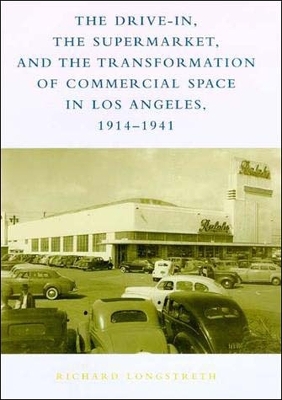
The Drive-In, the Supermarket, and the Transformation of Commercial Space in Los Angeles, 1914–1941
Seiten
2000
MIT Press (Verlag)
978-0-262-62142-7 (ISBN)
MIT Press (Verlag)
978-0-262-62142-7 (ISBN)
Longstreth explores the early development of two kinds of retail space that have become ubiquitous in the United States in the second half of the twentieth century.
Richard Longstreth is one of the few historians to focus on ordinary commercial buildings-buildings usually associated with commercial builders and real estate developers rather than architects and thus generally overlooked by historians of "high" architecture.
Here Longstreth explores the early development of two kinds of retail space that have become ubiquitous in the United States in the second half of the twentieth century. One, external, is devoted to the circulation and parking of automobiles on retail premises. Longstreth analyzes the origins of this development in the 1910s and 1920s, with the super service station and then the drive-in market. The other type of space, internal, was introduced soon thereafter with the single-story supermarket. The most innovative aspect of the supermarket was how its interior was designed for high-volume turnover of a large selection of goods with a minimum of staff assistance. Longstreth focuses on Los Angeles, the principal center for the development of both kinds of space, during the period from the mid-1910s to the early 1940s. This richly illustrated study integrates architectural, cultural, economic, and urban factors to describe the evolution of retailing and how it has affected the urban landscape.
Richard Longstreth is one of the few historians to focus on ordinary commercial buildings-buildings usually associated with commercial builders and real estate developers rather than architects and thus generally overlooked by historians of "high" architecture.
Here Longstreth explores the early development of two kinds of retail space that have become ubiquitous in the United States in the second half of the twentieth century. One, external, is devoted to the circulation and parking of automobiles on retail premises. Longstreth analyzes the origins of this development in the 1910s and 1920s, with the super service station and then the drive-in market. The other type of space, internal, was introduced soon thereafter with the single-story supermarket. The most innovative aspect of the supermarket was how its interior was designed for high-volume turnover of a large selection of goods with a minimum of staff assistance. Longstreth focuses on Los Angeles, the principal center for the development of both kinds of space, during the period from the mid-1910s to the early 1940s. This richly illustrated study integrates architectural, cultural, economic, and urban factors to describe the evolution of retailing and how it has affected the urban landscape.
Richard W. Longstreth is Director of the Graduate Program in Historic Preservation at George Washington University.
| Reihe/Serie | The Drive-In, the Supermarket, and the Transformation of Commercial Space in Los Angeles, 1914–1941 |
|---|---|
| Verlagsort | Cambridge, Mass. |
| Sprache | englisch |
| Maße | 191 x 279 mm |
| Gewicht | 771 g |
| Themenwelt | Kunst / Musik / Theater ► Kunstgeschichte / Kunststile |
| Technik ► Architektur | |
| ISBN-10 | 0-262-62142-8 / 0262621428 |
| ISBN-13 | 978-0-262-62142-7 / 9780262621427 |
| Zustand | Neuware |
| Informationen gemäß Produktsicherheitsverordnung (GPSR) | |
| Haben Sie eine Frage zum Produkt? |
Mehr entdecken
aus dem Bereich

aus dem Bereich
kleine Kulturgeschichte einer brillanten Allianz
Buch | Softcover (2025)
Iudicium (Verlag)
CHF 33,90


