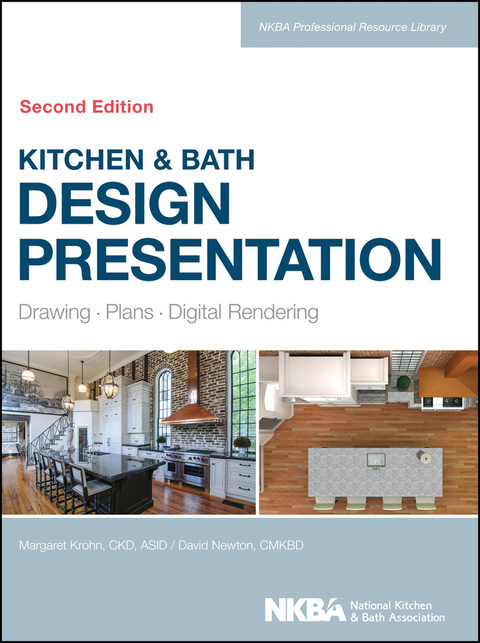
Kitchen & Bath Design Presentation (eBook)
John Wiley & Sons (Verlag)
978-1-118-82237-1 (ISBN)
Kitchen and Bath Design Presentation is the National Kitchen and Bath Association's complete guide to preparing clear and accurate project documents and plans. This updated second edition has been expanded to include more information on hand drafting, specifications, and project presentation, with additional CAD coverage featuring software programs approved for the NKBA certification exams. This full-color guide includes detailed information on the NKBA graphics and presentation standards, plus extensive reference appendices including sample documents, cabinet nomenclature, and metric conversions. Each chapter includes a summary and review questions, and samples of NKBA drawings throughout provide ample illustration of the techniques discussed.
Design presentation is the key communication between designer and client, contractor, and supplier. Accuracy and precision are essential, and mistakes can be costly in terms of both time and money. The National Kitchen and Bath Association established the standard guidelines for safe and effective kitchen planning, and Kitchen and Bath Design Presentation provides a thorough breakdown of the NKBA standards in design communication.
- Learn the secrets to accurate measurement with tips from the pros
- Master the art of hand drafting, and review the fundamentals of CAD
- Understand drafting conventions, dimensioning, and construction planning
- Study the NKBA's graphics and presentation standards, including specs, titling, copyright, and more
Comprehensive coverage and clear instruction make this book ideal for CKD and CBD exam prep, and easy navigation and strong visual design make it a useful reference for professionals needing to communicate their vision. Designers must be skilled at translating idea to reality, and Kitchen and Bath Design Presentation is the industry standard guide to doing it right.
Margaret Krohn, CKD, ASID is a full-time kitchen and bath design instructor at Century College in Minnesota, where she develops and implements design curriculum. She is also the owner of the firm Design Specifics.
Margaret Krohn, CKD, ASID is a full-time kitchen and bath design instructor at Century College in Minnesota, where she develops and implements design curriculum. She is also the owner of the firm Design Specifics.
PREFACE xi
ACKNOWLEDGMENTS xiii
CHAPTER 1 NKBA DRAWINGS AND DOCUMENTS 1
The Set of NKBA Drawings 1
NKBA Forms 8
Summary 10
Review Questions 11
CHAPTER 2 MEASURING THE DESIGN SPACE 13
Steps to Accurate Measurements 13
Measuring the Remodeling Job 15
Measuring New Construction 19
Angles and Curves 20
Tips from the Pros 22
Summary 23
Review Questions 23
CHAPTER 3 THE TOOLS AND TECHNIQUES OF HAND DRAFTING
25
Drafting Tools and Techniques 25
Drawing Media 30
Drafting Pencils and Other Tools 31
Leads 32
Technique for Drawing Vertical Lines 35
Portfolios 48
Additional Techniques to Draw Angled Lines and Understand Angles
50
Summary 56
Review Questions 56
CHAPTER 4 DRAFTING CONVENTIONS: LINE TYPES, SYMBOLS, AND
TECHNIQUES 57
Lines and Technique 57
Standard Symbols for Drawings 61
Summary 76
Review Questions 76
CHAPTER 5 THE NKBA FLOOR PLAN: DRAFTING AND DIMENSIONING THE
PLAN 77
Programming 77
Floor Plan Considerations 80
Dimensioning the Floor Plan 90
Summary 95
Review Questions 95
CHAPTER 6 NKBA DRAWINGS IN A SET OF PLANS 97
Floor Plan 97
Drafting the Construction Plan 97
Drawing the Construction Plan 98
Drafting the Mechanical Plan 99
Interpretive Drawings 112
Summary 120
Review Questions 120
CHAPTER 7 USING THE COMPUTER TO DESIGN KITCHENS AND BATHS
121
Computer Terminology 121
CAD: A General Overview 123
NKBA Certification Software 127
Summary 133
Review Questions 133
CHAPTER 8 NKBA'S GRAPHICS AND PRESENTATION STANDARDS
135
Purpose of Graphics and Presentation Standards 135
Kitchen or Bath Floor Plan 136
Construction Plan 142
Mechanical Plan and Symbols 142
Interpretive Drawings 143
Specifications 144
Design Statement 145
Titling Project Documents 145
Copyright and Ownership 146
Summary 147
Review Questions 147
APPENDIX A: SAMPLE KITCHEN AND BATHROOM PROJECT DOCUMENTS
149
APPENDIX B: GENERIC CABINET NOMENCLATURE 195
APPENDIX C: METRIC CONVERSIONS 231
GLOSSARY 239
REFERENCES 247
INDEX 249
1
NKBA Drawings and D ocuments
Kitchen and bath drawings are referred to as a set of drawings or plans. These drawings give a visual representation of how the space will look when completed as well as where items are to be installed. Each drawing has a purpose and presents information necessary for individuals involved with the project, including the installer, contractor, electrician, plumber, and others involved. Each page in the set of drawings is numbered and cross-referenced to the relevant drawing. There is an industry standard order of drawing placement within the set of plans.
An overview of each page found in a set of NKBA drawings and documents is described in this chapter. You will learn how to create the various drawings step-by-step as you read through this book. To help you focus on key components of this chapter, learning objectives are listed next.
Learning Objective 1: Identify drawings in a set of NKBA plans.
Learning Objective 2: Understand cut height and its relationship to the floor plan.
Learning Objective 3: Understand components found on the different types of drawings.
THE SET OF NKBA DRAWINGS
Each sheet in a set of drawings is identified with a title block placed at the bottom or right side of the page. Drawings are bound on the left side. The title block contains important information that identifies the type of drawing and project specifics (see Figure 1.1).
Figure 1.1 The title block on each sheet cross references the other drawings in the set of drawings.
Together the drawings and documents communicate the entire scope of the project as well as all the pertinent details. We must have client approval on all drawings for the project to ensure there are no questions regarding the work that will be completed. It is important that the entire set of drawings be reviewed by everyone involved with the project. The typical set of NKBA project drawings consists of a title page, floor plan, construction plan, mechanical plan, and interior elevations. Detail drawings and cross-sectional drawings may be needed to show more specific details. A perspective drawing is often included to show a three-dimensional view of the space. Additional drawings may include a countertop plan, soffit plan, or reflected ceiling plan. Other documents also typically included are a schedule, specifications, and a design statement (see Figure 1.2).
Figure 1.2 Drawings found in a typical set of NKBA drawings.
Title Page
The title page is the cover page for a set of drawings. Information typically included on the title page is the client or building name, location, designer's name and design firm's name, a key to the symbols for materials, and an index of the drawings. It may also include an illustration (see Figure 1.3).
Figure 1.3 The title page is the cover page for the set of NKBA drawings. This page typically includes the client's name and an index of drawings.
Floor Plan
The floor plan is the central reference point for all the other drawings in the set of documents. A floor plan is an overhead cutaway view of the room. It generally depicts the entire room and shows all major structural elements, such as walls, door swings, door openings, partitions, windows, and archways. It also shows cabinet, appliance, and fixture placement, dimensions, nomenclature, and other necessary notes. There are industry standards used for drafting a floor plan, so that other individuals involved in the project will be able to interpret the information on the drawings (see Figure 1.4).
Figure 1.4 Cutting plane height (cut height) is at ceiling for NKBA drawings so all details may be captured in the design of the space.
The typical scale used for NKBA drawings is ½″ = 1′−0″ (1:20 metric). This scale allows the drafter to provide the required level of detail. The dimensions written on the plans are exact and are always used as the actual measurement when reading a plan. Never use a scale to measure dimensions on a floor plan. The plan could be distorted from duplication or a line could be off. Always use the dimensions written on the floor plan. Sometimes the drawings may not be perfectly to scale, in which case there may be a notation “NTS” (“not to scale”) in the title block.
There are line types and symbols used on a floor plan and other drawings that are standard in the industry. Specifications are also placed on the floor plan to provide more specific information. These are explained in detail in chapter 4 (see Figure 1.5).
Figure 1.5 NKBA floor plan with floor plan specifications on the right side.
Construction Plan
A construction plan is another type of drawing found in the set of NKBA drawings. If walls or openings need to be altered from their original locations, a construction plan is required. This plan shows both the existing floor plan and the changes to be made to achieve the design. Changes include items such as removing and/or adding windows, doors, walls, plus more. Specific wall symbols are used to denote changes made to original floor plan of the space. More information can be found in chapter 6.
The construction plan includes only the walls, changes to the walls, dimensions, and a construction legend indicating what the symbols represent (see Figure 1.6).
Figure 1.6 Construction plan indicating new walls and walls to be removed. Note construction legend on right side of drawing.
Mechanical Plan
Another drawing in the set of NKBA drawings is the mechanical plan. The mechanical plan indicates placement of the electrical system, lighting, plumbing, heating, ventilation, and air conditioning (HVAC). As with the other plans, standard symbols are used on the mechanical plan to denote each item found on the plan. (More information can be found in chapter 3.) The mechanical plan must have a legend that illustrates the symbols used on the plan along with descriptions, and it must cross reference all symbols on the floor plan. The mechanical plan contains a great deal of information. The cabinet nomenclature is omitted from the plan so that all information can be more easily read (see Figure 1.7).
Figure 1.7 Mechanical plan showing plumbing, lighting, electrical, heating, and ventilation information. Note the mechanical legend on right side of the drawing.
It is important to understand mechanical plans because, as you create a design, you may need to determine whether there is any flexibility in the plumbing supply line, drain, or vent locations, for example. Most likely you will not illustrate the entire heating and air conditioning system, but you do need to identify where the vents are and should be aware of where the ducting is within the structure and how it will affect your design.
Interpretive Drawings
An interpretive drawing helps viewers visualize what the finished project will look like. Interpretive drawings are used as an explanatory means of understanding the floor plans. The most common interpretive drawings are interior elevations and perspectives.
Interior Elevation
The interior elevation (elevation) is a two-dimensional drawing of the interior wall as you are facing it. All walls with cabinets, the sides of an island, and any built-in items and architectural features need an elevation to show how they will look when installed. This drawing is to scale and includes the heights and widths of all items. Since this drawing is two-dimensional, it is a flat surface and does not show the depths of items. The interior elevations are cross-referenced with the floor plan (see Figure 1.8.).
Figure 1.8 A typical interior elevation drawing showing one wall of a kitchen with the dimensions on all four sides. It is to scale in height and width but does not convey any depth.
Perspective Drawings
The perspective drawing is a three-dimensional view that shows how the given space will look. The realistic appearance of a perspective makes it the ideal type of interpretive drawing because it most closely resembles what the human eye sees. Perspective drawings are not drawn to a true scale but to perspective scale. This means that items in the drawing appear larger as they are closer to the viewer. Since the perspective drawing is three-dimensional, you can see the depth of items so they look more realistic and in better proportion without distortion (see Figure 1.9).
Figure 1.9 A perspective drawing provides a three-dimensional view of the space, showing depth. This drawing closely resembles how the human eye sees a space.
Courtesy of Adrean Stephenson, AKBD, Chief Architect
Section Drawings and Detail Drawings
A section drawing (also referred to as a cross section) represents a vertical cut through the object to show the interior. A cross section can show the interior construction of an object, the relationships of floors in a building, or more detailed construction of items such as cabinetry, moldings, soffits, or backsplashes. To illustrate in more detail how these items are put together, an additional detail drawing may be necessary. The detail drawings show the relationship of parts and components for the specific object you are working with and are drawn at a larger scale. A typical section drawing is used to show how moldings may be stacked on a cabinet for a project (see Figure 1.10).
| Erscheint lt. Verlag | 27.2.2014 |
|---|---|
| Reihe/Serie | NKBA Professional Resource Library |
| NKBA Professional Resource Library | NKBA Professional Resource Library |
| Sprache | englisch |
| Themenwelt | Kunst / Musik / Theater ► Design / Innenarchitektur / Mode |
| Technik ► Architektur | |
| Schlagworte | 20-20 • Architecture • Architektur • bathroom planning • CAD • CBD drafting • chief architect • CKD drafting • Design communication • drafting conventions • hand drafting • Innenarchitektur • Interior design • interior design rendering • interior design text • kitchen and bath design • Kitchen and Bath Design Presentation: Drawing, Plans, Digital Rendering 2nd Edition • Kitchen and Bath Drawing • Kitchen planning • Margaret Krohn • National Kitchen and Bath Association • NKBA • NKBA drawings • NKBA graphics and presentation standards • rendering instruction • rendering skills • residential interior design |
| ISBN-10 | 1-118-82237-4 / 1118822374 |
| ISBN-13 | 978-1-118-82237-1 / 9781118822371 |
| Informationen gemäß Produktsicherheitsverordnung (GPSR) | |
| Haben Sie eine Frage zum Produkt? |
 PDF (Adobe DRM)
Größe: 49,5 MB
Kopierschutz: Adobe-DRM
Adobe-DRM ist ein Kopierschutz, der das eBook vor Mißbrauch schützen soll. Dabei wird das eBook bereits beim Download auf Ihre persönliche Adobe-ID autorisiert. Lesen können Sie das eBook dann nur auf den Geräten, welche ebenfalls auf Ihre Adobe-ID registriert sind.
Details zum Adobe-DRM
Dateiformat: PDF (Portable Document Format)
Mit einem festen Seitenlayout eignet sich die PDF besonders für Fachbücher mit Spalten, Tabellen und Abbildungen. Eine PDF kann auf fast allen Geräten angezeigt werden, ist aber für kleine Displays (Smartphone, eReader) nur eingeschränkt geeignet.
Systemvoraussetzungen:
PC/Mac: Mit einem PC oder Mac können Sie dieses eBook lesen. Sie benötigen eine
eReader: Dieses eBook kann mit (fast) allen eBook-Readern gelesen werden. Mit dem amazon-Kindle ist es aber nicht kompatibel.
Smartphone/Tablet: Egal ob Apple oder Android, dieses eBook können Sie lesen. Sie benötigen eine
Geräteliste und zusätzliche Hinweise
Zusätzliches Feature: Online Lesen
Dieses eBook können Sie zusätzlich zum Download auch online im Webbrowser lesen.
Buying eBooks from abroad
For tax law reasons we can sell eBooks just within Germany and Switzerland. Regrettably we cannot fulfill eBook-orders from other countries.
 EPUB (Adobe DRM)
Kopierschutz: Adobe-DRM
Adobe-DRM ist ein Kopierschutz, der das eBook vor Mißbrauch schützen soll. Dabei wird das eBook bereits beim Download auf Ihre persönliche Adobe-ID autorisiert. Lesen können Sie das eBook dann nur auf den Geräten, welche ebenfalls auf Ihre Adobe-ID registriert sind.
Details zum Adobe-DRM
Dateiformat: EPUB (Electronic Publication)
EPUB ist ein offener Standard für eBooks und eignet sich besonders zur Darstellung von Belletristik und Sachbüchern. Der Fließtext wird dynamisch an die Display- und Schriftgröße angepasst. Auch für mobile Lesegeräte ist EPUB daher gut geeignet.
Systemvoraussetzungen:
PC/Mac: Mit einem PC oder Mac können Sie dieses eBook lesen. Sie benötigen eine
eReader: Dieses eBook kann mit (fast) allen eBook-Readern gelesen werden. Mit dem amazon-Kindle ist es aber nicht kompatibel.
Smartphone/Tablet: Egal ob Apple oder Android, dieses eBook können Sie lesen. Sie benötigen eine
Geräteliste und zusätzliche Hinweise
Buying eBooks from abroad
For tax law reasons we can sell eBooks just within Germany and Switzerland. Regrettably we cannot fulfill eBook-orders from other countries.
aus dem Bereich