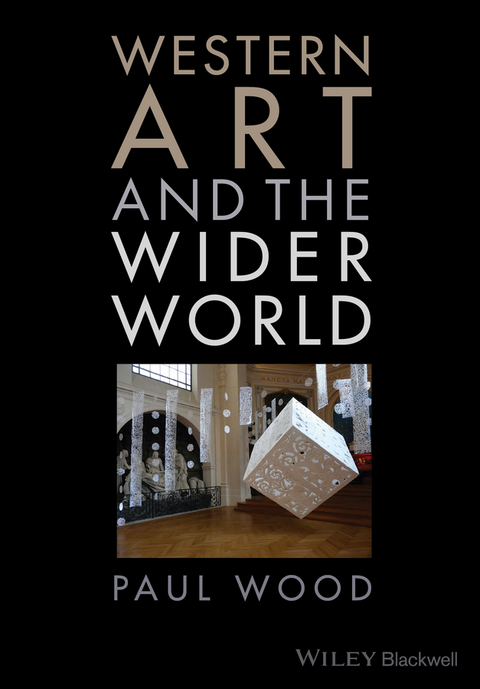
Western Art and the Wider World (eBook)
320 Seiten
Wiley-Blackwell (Verlag)
978-1-118-59877-1 (ISBN)
- Explores the origins, influences, and evolving relationship between the Western canon of art as it has developed since the Renaissance and the art and culture of the Islamic world, the Far East, Australasia, Africa and the Americas
- Makes the case for 'world art' long before the fashion of globalization
- Charts connections between areas of study in art that long were considered in isolation, such as the Renaissance encounter with the Ottoman Empire, the influence of Japanese art on the 19th-century French avant-garde and of African art on early modernism, as well as debates about the relation of 'contemporary art' to the past.
- Written by a well-known art historian and co-editor of the landmark Art in Theory volumes
Paul Wood is Senior Lecturer in Art History at the Open University, England. He has published widely in the field of modern and contemporary art, and is co-editor, with Charles Harrison and Jason Gaiger, of the landmark three-volume collection Art in Theory: An Anthology of Changing Ideas.
Paul Wood is Senior Lecturer in Art History at the Open University, England. He has published widely in the field of modern and contemporary art, and is co-editor, with Charles Harrison and Jason Gaiger, of the landmark three-volume collection Art in Theory: An Anthology of Changing Ideas.
Western Art and the Wider World 5
Copyright 5
Contents 9
List of Illustrations 10
Acknowledgments 12
Introduction 13
Notes 22
References 22
1 Renaissance and Old World 24
Introduction: The Status of the Renaissance 24
Changing Histories 28
Venice 32
New Light on Perspective 36
A Portrait 39
Some History Paintings 47
Later 54
Notes 58
References 61
2 Enlightenment and New World 64
America 64
White and De Bry 70
European Responses 77
Science 80
Allegory 82
Enlightenment and Empire 84
Pacific 85
Art and Visual Truth 87
Visual Truth and Fiction 89
Ideas of Human Development 92
Complicated Paradise 95
Picturing the “Noble Savage” 99
Art and “Curiosity” 101
Eurocentrism 104
Tupaia 105
Notes 108
References 110
3 Modernism and Modern World 112
Introduction 112
In the Beginning … 114
History and Empire 117
European Effects 119
Mughal India 119
Japan 121
China 123
East–West Crossings 124
Inception of “Orientalism” 125
Looking Out 127
Chinoiserie 128
Exclusivity 131
Hegel 133
Other Ideas 137
Orientalism 140
Orientalism and Naturalism 146
Orientalism Revisited 151
Modernity 154
Manet and “Japonisme” 156
Primitivism 164
The Question of Origins 170
Primitivism and Expressionism 172
Academy and Empire 175
Benin 177
Fry and Primitivism 180
Later Modernist Primitivism 183
Notes 187
References 192
4 Avant-Garde, Contemporary, and Globalized World
197
To Mid-Century 197
“Modernist” and “Avant-garde” 197
Futurism 200
Relativizing Representation 201
Dada’s Australia 201
Einstein’s Africa 203
Schäfer’s Egypt 206
Surrealism and Ethnography 208
Exhibition 210
Mapping it Out 213
Caribbean 215
Realisms 219
Mexico to Michigan 223
Independence 225
Since Mid-Century 228
The Neo-avant-garde 228
Across the Atlantic 233
“Provincialism” 236
Conceptual Art and Conceptualism 238
Global Conceptualism 244
Consequences 247
Display 255
Notes 258
References 261
5 “World Art History” and “Contemporary Art”
265
Introduction 265
“World Art History” 269
Thinking “Contemporary Art” 281
The Wider World Now 294
Notes 299
References 301
Index 304
"Western Art and the Wider World is certainly a timely
myth-buster in terms of current anxieties and panics about the
demise of the West's supposed cultural and economic place at
the centre of things. Wood traces a long history of admiration and
indebtedness to the East - in terms of knowledge, art,
commerce and governance. He also asserts that the history of
western 'cultural dominance' has been relatively short
- less than 200 years in his reckoning. Western Art and
the Wider World tells stories of exchange, parity and mutual
curiosity between the West and rest." (The Visual
Artists' News Sheet, 1 March 2014)
"A cautious, open-minded attempt to write about the history of
Western Art form the Renaissance through the early and late
modernist era, as it encountered, and was encountered by, the rest
of the world." (Art Review, 1 March 2014)
"This is a truly important book, essential reading for
anyone looking for critical insight into how understandings of
Western art and its history are being reshaped by the increasingly
globalized conditions of artistic culture." - Alex
Potts, University of Michigan, USA
"Any reader wanting to traverse the complex terrain of
world art could find no wiser, more judicious or better-written
guide than Paul Wood's Western Art and the Wider
World. His learning in history, philosophy, and
contemporary debates is deep but carried lightly. His voice
will reach both novice and professional readers in a most timely
contribution." -Thomas E. Crow, New York
University, USA
"An important and timely intervention in the contested
territory of world art. Combining extensive historical research
with incisive awareness of contemporary debates, this book both
challenges and expands our understanding of Western art within a
global context." -Fionna Barber, Manchester
Metropolitan University, UK
| Erscheint lt. Verlag | 18.11.2013 |
|---|---|
| Sprache | englisch |
| Themenwelt | Kunst / Musik / Theater ► Allgemeines / Lexika |
| Kunst / Musik / Theater ► Kunstgeschichte / Kunststile | |
| Kunst / Musik / Theater ► Malerei / Plastik | |
| Schlagworte | Art & Applied Arts • Art History & Criticism • Art History & Theory • art theory • Kunst • Kunstgeschichte u. -kritik • Kunstgeschichte u. -theorie • Kunsttheorie • Kunst u. Angewandte Kunst • Modern art, World art history, Western art canon, Art history textbook, Art History course, globalization of art, Renaissance, Non-Western art, Islamic art, Eastern art, American art, African art, Aboriginal art, Orientalism, primitivism, 18th-century art, 19th-century art, 20th-century art |
| ISBN-10 | 1-118-59877-6 / 1118598776 |
| ISBN-13 | 978-1-118-59877-1 / 9781118598771 |
| Informationen gemäß Produktsicherheitsverordnung (GPSR) | |
| Haben Sie eine Frage zum Produkt? |
 PDF (Adobe DRM)
Kopierschutz: Adobe-DRM
Adobe-DRM ist ein Kopierschutz, der das eBook vor Mißbrauch schützen soll. Dabei wird das eBook bereits beim Download auf Ihre persönliche Adobe-ID autorisiert. Lesen können Sie das eBook dann nur auf den Geräten, welche ebenfalls auf Ihre Adobe-ID registriert sind.
Details zum Adobe-DRM
Dateiformat: PDF (Portable Document Format)
Mit einem festen Seitenlayout eignet sich die PDF besonders für Fachbücher mit Spalten, Tabellen und Abbildungen. Eine PDF kann auf fast allen Geräten angezeigt werden, ist aber für kleine Displays (Smartphone, eReader) nur eingeschränkt geeignet.
Systemvoraussetzungen:
PC/Mac: Mit einem PC oder Mac können Sie dieses eBook lesen. Sie benötigen eine
eReader: Dieses eBook kann mit (fast) allen eBook-Readern gelesen werden. Mit dem amazon-Kindle ist es aber nicht kompatibel.
Smartphone/Tablet: Egal ob Apple oder Android, dieses eBook können Sie lesen. Sie benötigen eine
Geräteliste und zusätzliche Hinweise
Buying eBooks from abroad
For tax law reasons we can sell eBooks just within Germany and Switzerland. Regrettably we cannot fulfill eBook-orders from other countries.
aus dem Bereich