The Classical Tradition (eBook)
John Wiley & Sons (Verlag)
978-1-118-61048-0 (ISBN)
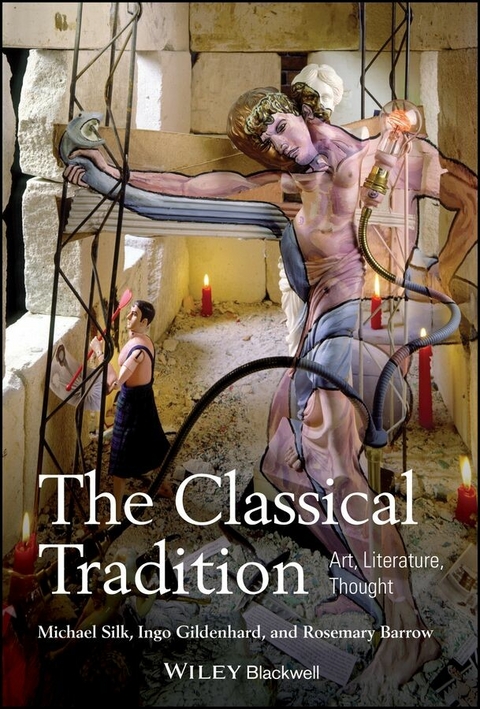
The Classical Tradition: Art, Literature, Thought presents an authoritative, coherent and wide-ranging guide to the afterlife of Greco-Roman antiquity in later Western cultures and a ground-breaking reinterpretation of large aspects of Western culture as a whole from a classical perspective.
- Features a unique combination of chronological range, cultural scope, coherent argument, and unified analysis
- Written in a lively, engaging, and elegant manner
- Presents an innovative overview of the afterlife of antiquity
- Crosses disciplinary boundaries to make new sense of a rich variety of material, rarely brought together
- Fully illustrated with a mix of color and black & white images
Michael Silk is Professor of Classical and Comparative Literature at King’s College London and Adjunct Professor in the Department of English and Comparative Literature at the University of North Carolina, Chapel Hill.
Ingo Gildenhard is a Lecturer in Classics at the University of Cambridge and a Fellow of King's College.
Rosemary Barrow is Reader in Classical Art and Reception at the University of Roehampton.
The classical tradition the legacy of Ancient Greece and Rome is a large, diverse and important field that continues to shape human endeavour and engender wide public interest. The Classical Tradition: Art, Literature, Thought presents an original, coherent and wide-ranging guide to the afterlife of Greco-Roman antiquity in later Western cultures and a ground-breaking reinterpretation of large aspects of Western culture as a whole English-speaking, French, German and Italian from a classical perspective. Encompassing almost two millennia of developments in art, literature, and thought, the authors provide an overview of the field, a concise point of reference, and a critical review of selected examples, from Titian to T. S. Eliot, from the hero to concepts of government. They engage in current theoretical debate on various fronts, from hermeneutics to gender. Themes explored include the Western languages and their continuing engagement with Latin and Greek; the role of translation; the intricate relationship of pagan and Christian; the ideological implications of the classical tradition; the interplay between the classical tradition and the histories of scholarship and education; the relation between high and low culture; and the myriad complex relationships comparative, contrastive, and interactive between art, literature, and thought themselves. Authoritative and accessible, The Classical Tradition: Art, Literature, Thought offers new insights into the powerful legacy of the ancient world from the Middle Ages and the Renaissance to the present day.
Michael Silk is Professor of Classical and Comparative Literature at King's College London and Adjunct Professor in the Department of English and Comparative Literature at the University of North Carolina, Chapel Hill. Ingo Gildenhard is a Lecturer in Classics at the University of Cambridge and a Fellow of King's College. Rosemary Barrow is Reader in Classical Art and Reception at the University of Roehampton.
List of Figures vii
List of Plates viii
Prologue ix
Acknowledgements xiii
Part I Overview 1
§1 The Classical Tradition and the Scope of Our Book 3
§2 Mapping the Field 10
§3 Eras 15
§4 Sustaining the Tradition: Classics and Education 32
§5 Authority and Authorities 52
§6 Masters of Knowledge 61
§7 Models of Style 69
§8 Beacons of Morality 79
§9 Love Guides 87
§10 Special Relationships 98
§11 The Visual Arts: Contexts and Connections 102
§12 Popular Culture and Its Problematics 119
§13 Languages and Language 137
§14 Modes of Engagement 166
§15 Translation 173
§16 Science and Sensibility 199
§17 Looking at the Past 224
§18 The Classical Tradition - and the Rest 241
Part II Archetypes 249
§19 Preface 251
§20 The Dome 253
§21 The Hero 263
§22 Word-Genres 276
Part III The Imaginary 287
§23 Preface 289
§24 Myth 292
§25 The City: Rome 306
§26 Forms of Government 322
§27 The Order of Things 331
Part IV Making a Difference 341
§28 Preface 343
§29 Originators 346
§30 Points of Departure 358
§31 Ideas and Action 375
Part V Contrasts and Comparisons 391
§32 Preface 393
§33 Painting 394
§34 Political Thought 402
§35 Poetry 411
Epilogue 428
Bibliography 432
Index 475
"It conducts, to its great benefit and ours, a properly theoretical enquiry....The book's structure and contents are highly innovative, with short, packed chapters, in the main driven by ideas not data, jointly written throughout by the three authors with their complementary expertise (so giving an intellectual consistency that a multi-authored volume necessarily lacks)... It belongs in the library of anyone who seriously cares about Western culture." (Translation and Literature, 2015)
"The authors are able to write a most readable book that has the merit to summarize the topic of the afterlife of antiquity with a variety not common in other books on the same subject. The emphasis on architecture, and not only on visual arts, and the references to political and aesthetic thought are most welcome." (Enthymema, 28 November 2014)
"Reorganizes the field and challenges our preconceptions in both
familiar areas and in disciplines that are not usually treated in
studies on the classical tradition. A must read."
--Craig Kallendorf, Texas A&M University
"An exciting read: energetic, considered, sparklingly
written. One gets the feeling that all angles have been properly
covered. An ambitious project brilliantly realized."
--Matthew Bell, King's College London
"The authors have pulled off the seemingly impossible task
of fusing their three voices into a single, urgently argued
discourse, and for that reason among many others, this will be a
wonderful book to read and to use, for all kinds of
readers."
--Terence Cave, St John's College, Oxford
"I found the text very readable and I particularly enjoyed
the post-post-modernist take on many issues. It is hugely
stimulating and intriguing throughout."
--Deborah Howard, University of Cambridge
"I think this is an absolutely splendid text, unique in
conception, elegant and ingenious in design, and extremely
'user-friendly' in styling and presentation."
--David Hopkins, Bristol University
§1
The Classical Tradition and the Scope of Our Book
The classical tradition covers a millennium and a half of cultural achievements, historical developments, facts, fictions, and phenomena on many levels. It subsumes the many ways in which, since the end of classical antiquity, the world of ancient Greece and Rome has inspired and influenced, has been constructed and reconstructed, has left innumerable traces (sometimes unregarded), and has, repeatedly, been appealed to, and contested, as a point of reference, and rehearsed and reconstituted (with or without direct reference) as an archetype.
Interest in aspects of the classical tradition is currently as active as it is widespread. The classical canon may no longer dominate the modern mind, as it once determined the responses of elite circles in the past, but we live in a time when Hollywood blockbusters about ‘three hundred’ Spartans or the tale of ‘Troy’ attract enthusiastic audiences around the world, when innovative stagings of Greek drama are a familiar presence in many countries, when idealistic notions of, or anxieties about, ‘democracy’ continue to engender debate, and when the enduring tussle between Britain and Greece over the ownership of the Elgin (or Parthenon) marbles shows how cultural goods tied up with the classical tradition can still be a matter of high politics and national interest. These and countless other achievements, developments, and debates, past and present, are increasingly the focus of a miniature explosion in publishing and what is almost a new academic discipline in its own right.1 Various, often controversial, factors may have played a part here, not least the switch, within classical education in the English-speaking world, from language skills to ‘classics in translation’ (§§4, 15), but the level of interest in the classical tradition, both among the classically trained and across the arts and humanities, is beyond dispute.
What is ‘the classical tradition’? In contemporary usage, ‘classical’ and ‘the classics’ may mean a Beethoven symphony, the novels of Tolstoy, the films of René Clair – or a range of notable entities, from permanently-in-fashion dress designs to pre-quantum mechanics.2 For our purposes, ‘the classical’ means the world of ancient Greece and Rome, and ‘the classical tradition’ means reflexes of,3 uses of, reconstitutions of, or responses to, the ancient world from the disintegration of the Western Roman Empire to our own day. But – given that ‘classical’ has always had strongly positive connotations, and ‘tradition’, arguably, too (§2) – this entire domain is inevitably caught up in implications of value. For a start, it is not just any aspect of the Greco-Roman world that inspires and influences, but, overwhelmingly, the special and the privileged – Homer's Iliad, Plato's dialogues, the ruined glories of Phidias' marbles – even if the process of inspiring and influencing can sometimes seem to make the whole of antiquity special and privileged anew.
The classical tradition overlaps with the reception (or receptions) of Greece and Rome. They are not the same thing, and for several reasons.4 First, because the reception of Greece and Rome includes readings and rereadings from within the ancient world itself.5 There will be all manner of particular differences, but there is no necessary difference in kind or in hermeneutic status, between a response to Virgil's Aeneid from Virgil's own time, one from later antiquity, and one from a later age – say, T. S. Eliot's response, in a pair of provoking essays (§35). Yet though these are all instances of the reception of Virgil, only Eliot's essays can meaningfully be referred to the classical tradition. Conversely, the classical tradition is wider in scope. Many of its embodiments are not classical receptions in any meaningful sense. Post-classical versions of classical archetypes sometimes involve reception, sometimes not (§19). Equally, the Romance and Modern Greek languages are momentous post-classical reflexes of Latin and Ancient Greek, and as such clearly belong to the classical tradition, but they are not, in themselves, ‘receptions’ of anything. Whether the same should be said of Medieval Latin, and of Renaissance Latin too, is another matter; both, in any event, belong straightforwardly to the tradition.
Then again, the classical tradition, as a continuum, subsumes not only direct engagements with antiquity, but engagements with earlier engagements. Like Eliot, the poet Milton responds to Virgil's poetry; unlike Eliot, he responds not as critic, but by and within his own poetry, which – from Lycidas to Paradise Lost – creates (among much else) an idiosyncratic classicizing idiom that looks back to classical Latinity in general and Virgil's Latin among others. In this sense, Milton's poetic language represents a distinctive embodiment of the classical tradition; it is also the object of an Eliotian critique in a notable essay, which, however, makes virtually no reference to antiquity at all. That essay is eminently discussible as itself a critical contribution to the tradition and as significant evidence for Eliot's sense of his own distinctive place within it6 – but there is nothing in the essay to invite talk of ‘reception’ of antiquity, nor indeed is the essay commonly discussed as such.
Above all, though, whereas ‘classical’ and ‘tradition’ tend to prompt consideration of value, ‘reception’ does not. In a nutshell, the ‘classical’ of ‘the classical tradition’ tends to imply canonicity, even when the post-antique engagement with the antique is anti-canonical (as is the case, most obviously, with engagements within popular culture: §12). Indeed, notwithstanding the fact that it is precisely the value associated with the classical over hundreds of years that has brought its multiple receptions into being, reception studies tend to operate in a relativistic spirit, generally preferring cultural-historical engagement with such issues to critical engagement. All in all: reception studies have helped to make what was once the preoccupation of a minority of classicists, and others, fashionable – while reception theory has helped to generate better understandings of various aspects of the field – but in no sense has ‘reception’ itself been shown to redefine, let alone to replace, ‘the classical tradition’ itself.7
The scope of the classical tradition is vast. Its many continuities (and discontinuities) range from high culture to low, from politics to sport, from law to urban planning, from the Romance languages, and the Modern Greek language, to the international, largely Greek-derived terminology of modern science and the continuing use of botanical Latin names for plants – and not just by professional botanists, but by ordinary gardeners too.8 And if the scope is vast, the variety of usage that arises from particular points of reference is no less so.
Take Augustus and his age. Often regarded as (and seemingly regarding itself as) a ‘classical’ age in its own right, on the model of fifth-century Athens, with its sublimely assured art and architecture and public poetry, the Augustan age has in turn inspired classicizing revivals, along with other responses, in great profusion. It has bequeathed to the Western world the concepts of urban renewal in the grand manner9 and of ‘the classic of all Europe’ (Eliot on Virgil again: §35). And the ideals it has been taken to embody have been acclaimed and denied and reinvented, from Charlemagne and Alcuin (who relived the relationship between Augustus and his poets) to the Holy Roman Emperors (who retained ‘Imperator Augustus’ in their titles), from Cosimo I of Florence (who promoted himself as a Renaissance version of Augustus the autocrat, saving the state from the instabilities of republicanism) to John Dryden (founding father of the English ‘Augustan’ poets, who reconfigured the same historical schema in his youthful ‘Astraea Redux’, composed to celebrate the restoration of Charles II), from Joachim Du Bellay (who invoked ‘that most happy age of Augustus’ as a model for the emergent French aspiration towards a great language and a high culture) to Benito Mussolini (who commemorated his hero's 2000th birthday with a grandiose Fascist exhibition in 1937–8)10 to W. H. Auden (whose poem ‘Secondary Epic’ sniped from below at Virgil's lofty vision of Augustus as a carrier of destiny). In this example, and a host of others, it is hard to overstate the rich complexity of a tradition that has Greco-Roman antiquity as its unifying point of reference, but comprehends such a variety of forms and figures, social settings and relations, themes, media, and conflicting ideologies.
The range of our book, and the diversity of its connections and appraisals, reflects this ‘infinite variety’, but (we repeat) the book makes no attempt to take account of all possible points of reference, in topical, chronological, or geographical terms. While it contains its proper share of facts and figures, attested origins and unmistakable developments, our overall aim is an...
| Erscheint lt. Verlag | 13.11.2013 |
|---|---|
| Sprache | englisch |
| Themenwelt | Literatur |
| Kunst / Musik / Theater ► Kunstgeschichte / Kunststile | |
| Geschichte ► Allgemeine Geschichte ► Vor- und Frühgeschichte | |
| Geschichte ► Allgemeine Geschichte ► Altertum / Antike | |
| Geisteswissenschaften ► Geschichte ► Regional- / Ländergeschichte | |
| Geisteswissenschaften ► Sprach- / Literaturwissenschaft ► Anglistik / Amerikanistik | |
| Geisteswissenschaften ► Sprach- / Literaturwissenschaft ► Literaturwissenschaft | |
| Schlagworte | Ancient & Classical Literature • Ancient Culture • Ancient Greek • Ancient Philosophy • ancient politics • ancient translation • Antike u. klassische Literatur • Art & Applied Arts • Art History & Criticism • Classical Studies • foundation of Western culture • Greco-Roman, Latin • Greek art • hermeneutics • Humanistische Studien • influences of Western culture • Kunstgeschichte • Kunstgeschichte u. -kritik • Kunst u. Angewandte Kunst • Reception of Ancient Greece • Reception of Ancient Rome • Reception of the Ancient World • Reference • Rezeption der Antike • Roman Art • Scholarship |
| ISBN-10 | 1-118-61048-2 / 1118610482 |
| ISBN-13 | 978-1-118-61048-0 / 9781118610480 |
| Informationen gemäß Produktsicherheitsverordnung (GPSR) | |
| Haben Sie eine Frage zum Produkt? |
 PDF (Adobe DRM)
Größe: 12,6 MB
Kopierschutz: Adobe-DRM
Adobe-DRM ist ein Kopierschutz, der das eBook vor Mißbrauch schützen soll. Dabei wird das eBook bereits beim Download auf Ihre persönliche Adobe-ID autorisiert. Lesen können Sie das eBook dann nur auf den Geräten, welche ebenfalls auf Ihre Adobe-ID registriert sind.
Details zum Adobe-DRM
Dateiformat: PDF (Portable Document Format)
Mit einem festen Seitenlayout eignet sich die PDF besonders für Fachbücher mit Spalten, Tabellen und Abbildungen. Eine PDF kann auf fast allen Geräten angezeigt werden, ist aber für kleine Displays (Smartphone, eReader) nur eingeschränkt geeignet.
Systemvoraussetzungen:
PC/Mac: Mit einem PC oder Mac können Sie dieses eBook lesen. Sie benötigen eine
eReader: Dieses eBook kann mit (fast) allen eBook-Readern gelesen werden. Mit dem amazon-Kindle ist es aber nicht kompatibel.
Smartphone/Tablet: Egal ob Apple oder Android, dieses eBook können Sie lesen. Sie benötigen eine
Geräteliste und zusätzliche Hinweise
Buying eBooks from abroad
For tax law reasons we can sell eBooks just within Germany and Switzerland. Regrettably we cannot fulfill eBook-orders from other countries.
 EPUB (Adobe DRM)
Kopierschutz: Adobe-DRM
Adobe-DRM ist ein Kopierschutz, der das eBook vor Mißbrauch schützen soll. Dabei wird das eBook bereits beim Download auf Ihre persönliche Adobe-ID autorisiert. Lesen können Sie das eBook dann nur auf den Geräten, welche ebenfalls auf Ihre Adobe-ID registriert sind.
Details zum Adobe-DRM
Dateiformat: EPUB (Electronic Publication)
EPUB ist ein offener Standard für eBooks und eignet sich besonders zur Darstellung von Belletristik und Sachbüchern. Der Fließtext wird dynamisch an die Display- und Schriftgröße angepasst. Auch für mobile Lesegeräte ist EPUB daher gut geeignet.
Systemvoraussetzungen:
PC/Mac: Mit einem PC oder Mac können Sie dieses eBook lesen. Sie benötigen eine
eReader: Dieses eBook kann mit (fast) allen eBook-Readern gelesen werden. Mit dem amazon-Kindle ist es aber nicht kompatibel.
Smartphone/Tablet: Egal ob Apple oder Android, dieses eBook können Sie lesen. Sie benötigen eine
Geräteliste und zusätzliche Hinweise
Buying eBooks from abroad
For tax law reasons we can sell eBooks just within Germany and Switzerland. Regrettably we cannot fulfill eBook-orders from other countries.
aus dem Bereich